
Skip to content

Behind the re-brand: A new look and feel for the British America’s Cup team

I caught up with the key protagonists of the newly rebranded GB1 campaign in Naples this week for a deep dive into the team's new-look challenge for the 38th America's Cup.

Britain’s America’s Cup challenger has a very new look after this week’s reveal of the syndicate’s new name, GB1, and its striking new red, white and blue livery. But the changes in the British camp extend well beyond the visuals. Behind the scenes British Olympic medallist and Volvo Ocean Race-winner Ian Walker has taken over as CEO, and there is new investment in the form of Oakley Capital which is now the organisation's major investor.

The Brits’ revamp was announced on Wednesday only a couple of hours prior to a sumptuous event in Naples that signalled the beginning of a brave new world for the America’s Cup under the control of a governance panel made up of the five competing teams, known as the America’s Cup Partnership (ACP).

A key part of the British team’s announcement was the naming of Olympic gold medallist Dylan Fletcher as helmsman for the AC38 campaign. Fletcher is a past International Moth world champion and won gold in the 49er class at the Tokyo 2020 Olympic Games.

At the 37th America’s Cup in Barcelona in 2024 he was port helmsman opposite Ainslie aboard the British AC75 as the team won the Louis Vuitton Challenger Series and faced off against Emirates Team New Zealand in the final Match.
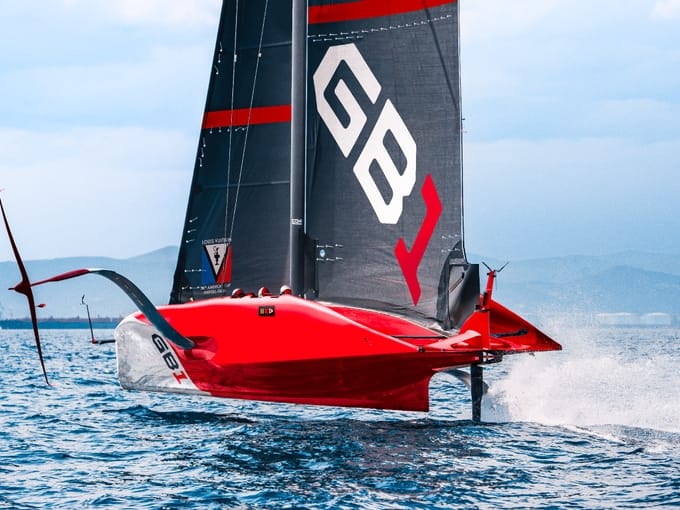
Image © GB1

Last year Fletcher guided Ainslie’s SailGP team Emirates Team GBR to victory in Season 5 and recently began Season 6 in the strongest possible manner with a spectacular win at the first event in Perth, Australia.

Now, according to GB1 CEO Walker, the latest iteration of the British America’s Cup squad will be built from the ground up around Fletcher, as the team looks to capitalise on 12 years of campaigning to win sailing’s oldest and most prestigious competition.

He and Fletcher are far from strangers to each other with the pair having worked closely together in the lead-up to Tokyo 2020 during Walker’s stint as performance director for the British Sailing Team.

“I think Dylan has proven with his performance in Barcelona, let alone his Olympic results and his performance in SailGP, that he can deliver under pressure,” Walker told me.

But what has impressed Walker even more is Fletcher’s constant desire to be the very best version of himself in every aspect of what he does.

“When he’s in the office he’s sitting with the designers, because he wants to help them with their role. [That’s the sort of thing] I see day-to-day and that impresses me more than if he wins the last race of a SailGP regatta. So it’s really exciting to see that development and I think he really deserves to have a team built around him.”

Despite becoming the first British team for 60 years to qualify for an America’s Cup Match the fallout between Ainslie and former backer Sir Jim Ratcliffe looked like destroying any hopes of building on that success.

Fletcher says the new GB1 campaign feels significantly different to the team’s tilt at AC37.

“We have retained a lot of the staff from last time,” he said. “But with the budget cap this time we are much smaller. I think all the teams are operating differently to how they have done previously.

“With everything that went on [after the last Cup cycle] I think there was a real team spirit where everyone really dug deep and worked hard behind the scenes to get us to the place where we are now.

“I’m very proud to have been a part of that and now to be integral to not just the sailing team but working with the designers to make the boat as fast as possible. It’s always a relentless pursuit of speed in the America’s Cup.”

Who might sit opposite Fletcher in Naples in 2027 is a question yet to be answered. Ainslie is on the record saying that his contribution to the campaign is unlikely to be in a sailing role – but that could change.

“My focus has been off the water over the last 14 months,” Ainslie told me. “It has taken a huge effort to get this partnership across the line and to keep this team together. Now we have Dylan secured – which is fantastic – and we have Hannah [Mills] leading the Pathway Programme, Oakley Capital coming in to back the team. All that has taken a massive amount of focus for me.

“I honestly don’t know where I will end up next year, whether I will be on or off the water – that hasn’t been my focus – but we have got a lot of work to do as a team to pull that technical development together and start to build a sailing team. A big part of that has been bringing Ian Walker on as CEO. He has only been with us a couple of months but already he has had a big impact on the team and he’s a really great addition.”

Fletcher could reveal no more on who his opposite number might turn out to be.

"Right now we are looking at what the options are," he told me. "There are some challenges with SailGP but we are in a very good position as a team and that’s all I can really say.

"At the moment I am the helmsman that we have announced. Ben and I worked really well last time and the way we gelled on the communication side really did help us perform on the water. Ultimately, you will just have to wait and see."

Image © GB1

Walker was quick to highlight the magnitude of the task Ainslie took on to drive forward the ACP with the other teams, while managing to keep the British campaign from collapsing beneath his feet.

“The uncertainty was hard on everybody,” he said. “But I think Ben has done a great job of insulating people from what he has had to go through. He’s tried to negotiate this participation agreement with all the other Challengers, and that’s no easy task. Trying to raise money to fund the team is no easy task. And all the time trying to keep everyone together and keep the team moving forward.

“My admiration for Ben was high before but it’s even higher now, understanding what’s had to be put into this. I think he has a lot of very loyal people who believe in him and want to work with him. My role is really to come in and try to relieve Ben of some of the day-to-day responsibilities so that he can be more strategic and put his energy into building the America’s Cup as an event, and the other properties he owns.”

What then have been Walker’s priorities since taking on the role in November last year?

“My first priority has been to start to get myself up to speed by learning from everyone else in the building that knows so much more about it than I do. That’s probably going to go on for a year or so, to be honest.”

“Like any business, it starts with understanding the finances. Only once you have done that can you start to plan and work out how we are going to allocate our resources, to create a strategy on the design and the performance side. From there you start to build a team, and that involves recruiting the right people, instilling the right culture.

“I’m lucky because I’m not starting from a standing start. Due to the work that Ben and Jo [Grindley, marketing and communications director],and Matt [Robinson, finance director] have done, the team is actually quite advanced in some areas. But some other areas really did slow down after the last Cup.

“These organisations are complex. Having a commercial team and a marcomms team that functions efficiently is really important. Then there are all of the resources that sit behind that: IT, HR, finance, all your systems. We have most of all that in place.

“The core design department is all in place as well. When it comes to the sailors, we have work to do, because we couldn’t make commitments to people at this point. We also need to grow our design capability quickly.”

Looking ahead to the 38th America’s Cup, which will see the teams race modified versions of the boats used in AC37, Ainslie said the British team had a clear plan and schedule for the remainder of 2026, which will include two AC38 preliminary regattas – the first of which will be contested in AC40s this May in Cagliari, Sardinia.

“For us it’s about pulling together the technical programme around the ultimate modifications we will make to the boat, and foils, and rig, and everything else,” Ainslie said. “And also to start building up the sailing team as well. We have got some great talent in the UK and over the coming months we have got to pull that squad together.”

Walker said he was a big believer in the idea that ‘the team builds the team’.

“I think you get your first few people in and then as a group you decide who is going to complement that group. As in any good team, there is a balance between having experience and youth.

“One of the big questions we have got to answer is how much do we build a team around the future events – 2029, 2031?” he said. “That’s going to be critical. One of the big strengths of the organisation is the pathway programme. We want to really make sure we have the pathway for people to make their way up as young sailors in the youth event or the women’s event to the senior boat. That’s something we are putting a lot of thought into.”

Although the British team already did some AC40 sailing in Barcelona in the final months of last year, Walker says the team plans to set up a sailing base in Cagliari in March for two-boat training.

“We will be sailing the AC40s – we have the Pathway boat and the senior boat – in the build-up to the Preliminary event,” he said. “Then we will move to Naples after Cagliari.”

In parallel with the AC40 action Ainslie told me that the team’s AC75 from Barcelona would undergo modifications to make it compliant with the new rules for AC38 that specify cockpits for five crew (plus one guest cockpit), as well as planned developments to the mast, sails, foils, and internal control systems.

“That [boat] is the development of 12 years of campaigning now and that’s the boat we will be racing next year,” he said.

“It’s a really strong package and I think we were really competitive in Barcelona last time. Obviously the Kiwis, in certain areas, were a little bit ahead of us. There are some subtle changes to the class rule – not just to the hull of the boat, but to the foils and other areas of the boat – so there will be some modifications to the platform, some new foils, a new aero package and some other areas that we will focus on. So a lot of work has to be done to get the boat in race trim for next year.”

Ainslie also confirmed that the team had possession of the valuable data generated through the team’s partnership with the Mercedes F1 team in the UK, despite a recent statement from Mercedes boss Toto Wolff that the motor racing team was ‘done with sailing’.

“Well I’m happy to make the statement that we are done with Formula 1 as well,” said Ainslie with a laugh. “Joking aside, it was a really good partnership. We learned a lot from it and I like to think that Mercedes learned something from us as well in terms of the differences in resources. So yes, we have got a lot of learning from that partnership and we will take that forward into this new campaign and really make the most of it.”

When I asked Walker if launching the AC75 at the end of 2026 seemed late, his typically pragmatic reply was: “Well, it is what it is.”

Image © GB1

For his part, Fletcher told me that he expected this latest edition of the America’s Cup to be the toughest one yet. He sees the Kiwis as still very much the favourites but nevertheless believes they can be beaten.

“There’s no doubt that they are still the favourites,” he said. “They have retained the biggest team and they have been working the hardest. There has been a bit of turmoil over the last year as to exactly what this latest Cup cycle would look like and they have been able to push harder than the others.

“There’s certainly a lot of what the Kiwis did that we have studied carefully. Everyone could see that they were tacking significantly better than us at the start of the Match, but by the last day we had really closed that gap. Because we have all got the same hulls this time I think we all have baked-in strengths and weaknesses. We believe we have a particularly fast hull and it will be interesting to see how that comes out this time around.”

Ultimately, Fletcher expects AC38 to be one of the closest in the modern era with diminished performance deltas between all five teams.

“I think that as we go through the various iterations of the design rule we inevitably all get closer in terms of performance,” he told me. “But, to be honest, we are here to try and make the gap bigger by jumping the Kiwis and the other Challengers and positioning ourselves as that real dominant force.

“As we saw last time, it’s not just the package that you have – but what you can extract from it. I think last time we did such a good job of getting more and more speed out of the yacht as the rounds progressed. Ultimately, though, we left a little bit too much on the table when it came to the Kiwis. I’m hoping we can close that gap and make the jump on them and it will be an easy one for us – but I’m really sure it will be the hardest one yet.”

All the time we will be working on the 75 and we are hoping to launch that towards the bend of the season.

We have got a plan now in terms of a schedule. For us it’s about pulling together the technical programme around the ultimate modifications we will make to the boat, and foils, and rig, and everything else. And also to start building up the sailing team as well. We have got some great talent in the UK and over the coming months we have got to pull that squad together.

Comments

Latest

Sailing fans have their say online after SailGP Auckland incident

Sailing fans have their say online after SailGP Auckland incident

This weekend’s crash between the French and New Zealand boats competing in the Auckland SailGP event has set the sailing world alight online, as sailing fans around the world weighed in with their opinions on the shocking incident that saw both boats badly damaged and two sailors hospitalised.

Free Members Public