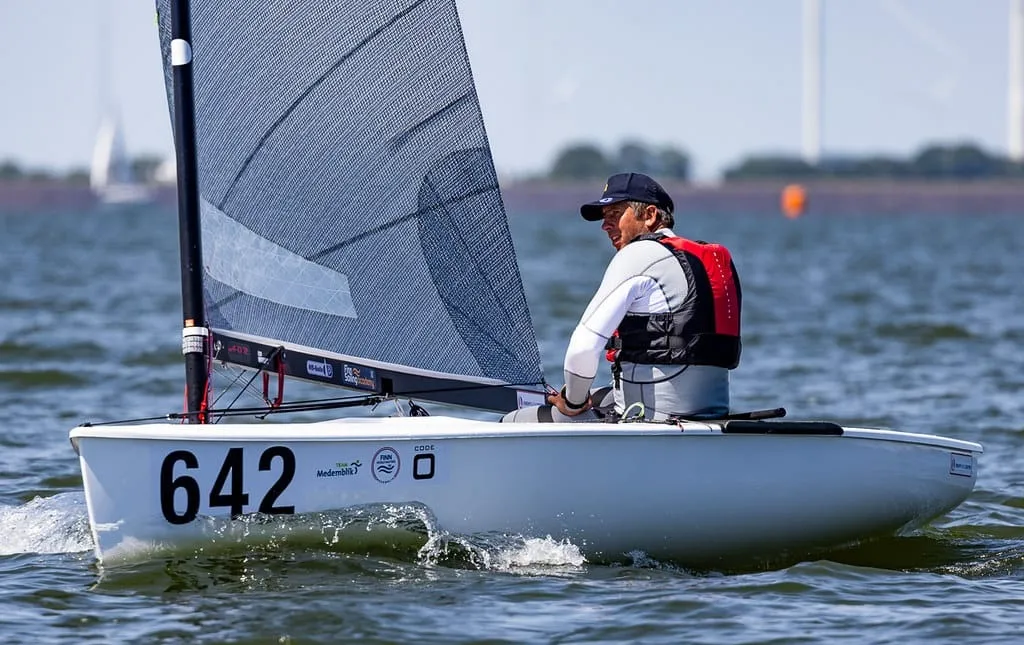



There are three stand-out aspects to Pieter-Jan Postma’s victory at the 2025 Finn Masters World Championship held this June at Medemblik in the Netherlands.
The first thing of note is the size of the fleet – with a gargantuan total of 301 Finn sailors from around the world taking part in the five-day, eight-race series. The second is Postma’s scoreline – a hugely impressive string of six race wins and two fourth places. Thirdly, his dominating performance came after a three-year absence from Finn sailing for the Dutch sailor.
All that said, given that Postma is a three-time Olympian and that the last event he did in a Finn was his victory at the 2022 Finn Gold Cup on Lake Garda, there is no denying that he went into the 2025 world championship as a firm favourite.
However, unlike during his years of Olympic campaigning when he would arrive at regattas fully prepared and with proven, tried and trusted kit, for this year’s Masters Worlds he had done no more than a week of sailing with a newly developed mast from Ceilidh Masts (carbonmasts.com) and a new mainsail.
“It was quite a big challenge to take on but it was also quite exciting to try to make it work,” Postma told me.
He quickly discovered that the new mast – which was designed to be stiffer sideways – delivered good speed in mid-range and windier conditions.
“I would even say the speed was very good on the downwinds because of its sideways stiffness,” he explained. “But in the light winds the sail was way too full.”
In the medium breezes that prevailed for the first three days of the event Postma found himself “ahead of the game” – as evidenced by his perfect picket fence scoreline – but when the breeze dropped for the final three races he had to adapt his plan accordingly – switching from a safe conservative strategy to take a few more risks.

“My strong points are starting and overall race strategy,” he said. “With good speed, those early races went smoothly, but then in the light wind races, the last three of them, I knew I needed my strategy to be much more risky because I didn’t have the speed advantage any more. In fact I was slower than the rest because I had a balloon for a sail.”
As examples of his risk taking Postma cites the two races where he started at the pin end of the line and went all the way to the right hand side of the first beat. Banging the corner paid off both times.
Part of the reason he was able to take such chances was because of his detailed knowledge of Medemblik as a regatta venue.
“At Medemblik you try to optimise your strategy for the prevailing conditions,” he said. “For some races it was an oscillating breeze, so you start on the lifted tack more in the middle of the line, for others it was a persistent shift, where you start at one end of the start line and then hit a corner.
“Both scenarios need different strategies so it is important to be able to identify which one you are dealing with. We had a couple of races where the wind was coming around the town and causing a wind bend. The tricky thing is that the wind bend moves across the racecourse, so you have to read where the wind bend is placed and tack at that moment.”
Dealing with an oscillating breeze, Postma said, is partly about having the patience to wait for the breeze to make its move. It starts of course with identifying an oscillating breeze before the race starts and timing its movement.
He likes to get out to the racecourse around 45 minutes before the start. Having first done his research into the expected weather patterns, he makes his own observations of the weather, harnessing what he describes as ‘the power of now’.
“It’s about observing without any preconceived ideas,” he said. “That’s a skill we need in sailing. A lot of the time part of your mind wants to see something happening to try to drive you to do something specific. But you have to be clear on that. You cannot take those thoughts with you. You have to be a very clear observer of what’s happening at that moment.
“You have to zoom from the big picture into the race area, where the time from the start to the top mark might only be 10 or 15 minutes, so it’s a short window of what might happen in that time.”

When I asked about his pre-race routine Postma told me the goal was always to begin the race with as much mental energy as possible.
“What gives you that energy is to be relaxed, to have your mind clean and empty, to be really ready for the race, with all the boxes ticked off,” he told me.
Postma said he started well throughout the regatta in every race bar one, where another boat came in at the last moment angling for his spot. Although the total fleet was split into roughly 80-boat fleets, that’s still a daunting scenario for most sailors.
“The trick with big fleets is to not get hung up on the small picture,” he said. “I try to sit above the line until one or two minutes before the start just so I can clearly see the bigger picture of what’s going on.
“Sometimes the fleet is below the line, sometimes it’s above the line, sometimes everybody is going left and the breeze is going right. The trick is to keep your head helicoptering above the fleet and see what’s happening in the bigger picture.
“Then in the last minutes you zoom into the small picture, because you really need to fight to have your position and have that clear air. But being able to keep the big picture in mind and then at the last minute fighting for your spot on the line is a nice combination.”
Postma rounded the top mark in the top three in every race except two light airs races at the end of the regatta. He describes himself as an attacking sailor upwind.
“I don’t play the numbers that much – I play the wind. What I mean by that is that I mostly focus on the bigger strategy. If in doubt then you always choose to have less risk, but 80 per cent of my attention is on the wind.”
In the lighter wind races – which were sailed in three to five knots of shifty patchy breeze – Postma said he focused on being first into the next patch of breeze and then trying to stay in it the longest.

He also gave this interesting insight into light air big fleet downwind sailing:
“In the light air the wind sees the fleet as an obstruction. So you have to sail with a little bit more leverage on the fleet to keep you away from the obstruction the fleet is causing. It could be seen as a riskier strategy but having more distance from the fleet gives you more certainty of having a bit of breeze to play with.”
Downwind Postma estimates that his mast was 15 per cent stiffer sideways than the norm – a factor that he said translates into improved acceleration and overall boat speed. Beyond that advantage he said his focus was on maintaining clean air, turning his head to look backwards 80 per cent of the time.
“With an 80-boat fleet that’s a challenge,” he said “So you need to be doing some chess-style thinking ahead about where the fleet is going to move next. That way you can use the obstruction of the fleet to guide the wind and try to be in the right spot where this clean air that’s guided by the fleet is giving you a bit more speed.”
Postma may not be a regular Finn sailor these days – his recent sailing has mostly been as tactician/strategist aboard one of the 14 20-metre Dutch steel barges that contest Holland’s largest regatta and are cheered on by thousands of fans – but he has a soft spot for the Finn class that has kept him coming back long after he stopped Olympic campaigning.
A major part of the attraction of this year’s Finn Masters World Championship, he said, was the chance to catch up with friends from around the world after racing each day.
“For me these are great people,” he said. “They give me energy. You have to sleep enough hours at a regatta but that doesn’t mean you have to go to bed super early. You can wake up a little bit later and if that means I get to spend time with friends then that works for me. Good people give energy to me and I always try to give more than I get and to have a great time with everybody.”