

Skip to content

Enzo Balanger Interview – Part 1: Preparing for victory

In the first of three exclusive stories based on my interview with 2025 Moth World Champion – Enzo Balanger – we find out how the French sailor prepared for the event by moving to the championship venue months ahead of the regatta.

Image © Martina Orsini

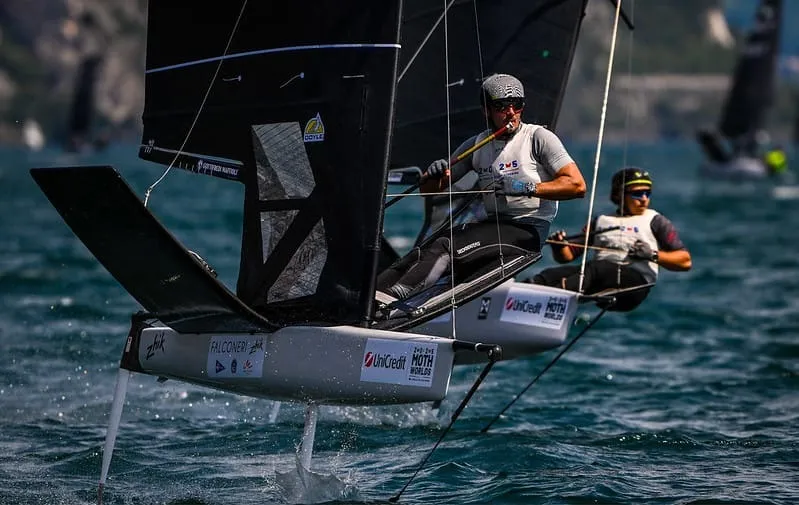
It’s almost two months since the young French sailor Enzo Balanger emerged victorious at what is arguably dinghy sailing’s most competitive regatta – the International Moth World Championship staged on Lake Garda, Italy – but the 24-year-old says it still feels like it was yesterday.

“I wake up every day and I see the trophy in my bedroom and I say ‘OK, this is yours for a year,” he told me.

Balanger might still be pinching himself about prevailing over a 131-boat fleet packed with some of foiling sailing’s top names – including the likes of past world champions and America’s Cup helmsmen Tom Slingsby and Paul Goodison, reigning world champion Mattias Coutts, and many more – but his 3,1,1,1,3,4,1,DNC,1,4 scoreline pretty much speaks for itself.
Balanger – who led the French Orient Express-L'Oréal Racing Team at the Youth America's Cup in Barcelona last summer – was born on the Caribbean island of Guadeloupe but moved to France when he was a teenager.

He started sailing at the age of six after ‘giving it a try’ at the Cataraïbes club in Petit-Bourg just down the road from where he lived. He made a name for himself locally in the Optimist class, winning four consecutive Guadeloupe national championships, before his move to La Rochelle, France to attend high school.

In 2014 he won both the French Optimist National Championship and the European Championship in Dublin, Ireland. A spell in 420s followed, where he and Gaultier Tallieu became a top five international youth pairing.

A move into the 470 and then the Nacra 17 followed – sailing with Roxanne Dubois – but in 2018 he sailed an International Moth for the first time and his love affair with the class began instantly.

“I was in La Rochelle and I saw a Moth flying and I was like, wow. I asked the guy if I could try it and immediately fell in love with it. That was my first ever foiling experience – at the age of 18.”

Balanger (second left) led the French Orient Express-L'Oréal Racing Team at the Youth America's Cup in Barcelona last summer. | Image © Alexander Champy-McLean / Orient Express Racing Team

Balanger confesses that initially the Moth was never his main project.

“After the 420 I moved into the 470 and then the Nacra, but the Moth lived in my garage and I was sailing it probably 25 days per year – just because it was really cool to go out on.”

Things changed, however, when Balanger started Moth sailing alongside Italian supercoach Philippe Presti (America’s Cup and SailGP) near his home in Bordeaux, France.

“Having that chance to sail alongside Philippe as a kid got me more focused on the Moth,” he recalls. “Then I went to my first Moth world championship on Lake Garda in 2021. So the Moth was really the start of my foiling experience. I still enjoy sailing on this boat; the crazy feeling you get every day when you take off for the first time – it’s always the same unbelievable feeling. I love the class and I hope I get to keep sailing in it for a long time.”

Balanger finished sixth at the 2024 Moth World Championship down in Auckland, New Zealand – coming away disappointed with the result and with a determination to at least make the podium a year later on Lake Garda.

The first stage of his strategy was to team up with coach Aymeric Arthaud – a fellow French Moth sailor and international match racer – to help him raise his game both on the water and with regard to the technicalities of setting up his boat.

“I wanted someone who could help me with the technical part, because it is not all about the sailing: you have to have a good reliable boat – and Aymeric was really the best person for that. Then on the water he was in the classic coach role: checking the wind, helping me with the tactics and strategy, and how to set up the boat. Having him was a big step forward for me.”

Image © Martina Orsini

Having watched the almost total domination that 2024 world champion Matthias Coutts and runner up Jacob Pye had achieved at the Worlds in Auckland after training together for months in advance of the event Balanger saw an opportunity to do the same for the 2025 championship in Italy.

He moved to Malcesine – the picturesque medieval town on the lake’s eastern shore of the northern end of Lake Garda at the foot of the towering Monte Baldo mountain range – in March of this year, months ahead of the world championship.

With its charming, winding cobblestone alleys and bustling waterfront cafes, bars, and restaurants, Malcesine is a big draw for tourists and watersports enthusiasts alike.

It’s also the home of the Fraglia Vela Malcesine – a sailing club renowned over the years for its expert hosting of a stream of major dinghy and small keelboat championships, as well as, since 2014 the host of that celebration of all things foiling, known as Foiling Week.

Balanger decamped to Malcesine at the end of March and stayed – other than a few days here and there back in France to see friends and family – for the full three months up until the world championships.

“What the Kiwis did in New Zealand in 2024 really inspired us in Europe. They really put in the most time in their boats at the venue and it showed. After the New Zealand Worlds I was disappointed with my result – I was hoping for more.

So I said to myself: ‘the best plan to train for a Worlds in Garda is to go to Garda, so let’s go’. I was lucky that I was not the only one thinking that way – and we had a really good group down there.

“I think that training was one of the biggest factors that helped me perform as well as I did. It gave me the speed and the knowledge of the lake.”

Image © Martina Orsini

Included in that unofficial training group were the likes of three-time Moth World Champion and America’s Cup helmsman Paul Goodison (GBR), Spanish SailGP skipper Diego Botin, past Moth World Champion and British America’s Cup helmsman Dylan Fletcher, ex-SailGP skipper Phil Robertson (NZL), as well as several other top names like Spain SailGP’s Joel Rodríguez, Kiwi Henry Haslett, and 2024 European champion Nicolai Jacobsen from Norway.

“When you are lining up for a speed test or doing some practice racing with any of those people you know you have to give the best of your skills every minute you are on the water,” Balanger comments. “We could see on the data how crazy quickly the VMG was increasing as we trained. I think that was because of the pressure we all put on each other over those months on the lake.

“It was certainly a big step forward for me compared with the Worlds in New Zealand, where I arrived two weeks before the regatta and with no training. This year I was ready to compete. It is always the same – you will do better training in a team than training alone, because on your own you improve, but really slowly.”

With everyone seemingly on the same page and keen to improve as much as possible in the run up to the most important regatta in the Moth calendar, organising the daily training sessions was as simple as asking the question “Who is available to sail at 1100 tomorrow?”

“It was really easy to organise,” Balanger says. “Usually, there was someone with a coach in a rib and so we could set up a course outside the sailing club. It was as simple as that – so every time the breeze was up, we were out on the lake.”

Similarly, although there were no formal group debriefing sessions, there were plenty of individual discussions between the sailors about what worked and what didn’t.

“I think one of the really good mindsets of the Moth Class is to exchange ideas a lot with each other,” Balanger explained. “Everyone wanted to improve their understanding of the pressure, the speed, the technique – and in this class you can walk up to anyone’s boat after a session, ask a question and get an answer. Like: ‘Hey what did you try today? How was it? What did you learn?’ That way, step by step you learn stuff and maybe try those things out yourself.”

Typically Balanger would spend between an hour and a half and three hours on the water each day – around the same time as he might spend rigging and preparing his boat.

“My average time was about two hours on the water,” he said. “That doesn’t sound long but in the Moth you have to hike a lot so two hours is enough. Also, the Moth takes a long time to prepare – you have to work on the foils, the boat, and the rig.”

Working to his advantage were the favourable weather conditions on and around Lake Garda during his training period that enabled him to average between 20 and 25 days per month on the water.

Watch out for part two of our exclusive three-part feature on 2025 Moth World Champion Enzo Balanger later this week.

Comments

Latest