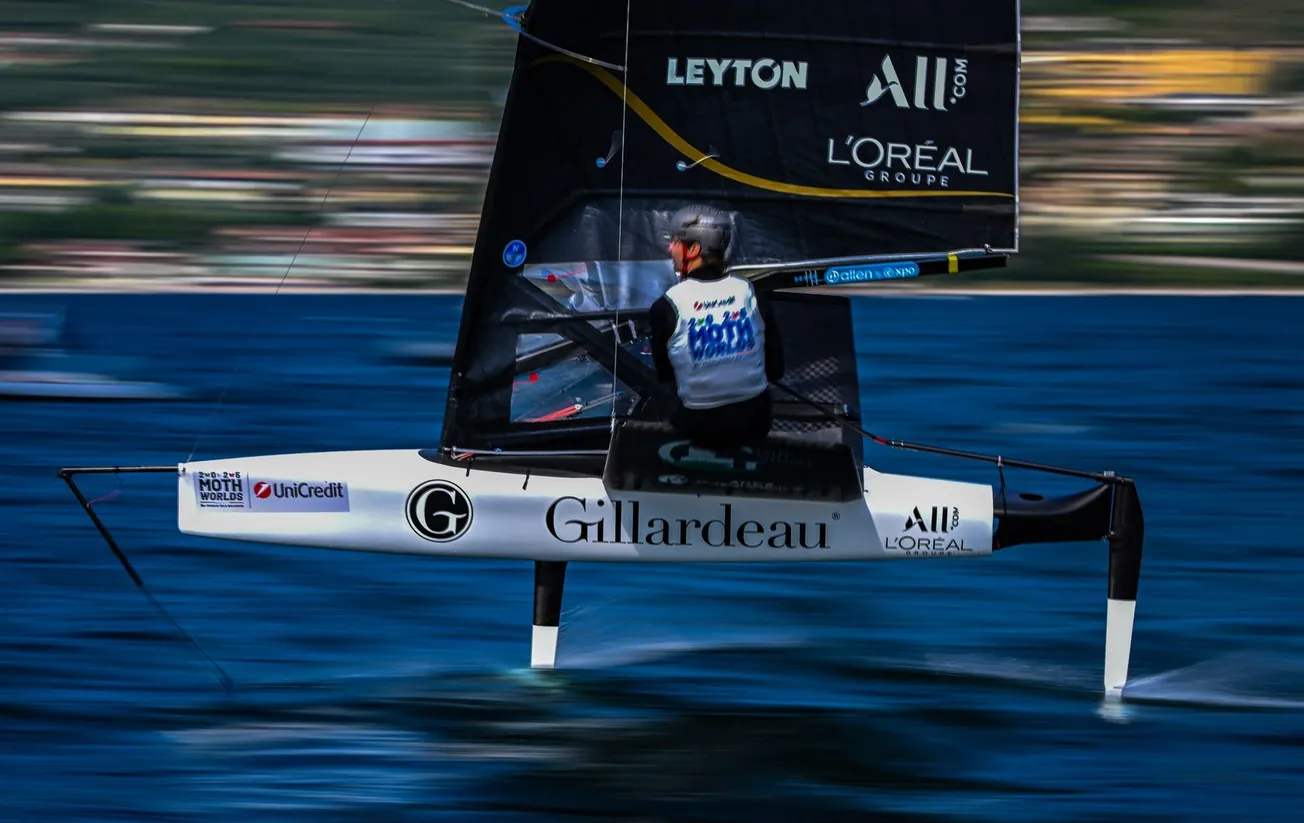



The Moth Class has a reputation for rapid evolution, so it was perhaps surprising to hear that Balanger won the 2025 world championship using a one-and-a-half-year-old Mackay Bieker V3. Moreover, he says he plans to keep the same boat – ‘platform’ as he describes it – to try to defend his title next year in Perth, Australia.
“They have done a really nice job with this design,” he told me. “They have found big gains in terms of righting moment and drag and the systems are all working really well.”
Although there were few changes to the platform between the Auckland and Garda world championships, Balanger said the biggest step forward was around the adoption of metal foils.
In New Zealand we had just introduced the metal main foil. That was like plug and play speed: you are just immediately one knot faster all around the course – so a massive performance gain.
“Then for the Worlds this year we had metal rudders also – which kind of changed everything. Because the rudders made us even faster it changed quite a lot the way we needed to sail the boats, because the VMG was different and so the manoeuvres were different.”
Balanger admitted that he had been surprised by the speed bump from the steel rudder blades which are shrouded in carbon and have a finer profile that delivers a wetted surface reduction of 22 per cent.
Amongst the things to get used to with the new steel rudders – which the sailors took delivery of in June, just a few weeks before the world championship – was that they are significantly softer than the previous all-carbon versions (the horizontal wings are still all-carbon).
“You have to make sure you don’t bend it if you have a big turn or a crash,” Balanger explained. Plus it changes the balance of the boat because the metal rudders are heavier – so you have more weight at the back of the boat.”
Balanger’s technique upwind and downwind had to be modified to take into account the roughly one-and-a-half-knot speed gain.
“The technique for a tack changes because you can turn slower and keep the same speed. You are more efficient and have more glide,” he said. “It’s the same for the gybes too and downwind you have to change the way you sail because you are faster in any given pressure. So you make different laylines because you are faster and have better VMG.”
Unsurprisingly, Balanger says he likes the new bendier, lower drag steel rudders – but accepts that it might not suit everyone.
“I prefer to sail with a smaller rudder, with a smaller chord, so you have less drag but it’s more flexy. Maybe some people would prefer something stiffer, but I think when you are going upwind at 21-22 or even 23 knots, the drag is really important.
“Perhaps there is some technology coming that will allow us to make carbon foils smaller and still really strong. But for now we are on the metals and it will be interesting to see how they will perform longer term. There is no data on that at the moment.”
Aside from the new foils Balanger says there are subtle differences in how each of the Bieker V3 sailors set up and sail their boats.
“I think most people are using their boats pretty much the same way. But, for sure, there are some differences in the stiffness of the mast, the way you set the sails – the battens you use, maybe – and then how you fly the boat.”
As Balanger explains to me, when it comes to flight control, Moth sailors have four controls they can tweak to their own individual preference.
“You have the ride height, the gearing, the rudder rake, and then the bungee for the wand. So even if you have the same boat, nobody is flying the boat in exactly the same way. I think that was the biggest challenge while getting ready for the Worlds on Lake Garda: trying to find the best compromise between the pitch, ride height, and the balance of the boat. That’s what I focused on most during the training period.”
Watch out for the final installment of our exclusive three-part feature on 2025 Moth World Champion Enzo Balanger coming soon.