

Skip to content

Ferrari Hypersail Update

Last week I made a ‘trains, planes, and automobiles’ round trip to attend an update presentation on Giovanni Soldini’s Ferrari Hypersail project at the spectacular all-new North Sails loft in Genoa, Italy.

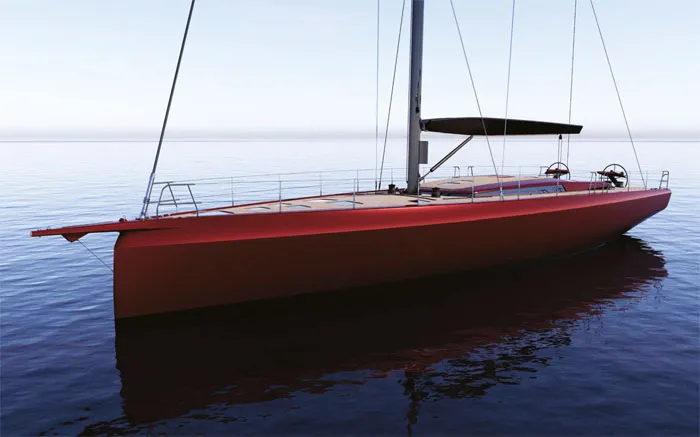
Image © Ferrari Hypersail

For the ‘Engine Above the Deck’ – aka, the mast, sails, and rigging – on this radical project Ferrari have smartly partnered with North through the umbrella North Technology Group (NTG), also giving them access to the smart thinkers and manufacturing resources at group companies like Southern Spars and Future Fibres.

It is easy to see why picking NTG was such a no-brainer for the team at Ferrari, which is led by the highly enigmatic Marco Guglielmo Ribigini – a mechanical engineer with a more than 20-year career at the company – along with the project’s CTO, fellow long-termer Matteo Lanzavecchia, who also leads Ferrari’s sports car engineering division.

Both have been working on the Hypersail project since 2022 which was reportedly born out of a breakfast/lunch/dinner conversation between Soldini, legendary high-performance yacht Guillaume Verdier, and Ferrari executive chairman John Elkann, about the possibility of creating a truly visionary design for an offshore foiling monohull capable of generating its own power and setting open ocean passage records.
It’s a hugely bold and ambitious mission that will require next-level innovation to bring it to fruition and will demand seamless cooperation between all the parties involved. According to NTG CEO Sam Watson, the group’s position ‘at the forefront of competitive sailing and high-performance sailing through the company’s mast and sail making businesses’ made it a perfect fit for the Ferrari project.

“Part of the collaboration opportunity with Ferrari is that we are culturally aligned as well,” Watson said. “Coming from a competitive sport background means there are a lot of similarities there and a couple of things really resonate: teamwork is an essential part of our culture and I can see that with the Ferrari team as well. I can see that the collaboration between our two teams is very deep. Then there’s innovation – which is at the heart of everything that North and everything that Ferrari does – and the teams are collectively inventing new technologies for this project that have never been seen before.”

Giovanni Soldini | Image © Miguel Hahn / North Sails

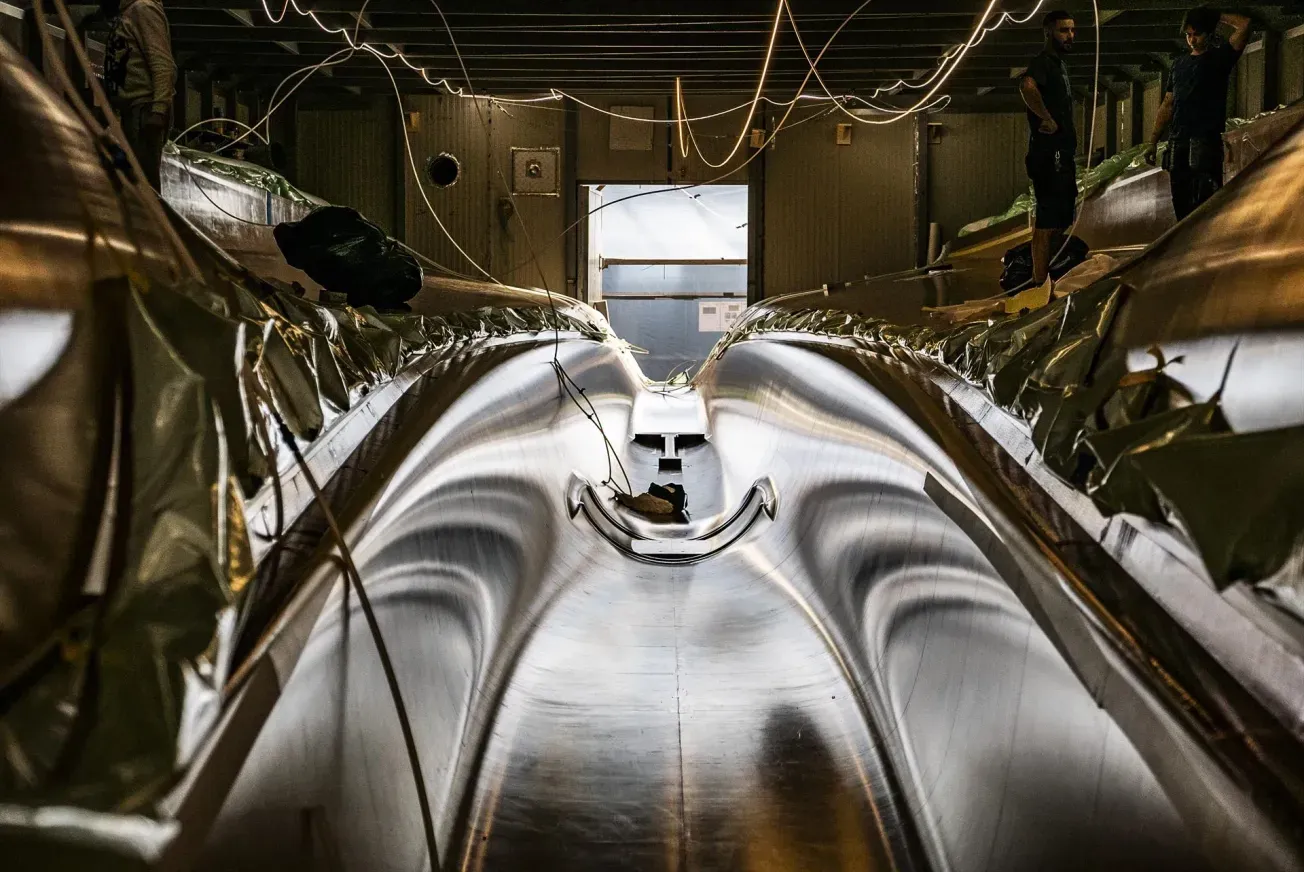
There was a lot to take in over the day which started with an update from Soldini on the progress of the hull construction which is taking place at a yet to be officially confirmed high tech facility. According to the legendary Italian sailor the process has gone smoothly so far.

“The boat is under construction,” he told us. “We are nearly finished with the installation of the bulkheads – there are just two or three left – so we are in pretty good shape. The deck is also done, so we are almost finished with the structure and then we will close the boat. The next few months are really exciting as we start to put together all the systems – which is also a very big job.”

To take charge of the design and construction of his amazing new boat’s mast and sails, Soldini recruited the Australian sailor Glenn Ashby – an individual who needs little introduction to Yacht Racing Life readers.

An Olympic silver medallist and a ten-time A Class world champion (his first came when he was just 18), Ashby is perhaps best known to sailing fans for his three America’s Cup campaigns – two of them successful – with Emirates Team New Zealand, which he followed up by setting a remarkable new wind-powered land speed record of 225.58km/h (140.17mph).

For the self-confessed speed addict and petrol head who as a 12-year-old had a Ferrari Testarossa poster on his bedroom wall, the chance to work at Ferrari HQ is very much a childhood pipe dream somehow magically fulfilled.

“If someone had told me as a kid that ‘hey you are going to go and work at the Ferrari factory in Maranello with a whole lot of Ferraris driving around and you are going to be working on a sailing project’... you have to pinch yourself, it’s like a dream,” he told me.

“After getting to the end of my America’s Cup career and stepping away from that I have definitely got more into the technological design side of things. I feel like I have got a really good understanding of how and why things work now, over the years, and I’m able to use some of that knowledge and technical expertise in this project.

“I guess they saw me as someone who comes from a background of having to build things [from scratch], to push the limits, all the way from being a young kid to where I am now at 48 years old.”

Although responsible primarily for the rig, Ashby has found himself heavily involved with pretty much everything else on the boat as well.

“I am not an expert in any one field,” he said. “I never pretend to be that. I do feel though that I have a good understanding of how to work well with all the departments, having a global understanding of what the boat is and what each department has to do, getting the best out of the people that are there and promoting them to really lift up and step up. To not be afraid to be bold and be brave… being part of that group going forward that’s pushing the boat to the limits it needs to be at to be successful.”

Unlimited by the constraints of event or class rules, Ashby told me has given the team the flexibility to “take the blinkers off”, to “look outside the square”, and to push into previously unexplored territory.

“For me, the personal joy of being allowed to look far afield, to look into the distance of where you could possibly go is amazing. With the AC75 the America’s Cup is now much more of a refinement game than it’s ever been before. Whilst I love all that and – like in Olympic sailing – the fine detail and the incremental gains you can find here and there, these are really quantum leap gains you are finding. I have really enjoyed that in the past and certainly with this project it’s just incredible the gains you can make really quickly if you make the right decisions.”

As must be expected of such a revolutionary concept, Ashby cautions against expecting the boat to be an overnight success. He has been working on the project for two years now and says the project is on track for its carefully thought-through long-term timeline.

“There's a really good and detailed five-year plan,” he explained. “The boat will go on the water later next year and be worked up towards doing some races around the world. It’s not something that you can put in the water and turn the key and expect to be perfect from day one. Nobody has those expectations.

“There’s a lot of new technology, new systems that have never been tested in real life. So there will be a lot of bench testing. Ferrari do a lot of car testing so they are very well-attuned to putting things through their paces before they go into real use. So we are going to use a lot of that expertise and we are very confident that there will be minimal disruptions. With a new rig, new foils, and a whole lot of new structure, we will have to work the boat up over time – just like you do with an AC75 – then you can go and race and be comfortable.”


Listen to my interview with Glenn on the Yacht Racing Life Podcast:

Powered by RedCircle


Other options were meticulously investigated but the decision has been made to opt for an America’s Cup-style twin-skin mainsail – making it the first time such a setup will be used on an ocean-going boat. It’s a choice that Ashby says is the best solution to deliver the range of sail shape configurations that will enable the Ferrari Hypersail crew to avoid having to reef in stronger winds.

It’s a choice that Ashby said he feels “pretty responsible” for guiding the group into.

“After being heavily involved in the development of all that on the America’s Cup side of things I knew very, very, well how those rigs work and the advantages of the twin-skin mainsail. We ran the numbers and showed the guys the advantages – just how much performance we were going to get out of that rig – albeit that it is more difficult because we are in an offshore environment so you have to get it up and down and reef it.”

As Ashby explained, the plan is to have the capability to reef the massive twin-skin mainsail, but to avoid having to do so through smart weather routing and the rig’s phenomenal adaptability to a very wide range of wind strengths.

“Time will tell,” he said, with a gulp. “I feel very responsible and we definitely need to make sure it works – but I definitely feel like it is a no-brainer for this project. We can’t afford to be stopping and starting and shaking reefs out like existing boats have done in the past. We need something that can take us through a huge range of conditions without having to take the throttle off while we are doing it.”

So just how fast is he expecting this radical new boat to be, I wondered? Might it, for instance, be capable of outperforming the around-the-world-record-setting Ultim maxi trimarans?

“I can’t really tell you the exact number at the moment,” Ashby replied. “But I think that in the moderate to windy conditions that the Ultims are targeting as well (you are not going to try to set a Jules Verne record in 10 knots of wind) reaching and upwind – and possibly downwind as well – this boat has the potential of being quicker than those big multihulls.”

Comments

Latest

Maxi Edmond de Rothschild launched in Lorient

Maxi Edmond de Rothschild launched in Lorient

After more than two years in build, Gitana 18, the 32-metre Maxi Edmond de Rothschild has been launched, marking the culmination of an ambitious construction programme and the start of a new chapter for the Gitana Team.

Free Members Public