At the elite end of the sport, the coaching pool is small. The gang sat in the RIBs, giving the briefings, leading the morning Pilates, sat near the star helm at dinner, or poring relentlessly over the data screens are known by everyone - and know everyone.
In the America’s Cup and SailGP, these coaches are paid to recognise the moves of the best, advise, adapt and demand execution. The good ones stay for a long while on the circuit, the poor ones get churned...and quickly. One thing they all have in common is that they are almost singularly unimpressionable. They have seen it all: from the years of Ben Ainslie re-defining downwind sailing, to Pete Burling re-defining winning in the America’s Cup. They know the real deals when they see them.
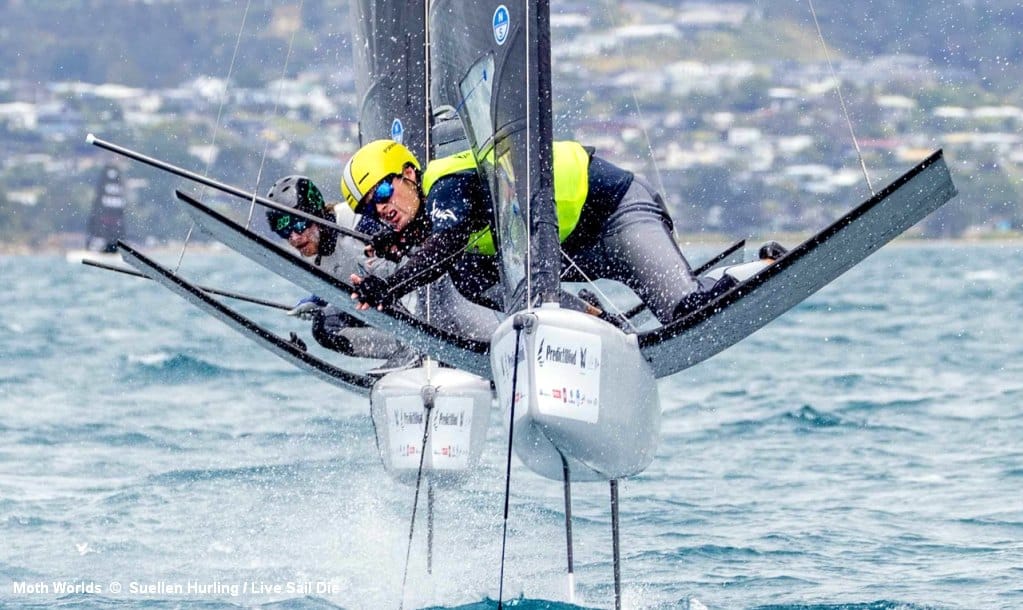
Interesting then to see Hamish Wilcox sat at the windward mark at the recent Moth World Championships down at Manly Sailing Club with his mouth open, video camera at the ready, and utterly astounded at what he saw the top sailors do.
Hamish is no spring-chicken, nor is he impressionable. A gold medallist in his own right as well as a key member of the coaching staff at Luna Rossa Prada Pirelli, Hamish has bought the T-shirt on coaching and sailing and wears it well. But what he will have seen at Manly Sailing Club was something out of the top drawer of innovation. He saw foiling technique unseen before and execution that is the stuff of dreams.
The top two sailors were Mattias Coutts and Jake Pye who topped the standings by a veritable country mile, regularly over the horizon race after race. The most obvious change in technique was at the bear-away and all the way down the run. Coutts would prefer hiking the boat dead-flat and running deep whilst Pye would induce windward heel downwind to match the angles.
Nobody, but nobody, could live with their depth and the speed they could induce. If they rounded the windward gate anywhere in the top ten, within a few hundred metres they were taking scalps at a lick and finding themselves positionally in a spot that gave them the edge come the first gybe. It was masterclass stuff.
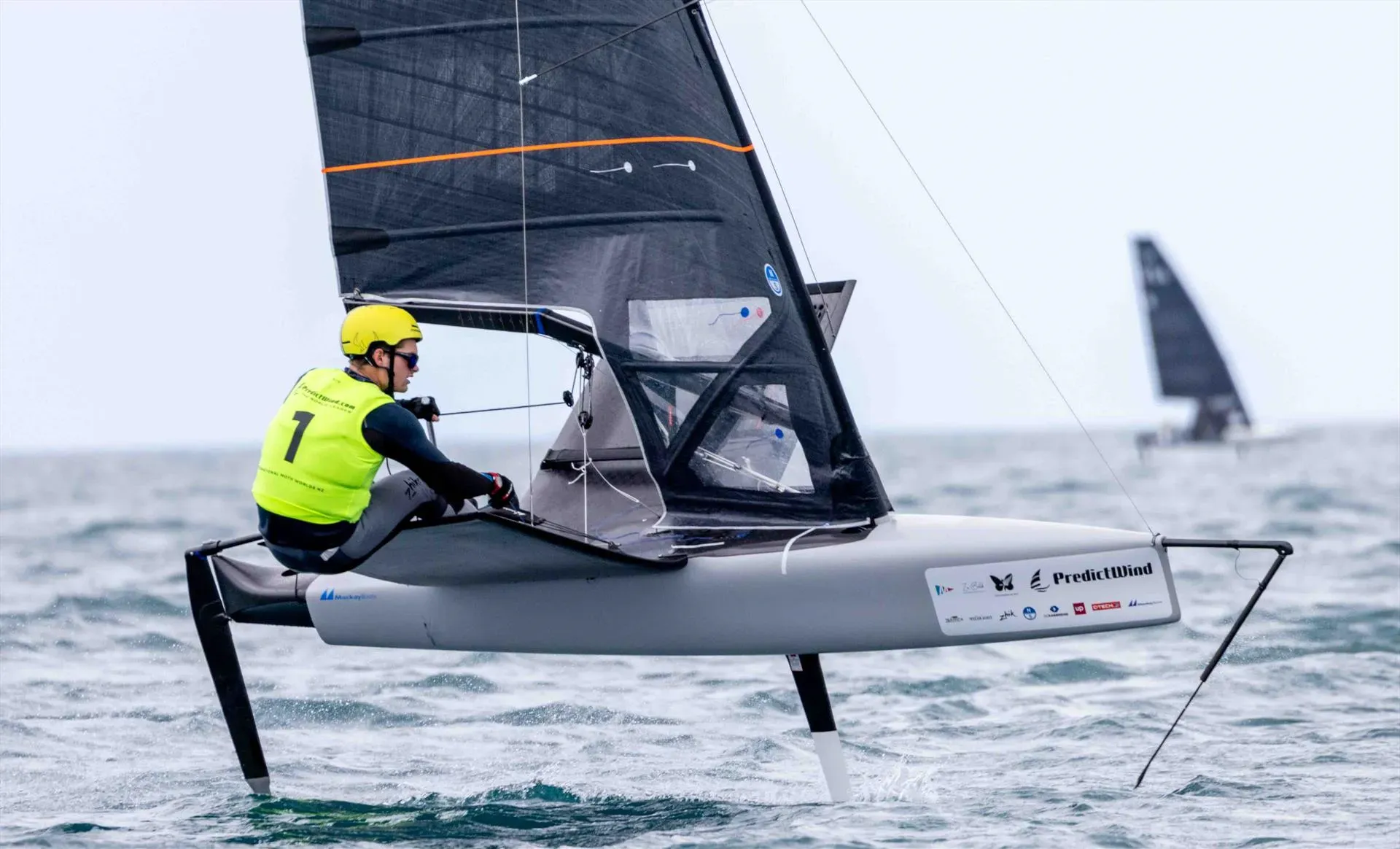
Shoreside in Manly everyone was talking about rake. The smaller sailors, the ones who were demonstrably better at tacking, raked back further thus inducing a far lower boom which was harder to get underneath and across with less margin for error, but ended up quicker through the tack and back onto course.
Extreme rake angles were being trialled both in practice and during racing with varying degrees of success. The International Moth, long the preserve of sylph like sailors in its previous incarnation as a low-rider, is now dominated by fit athletes in the 85kg+ category in the foiling generation. The added power that is all sent upwards through the rig requires righting momentum and the more dynamic the athlete, the more they work the rig/foil power ratio, the faster they go.
Deck sweeper length was the biggest contributor to a change of technique through the boat in manoeuvres. This is also limited by the mainsheet strop position. Most people have the standard 1050mm foot length on the deck-sweeper for optimum aero efficiency but it’s an area of development that the sail manufacturers and sailors are working closely together on.
Post the World Championship, North Sails went into a period of development with a number of sailors to ascertain the take-aways from the regatta. Those results will be seen in time, and further work with Tom Slingsby has been undertaken in Australia on his new Moth project with Tom, arguably the world’s greatest competitive sailor, eyeing the World Championship in Lake Garda in July 2025.
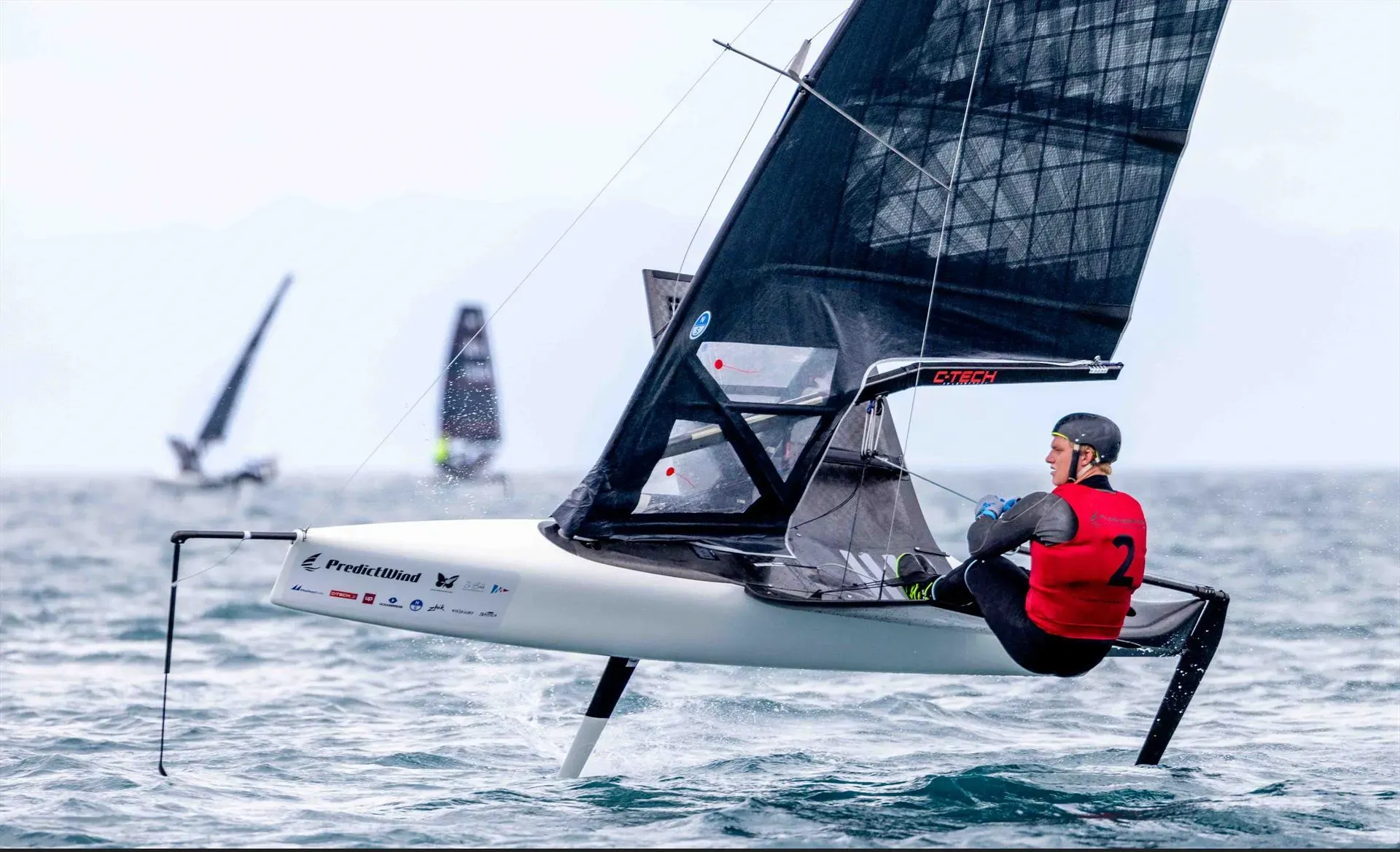
North Sails have pushed hard with their HELIX structured-luff technology which affords the maximum power generation from the sailor’s upper body pumping. The main body of the sails themselves are full 3Di RAW moulded composite, highly aero with no seams across what they call the ‘flying surface.’
Furthermore, the split batten revelation, developed by the marque, creates a far smoother sail shape and takes away the necessity for camber inducers with the overall effect being enhanced aerodynamic drag efficiency when sailing in apparent wind situations. It’s mini-America’s Cup level attention to detail all round.
Go through the Moth Tuning Guides and you’ll see that at the top end of the class, mast lengths are getting shorter to lower the rig’s centre of effort and improve performance. A shorter luff length results in a longer boom length and over the last five years rigs have progressively become lower, and mast lengths have reduced from 5270mm or 5300mm to the current standard of 5100mm.
There’s also big discussions over ‘gearing’ and that is the correlation between the wand and the foils with the rate at which your foils respond being totally dependent on wind speed and wave height. The general rule in the Moth class is that the wavier the conditions, the more sensitive you want that ‘gearing’ to be as sailing in rougher water requires faster gearing between the actuator and main foils.
Foil size is also critical and it’s an area that came under much scrutiny with Coutts’s boat in its pre-worlds configuration where development foils were attached, presumably via direct input from the resources he can call upon from the SailGP world. From the beach, many observers opined that they were steel but for the worlds themselves, Coutts was on more conventional carbon, and it was a straight choice between smaller ones on the windier days and towards the end, the larger ones to promote faster flight. It’s a key area of development going forward through to Lake Garda this summer.
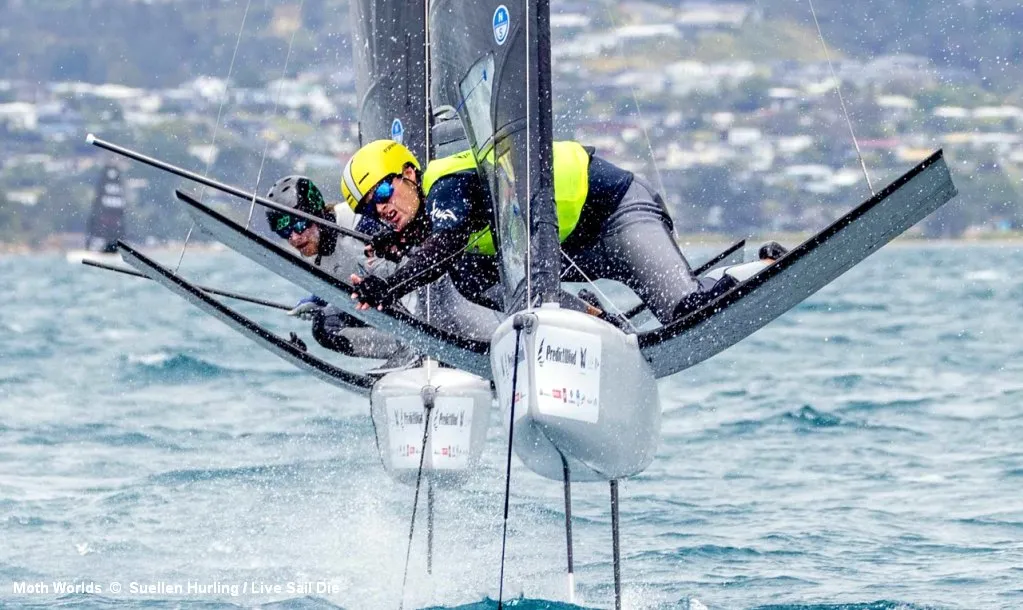
To watch the fleet at Manly Sailing Club, particularly at the starts, was a hair-raising experience. If you are used to watching conventional dinghy starts with nearly all the fleet on starboard tack coming into the line, forget it. The game in the Moth Class is to reduce your overall number of tacks upwind, so with seconds to go and boats at frightening upwind speeds of around 20 knots, there is always a gaggle of boats lining up on port at the pin end of the line. It looks kamikaze to say the least and much sport was enjoyed picking the winners and losers, those that could cross and those that got snaffled by the fleet. It’s one of the unique elements of this most exciting of classes.
What we saw all round was the whole technique of foiling going to levels unimaginable a few years ago. With several clubs, particularly antipodean beach clubs, having promoted foiling ahead of displacement sailing for teenagers once they had progressed beyond the very basics, the fruits of that policy are being brought to bear.
Foiling technique is progressing alongside very different tactics too. It’s an exciting time for the sport and it won’t be long before today’s Moth stars take those techniques and reaction times up into the big league of sailing’s pinnacle events.
Many eyes were on Manly Sailing Club in late December and early January. New champions were crowned and the sport pushed onwards to ever better levels. The coaches watching were impressed – as was the rest of the sailing world.
Magnus Wheatley