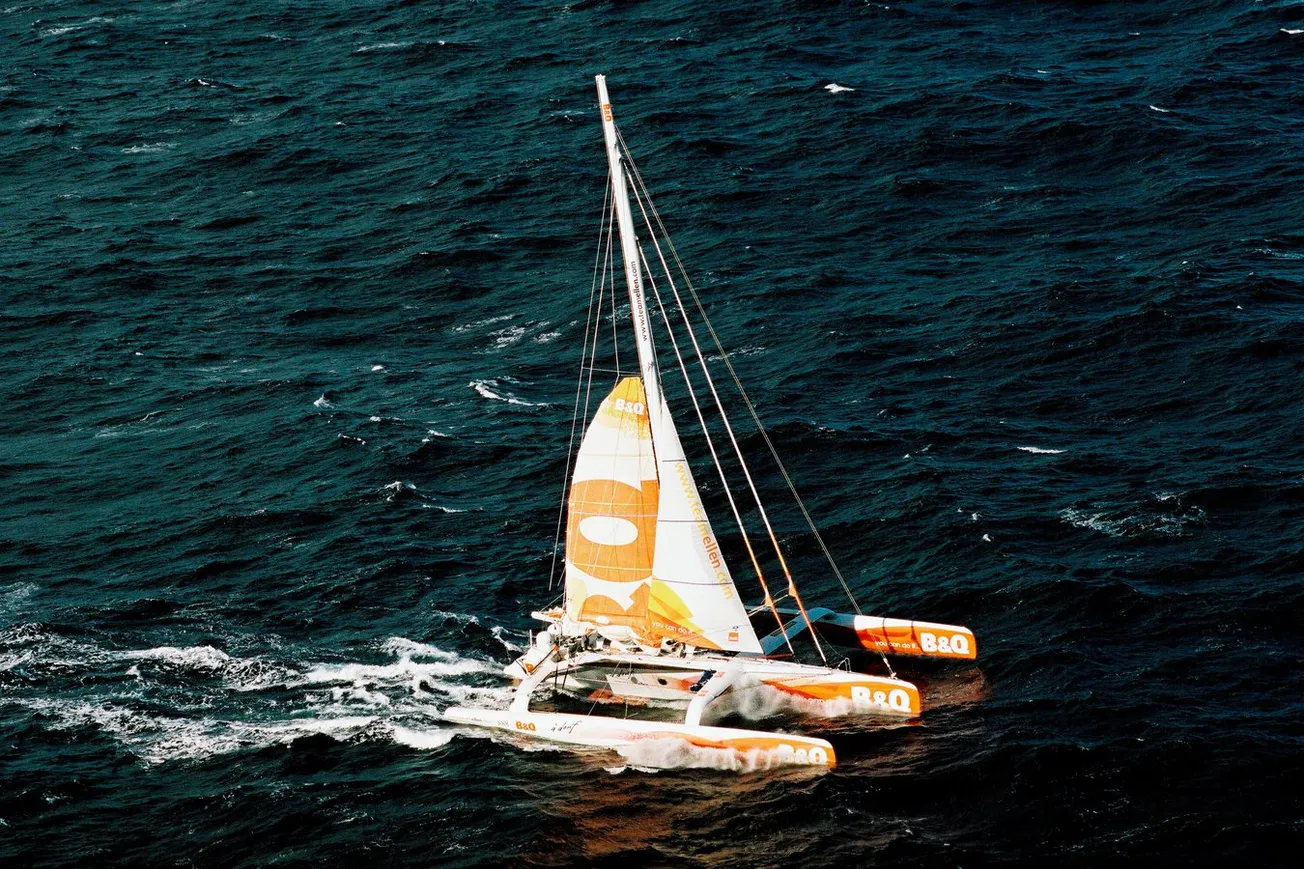

It was an astonishing achievement, completed in February 2005 when she arrived in glory at Falmouth, that capped an unprecedented career which was to continue for 12 more months but effectively ended with that record.
One of the many fascinating aspects of MacArthur’s brief appearance at the peak of the solo sailing world is that, with every passing year, it becomes harder to explain, not easier. It was an outlier in almost every respect featuring a young woman who streaked across the sailing firmament like a meteor or a shooting star.
Why harder to explain? Well, for starters, no other woman has come close to achieving what MacArthur did – two victories in professional solo transatlantic races – the Europe 1 New Man Star (the forerunner of the Transat CIC), and the Route du Rhum – the small matter of second place in the Vendée Globe to Michel Desjoyeaux, and then a solo round-the-world record when she got round the planet in 71 days.
Then there was the intensity. This was a lifetime at sea crammed into 10 frenetic years when MacArthur raced and raced, or trained or delivered boats, covering about 250,000 nautical miles before hanging up her sea boots before she was even 30. It left her exhausted and everyone who worked with her gasping for air. And because she stopped so abruptly, has never returned to competitive sailing and rarely talks about her sailing career in public, it all seems especially stark in retrospect.
And there was the profile. One of the great communicators who wore her heart on her sleeve, MacArthur achieved what no other British sailor has since the heyday of Britain’s solo ocean sailing pioneers, men like Francis Chichester and Robin Knox-Johnston. She became a household name in both Britain and France and elsewhere, with a mainstream media presence that included being lampooned by comedians on popular TV comedy shows.
Oh – I almost forgot – her background. What were the chances that a young woman brought up on a small-holding in rural Derbyshire with no outstanding sailing forebears, would very quickly not just find her feet in professional sailing, but become one of the best of the best? Sailors come from all backgrounds, but this aspect of MacArthur’s career and emergence onto the world stage from relative obscurity still amazes me all these years later. Remember, she wanted to be a vet, a career choice that would have been more realistic, you might think, than trying to become an elite class sailor.
I have no doubt that MacArthur can rightly be regarded as the most successful female solo ocean racer of all time but also the greatest, accolades that have not been under threat since she retired. It’s always tricky to make comparisons, but whichever way I have tried to look at it, MacArthur comes out on top.
Among those highest in the ranking in her wake would be Florence Arthaud (Route du Rhum winner and solo transatlantic record holder), Dee Caffari (first woman to sail around the world solo and non-stop in both directions and the only woman to have sailed around the world non-stop three times), Sam Davies (fourth in the Vendée Globe and third in the Transat CIC), Catherine Chabaud (first woman to finish the Vendée Globe) and Isabelle Autissier (first women to sail around the world in a race).
But neither of them compare to Ellen who was the youngest person ever to win the single-handed transatlantic race and the first woman to do so, the youngest competitor at the time ever to attempt the Vendée Globe and the first woman to make the podium of the toughest race of them all, either at that time or since. In the Route du Rhum – her last race on board her Owen/Humphreys-designed Open 60, Kingfisher – she beat 16 other sailors in a race record-smashing time and ahead of all the multihulls.
Then came her greatest achievement – the solo round the world record. This turned into a gruelling battle against the clock, against the oceans and her own inner demons as she sailed her 75ft Nigel Irens-designed trimaran into the record books, beating Francis Joyon’s previous fastest time by just over 24 hours.
Looking back, what I remember from this remarkable journey, was the innate competitiveness, the sheer drive and the down-to-earth modesty in the way that MacArthur approached the toughest tasks. Helped every step of the way by Mark Turner who became her manager, promoter and driving force, MacArthur set her goals and then went about achieving them systematically. She had an extraordinary ability to absorb information and became not just a formidable and methodically reliable skipper, but also a highly competent technician capable of dealing with the myriad issues that arise in single-handed racing.
What I particularly liked was the way MacArthur and Turner developed strategies to make her better and to improve her game. For instance, Kingfisher was built in New Zealand and then sailed back – first with a crew and then solo from Cape Horn – by MacArthur to France. By the time she got back she had a new boat that had been pre-race tested like no other Open 60 or IMOCA before or since. Likewise, when MacArthur felt she needed to sharpen her boat-on-boat skills, she called in Olympic 470 and Laser 4000 sailor Paul Brotherton and went racing with him.
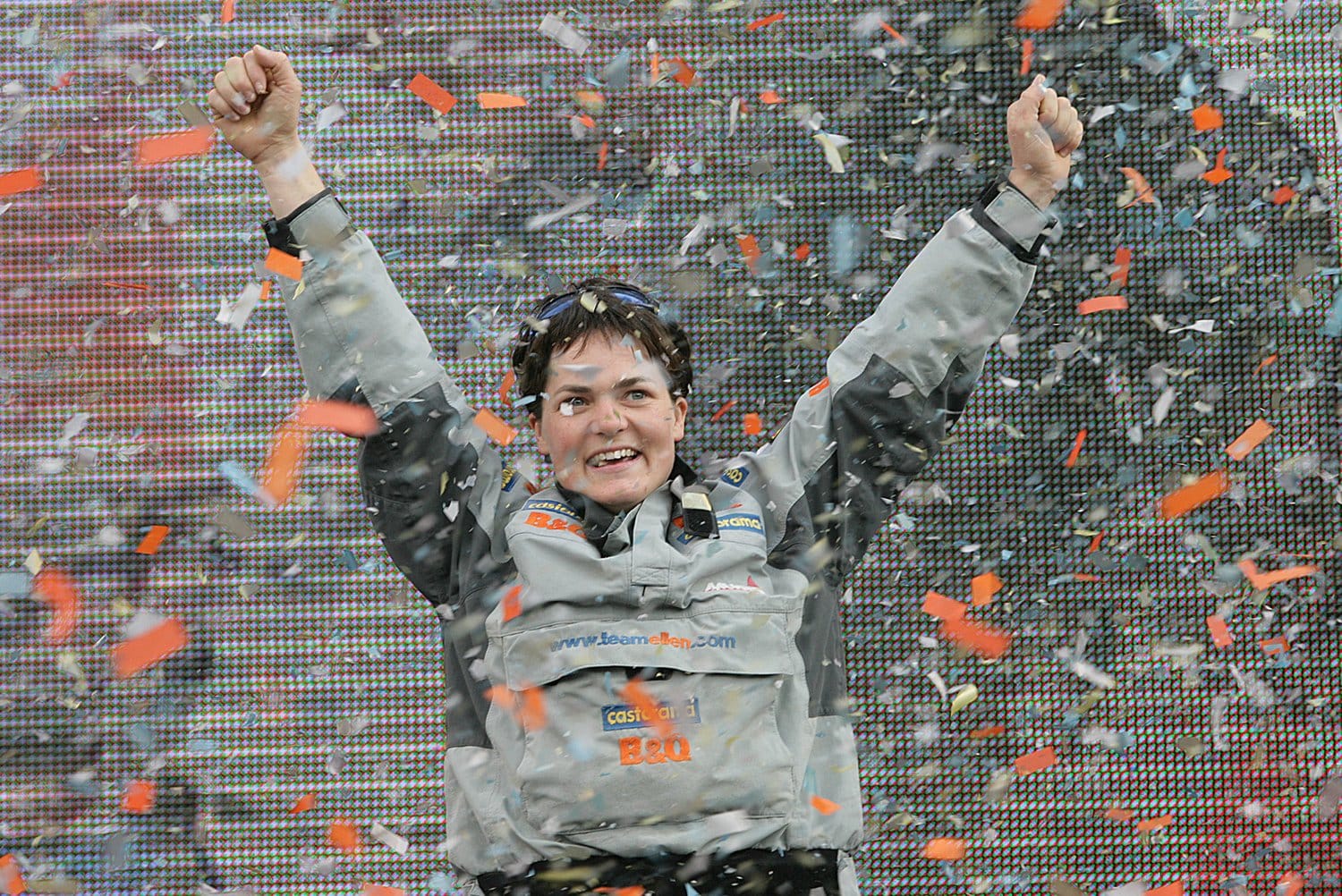
The same single-mindedness that underpinned MacArthur's approach to sailing has been evident since she retired from the sport and set up the Ellen MacArthur Foundation, an organisation devoted to promoting her belief in the circular economy. The Foundation works with a growing list of companies on how to design and produce goods that can be re-used or recycled to cut down the waste associated with unfettered capitalism. Her focus on this is as unwavering as it was on sailing and there is no room in MacArthur’s current life for talking up her past exploits on boats. It feels like she got to the end of sailing and shut the door, another reason why this anniversary has gone by with barely a mention in the media or online.
I was lucky enough to cover just about every race and every stage of MacArthur’s sailing career from the start – when I met a bubbly young woman who laughed a lot while talking about her dream of completing the Mini-Transat – to the finish, accompanying her on a promotional trip with B&Q in China, 10 years later. My favourite memory was turning up in Guadeloupe in November 2002, just in time to jump in a RIB with Turner to watch MacArthur complete the final miles of her victorious Route du Rhum.
The boat and its skipper had survived a baptism of fire in the early stages of an attritional race. Among those they had left in their wake were Seb Josse, Jean-Pierre Dick, Roland Jourdain and Mike Golding. Kingfisher looked immaculate as she came gliding in, her nav instrument lights glowing red in the twilight as MacArthur sailed along the coast. Lining the boat up on the way past the lighthouse on Basse-Terre, Kingfisher came alive in the evening breeze, hitting 22 knots as we strained to keep up. Ahead of her was one of the best parties at a race finish in sailing as the locals at Pointe-à-Pitre danced the night away with her. “Ellen! Ellen! Ellen!” they cried in celebration.
It was a bittersweet moment because this would be her last race on Kingfisher as she prepared to move on to an ultimately unsuccessful Jules Verne campaign on the maxi-cat formerly named Orange. MacArthur had enjoyed an intense love affair with her Open 60 and was heartbroken about having to say goodbye to her. Sitting cross-legged on a sofa under an awning slung between palm trees after the party had finally ebbed away, she spoke about how she was still learning a boat that had brought her so much success.
“I learnt a lot about myself in the Vendée, but every time you sail you learn new things,” she said. “I’ve sailed a lot in Kingfisher and I’ve learnt a lot about how to sail her and what she’s capable of. I could never have sailed before with that much wind with the spinnaker up when the boat completely takes off – she just becomes a flying machine.”
“It’s been a very tough race,” she added, “I’m pretty tired and I’m a bit slurry of speech and my head’s in the clouds…” It had been a long day and it ended with MacArthur stopping by her boat on her way to the hotel. “She’s so pretty isn't she,” the race winning skipper muttered almost to herself. “She’s the prettiest boat in the world.”
Get all areas access to Yacht Racing Life with a Full Membership free 30-day trial. There's no obligation and you can cancel at anytime.