


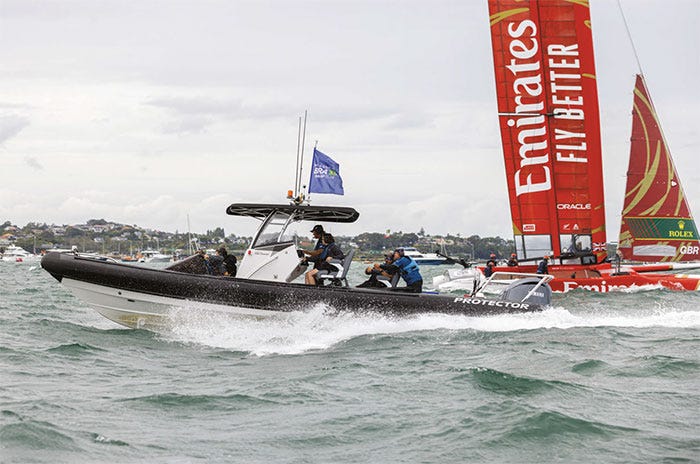

High-octane chases, aggressive close-quarters manoeuvres and long days exposed to relentless sun, wind and waves: the modern chase boat has become one of the hardest-working assets in a race team’s inventory.
For more than 30 years, Protector Boats has been designing and building high-performance support craft for some of the world’s most demanding marine operations. Today, its boats are widely used throughout elite yacht racing, including the America’s Cup, AC40 and SailGP fleets, where reliability, adaptability and performance are critical.
With yachts racing at ever-faster pace and in an increasingly technical sphere, the demands placed on support craft are evolving just as rapidly. Whether providing an operations centre for coaches and analysts, a platform for media teams capturing content, a hospitality vessel for sponsors and guests, a safety boat, or a transport solution for crew, sails and spares, modern chase boats are expected to fulfil multiple roles simultaneously.
For race teams competing at the highest level, having a reliable, adaptable and efficient chase boat is no longer a luxury; it is fundamental to enabling support crews to perform at their best and, ultimately, to enhancing overall team performance.
Protector Boats has used its decades of experience to shape a new era of support boat design. Through its Targa and Chase series, the New Zealand manufacturer offers two fully customisable ranges of hard- and soft-top 25-41ft RIBs, available in Europe through PB Europe, a subsidiary of the Ancasta Group.
Throughout the range, performance is a given. Equipped with twin or triple engines producing up to 1,350hp, Protector RIBs are capable of matching the pace of the world’s fastest racing yachts. Yet outright speed is only part of the equation. What distinguishes an effective chase boat from a merely fast one is its ability to operate safely and comfortably over long periods, while being easy to handle in demanding conditions. Engineered for stability with robust deep-V hulls, Protector RIBs are designed to excel wherever race support is required.
According to Ian ‘Andy’ Andrews, brand manager for PB Europe, these qualities, combined with the ability to tailor each vessel to a team’s precise requirements, are what set Protector apart.
Drawing on more than two decades in the Royal Navy, alongside extensive experience managing marine operations and equipment projects across Africa and the Middle East, Andrews brings a practical understanding of what professional teams need from a working platform.
Race teams account for the majority of Protector’s Targa and Chase customer base, and Andrews estimates that around 80 per cent of his time is spent on the water working directly with clients, identifying opportunities for bespoke design innovation.
‘The chase boat is really an extension of the race yacht,’ Andrews explains. ‘The more seamlessly it integrates into the team’s operation, the more effective that team can be.’
Working closely with race teams’ support crews allows Andrews to understand how each team operates and where bespoke design solutions can improve workflow, safety and usability.
Liaising with Protector’s design and engineering teams in New Zealand, he helps tailor each vessel to its intended role. Regular discussions with clients, often supported by hand-drawn sketches and visual concepts, allow new ideas to be explored and refined before production begins. Once a finished boat arrives in Europe, Andrews personally oversees its commissioning to ensure every detail performs exactly as intended. The result is a support boat designed around functionality rather than compromise.
As chase boats are increasingly expected to perform multiple roles, the ability to reconfigure quickly between functions has become central to Protector’s design philosophy. Modular layouts, moveable consoles, removable seating systems and flexible deck arrangements allow teams to adapt their boats to changing requirements without sacrificing comfort or practicality.
Large fore and aft deck spaces can be configured to carry equipment, sails or specialist gear. Deck structures can be reinforced where necessary, while upgraded tow posts and strategically positioned, flush-mounted tie-down points allow teams to tailor each boat to the specific demands of their campaign.
For hospitality-focused operations, removable sunbeds, bar facilities, fresh water systems, galleys and onboard toilets can be incorporated. Extended bimini arrangements provide shade for guests, while enclosed cockpit configurations available within the Targa range offer protection for coaches, analysts and media teams working with sensitive electronic equipment.
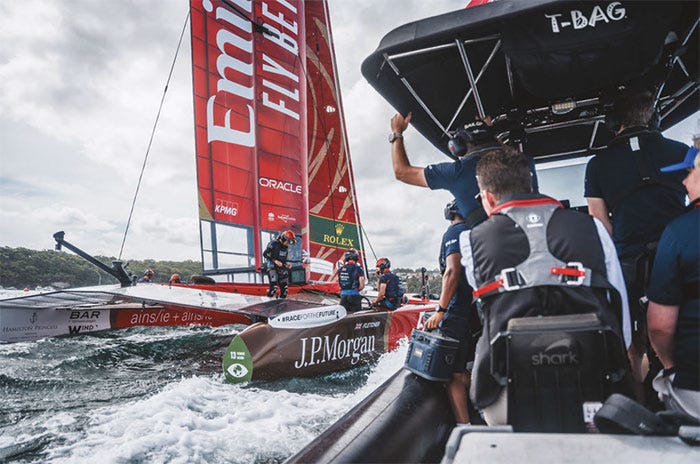
Enhanced communications and electronics packages can also be specified to support data gathering, live broadcasting and team coordination. Commercial coding requirements can be accommodated, while specialist features such as dive tank racks, extended swim platforms and expedition equipment can broaden a vessel’s capabilities far beyond race support.
Despite the extensive range of options available, Andrews often advocates a minimalist approach wherever possible. Soft storage solutions, for example, can replace fixed cabinetry, reducing maintenance requirements and improving long-term reliability. For professional teams operating within tightly scheduled international programmes, minimising service demands reduces both cost and downtime. This is a particularly important consideration for charter fleets and centrally managed racing circuits such as SailGP.
That reliability begins at Rayglass Boats’ state-of-the-art manufacturing facility in Auckland, New Zealand, where every Protector RIB is built by hand.
Durability is central to every Protector build. Heavy-duty Hypalon tubes provide buoyancy and impact resistance, while solid fibreglass deep-V hulls deliver rigidity, stability and a comfortable ride in challenging sea states. Hull thicknesses ranging from 19-35mm exceed typical industry standards, contributing to both longevity and performance.
These qualities have also earned Protector the trust of military, coastguard and law enforcement organisations around the world, including the New Zealand Coastguard, customs agencies and the Norwegian Police, all of whom depend on reliability, transportability and multi-role capability.
The same characteristics align closely with the demands of elite yacht racing.
For teams competing on international circuits, transport logistics can have a significant impact on both budgets and preparation schedules. The Chase 330 has become particularly popular because it can be packed into a standard 40ft shipping container while still offering one of the largest working deck areas available in a RIB of its size.
‘The Protector Chase 330 can be packed down in just a couple of hours,’ Andrews explains. ‘Once the boat is placed on a cradle, the tubes deflated and the bimini removed, it slides straight into a standard 40ft container. It can then be reassembled just as quickly at the next venue and back on the water ready for action.’
The ability to simplify transport logistics delivers significant advantages in both cost and operational efficiency.
Of course, boats operating regularly in dynamic, close-quarters environments will inevitably require maintenance from time to time. Through PB Europe and Ancasta’s network of 22 offices across Europe, race teams have access to rapid technical support whenever it is needed. Understanding the time pressures of a race campaign, the team works to minimise disruption and keep boats operating at peak performance.
Testament to the durability of the boats themselves is the fact that vessels originally commissioned for the 2007 America’s Cup remain operational today. Strong residual values achieved through Ancasta’s brokerage network further reflect that longevity.
While annual engine servicing remains recommended, propulsion technology continues to evolve. Protector is closely monitoring developments in hybrid and electric systems as part of its wider commitment to sustainability. For now, however, Andrews says conventional propulsion remains the preferred choice for most professional race programmes due to its proven range, reliability and performance.
Ultimately, Protector’s goal is simple: to provide support craft that allow race teams to focus entirely on the task at hand. ‘When a team knows their chase boat is completely fit for purpose, that’s when they can focus 100 per cent on racing,’ says Andrews. ‘That’s what makes the difference.’