


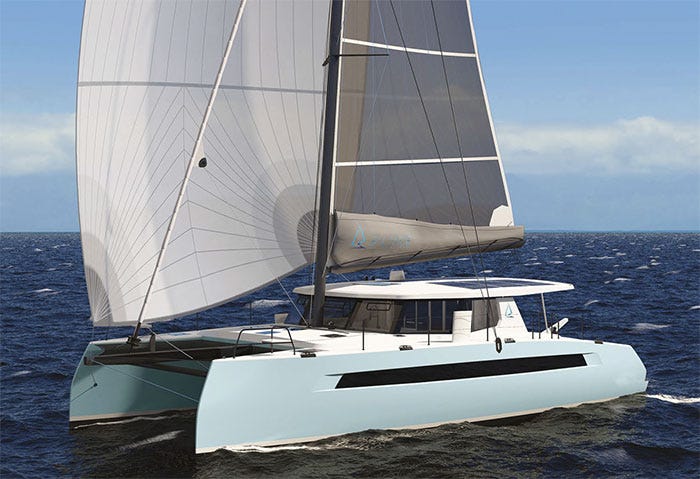

The latest expression of Balance Catamarans’ thinking is the new 14.2m (46.6ft) Balance 464. Exactly where that balance lies depends on the owner.
‘Some of our customers are more performance-skewed and some lean more towards comfort,’ says CEO and founder Phil Berman. ‘But we’re always trying to provide a boat with good payload, comfort and storage while achieving the best performance possible.’
On yachts of 50ft and above, improved performance often comes naturally through longer waterlines and greater sail area. Designing a genuinely high-performance cruising catamaran in the 45ft range, however, presents a different challenge.
‘It becomes difficult because everybody wants the same equipment they’d expect on a 50ft or 54ft boat,’ Berman explains. ‘Two fridges, two freezers, a watermaker, solar panels – all of it adds weight.’
Balance has been systematically redesigning its 13.5-23.2m (44-76ft) range, drawing on in-house experience, input from du Toit Yacht Design and feedback from its owner community. When it came to replacing the 13.5m (44.3ft) Balance 442 – the company’s entry-level model, which has sold 30 examples since 2021 – the objectives were clear.
‘We knew we could improve in a lot of areas,’ says Berman. ‘If we made the boat a little longer, built it lighter and increased the sail area, we could move closer to a true high-performance cruiser without sacrificing the comfort our owners expect. That was the fundamental design brief.’
The longer platform would also carry the new Integrel E drives – hybrid motoralternators that attach to the back of the Yanmar engines – which add weight aft.
‘So we needed a boat that was a little longer, a bit wider and could carry more payload in the back,’ Berman says.
Balance had already experimented with increasing the amount of carbon used in its boats, alongside full glassfibre and vinylester resin construction.
‘We were pleasantly surprised by the amount of weight we could remove,’ Berman recalls. ‘So Mark said, “Why don’t we do the entire boat with a carbon substructure?”’
‘There is substantially more carbon in the 464 than even some of the larger models originally had,’ says Mark Delany, owner and director of the Cape Town yard. ‘With the additional length, the hybrid propulsion system and a larger lithium battery system – 36kW at 48V – we wanted to pull as much weight out of the boat as we could.’
Previous custom-build experience had shown Balance that carbon hulls brought drawbacks. They tended to be noisier at sea and raised concerns around conductivity and corrosion.
‘So the exterior shell of the boat is made from E-glass and full vinylester,’ Delany explains. ‘The interior structure, saloon tray, bulkheads, floorboards, daggerboards, trunks and appendages are all carbon. You get a substantial weight saving in the 464, probably 750-800kg. It delivers the stiffness benefits of carbon construction without the negatives that can come with carbon hulls.’
For performance-minded owners, the advantages are obvious. ‘The more performance-oriented people ask, “What can you do to make my boat faster? How much will it cost to make it faster?”’ says Berman. ‘The carbon structure, although expensive, is the best way to save a substantial amount of weight’.
Balance has also increased sail area on the 464, from 112m² on the 442 to 124m². ‘The forebeam sits below the longeron, and there are stays that come down from it, so the pelican striker is less than a foot tall,’ Berman explains. ‘That allowed us to push the forestay forward by about a foot. We’ve significantly increased the area of the selftacking jib and enlarged the mainsail slightly, so she’s lighter than the 442, longer and carrying more sail area. In every respect, her performance has been enhanced.’
What does that mean on the water? The 464’s polars indicate speeds of 6-8kts upwind at 40° TWA in 10-14kts TWS, increasing to 8.5-12kts on a beam reach in the same conditions. Off the wind, the yacht is capable of reaching 20kts at 120-130° TWA in 25kts TWS.
Those numbers aren’t simply about excitement; they’re tailored to the way Balance owners actually cruise.

‘Some people use their boats in the Caribbean for six or seven months a year and haul them out for hurricane season,’ says Berman.’ Those living aboard are either sailing in the Mediterranean or spending summers in New England or Chesapeake Bay. They want a boat that can comfortably handle a 1,200-mile trip to the Caribbean and back and still make respectable progress to windward.
‘On a typical production catamaran with keels, once the wind moves forward of the beam, you’re often not sailing much better than 60 degrees to the true wind. When your VMG drops to three knots or less, people start motoring. Balance Catamaran owners don’t want to motor – they want to sail.’ With the performance box ticked, Balance has also introduced a number of practical refinements. The hull windows have been slightly recessed to add visual interest and the cockpit benefits from having a wider helm seat.
Like all Balance Cats, this yacht has the VersaHelm system: a wheel that flips up or down to allow steering either from the cockpit or from the elevated helm position where the sail controls are located. But the 464 also debuts the VersaStern, which eliminates the need to find storage space for washboards. When not secured in place to keep following seas out and crew in, it folds neatly onto the engine access hatch, sitting flush with the deck. ‘The side benefit,’ Berman notes, ‘is that when the door is down, it really muffles the sound of the engines.’
The interior receives the same upgrades seen across the wider Balance range, including Italian-style frameless cabinetry built using cored panels and offered with a choice of five real-wood veneer and fabric combinations.
‘We think our boats are more luxurious in finish than our competitors’, says Berman. ‘They’re every bit the quality of the finest monohulls. The furniture is handmade and the materials and finishes are very upscale.’
‘It’s one of the things we’re proudest of at Balance,’ Delany adds.
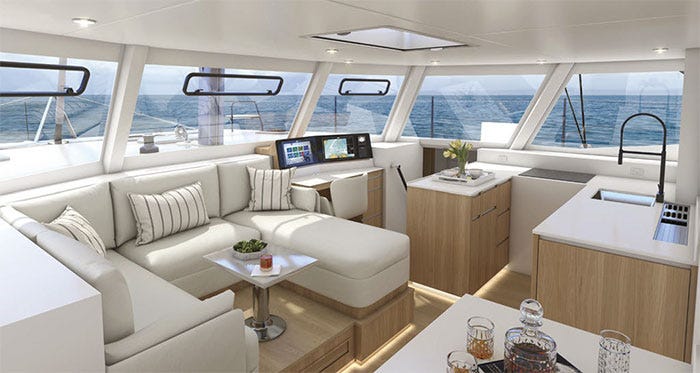
Recognising that most owners prefer to dine outdoors, the saloon has also been reconfigured. Lower-profile settees and a coffee table replace the traditional dining arrangement. ‘You’re sitting in a living room to watch TV or read a book,’ says Berman. ‘Aesthetically, it feels more relaxed and elegant.’
As ever with catamarans, ventilation remains a priority and two developments being rolled out across the Balance range give the 464 a notable advantage. For the forward cabins, Balance has introduced ports that open into draining lockers located just aft of the trampoline.
‘At anchor, those hatches can be locked open’ says Delany. ‘That feeds air into the cabin, even in the rain, giving you fresh airflow even when you’re not running the air conditioning.’
The saloon of the new Balance 464 benefits from similarly thoughtful design. ‘We’ve gone for much larger opening flush hatches on the forward windows,’ Delany explains, ‘as well as in the coachroof, so we’ve almost doubled the available openings to bring more fresh air into the saloon.’
Accommodating the largest central hatch required a substantial structural redesign.
‘We had to redesign all the mullions,’ Delany says. ‘Quite a lot of structure goes into keeping that opening possible but, even with the mast in place, the whole saloon area feels much more open.’
The changes in the saloon have also delivered improvements in visibility – a longstanding priority for Balance.


‘We brought the windows down as far as we could towards deck level because visibility has always been central to the Balance philosophy,’ says Berman. ‘You’re piloting these boats through the windows in inclement weather, so we’re always trying to improve sight lines. From inside, I think the visibility on this boat is the best I’ve ever seen on any catamaran.”
Another first for the Balance 464 is the inclusion of hybrid propulsion as standard. The Integrel E drives, which are disc-like alternator motors mounted between the 45hp Yanmar engines and their gearboxes, enable fossil-fuel-free close-quarters manoeuvring while also delivering substantial charging capability.
‘If you’re at anchor and charging at 1,500rpm, you’re getting 15kW from one engine,’ Berman says. ‘With E Power, Integrel’s belt-driven alternator, you’re getting about 7-7.5kW. If you’ve got two E Drives running at 1,500rpm, each charging at 15kW, it doesn’t take very long to top off these batteries. That’s the fastest charging rate I know of in the industry.’
‘If you start your engines and you’re moving off from an anchorage, within an hour you’ve got a full battery bank,’ Delany adds. ‘Combined with 3kW of solar, if you’re using the boat efficiently, you’ve got a vessel that’s semi-off-grid.’
Following a complete coachroof redesign, up to five glass solar panels now sit recessed and flush with the surrounding surfaces, with an air gap beneath them to improve their cooling efficiency.
Buyers seeking a lower entry price can opt for Integrel’s E Power system instead of the standard E Drive setup, reducing the high-spec base price of $1,391,358 by approximately $55,000.
Accommodation is arranged across three cabins. The owner’s hull to starboard features a forward double berth with heads and shower aft, while the port hull contains two double cabins sharing a bathroom.
There are currently no plans for a four-cabin version. ‘To be honest, we’re seeing more interest in having fewer cabins,’ says Delany. ‘In fact, we’ve just completed a port hull that is configured as a second owner’s suite.’
‘The convertible office in the aft port cabin is a very popular option,’ adds Berman. ‘You have a queen size berth, but you can slide it away and create a really useful workspace.’
Prospective owners won’t have to wait long to see the new model on the water. ‘We already have 10 of them in build,’ says Delany. ‘The North American boats will appear at spring boat shows such as Miami, while in the Mediterranean there should be one at La Grande Motte early next year.’
For many Balance owners, however, the experience begins long before delivery.
‘I’d say 90 per cent of our customers really enjoy the build process,’ Delany concludes. ‘They come to South Africa, go on safari, drink good wine, and then there’s the bucket-list experience of crossing an ocean on your maiden voyage – something most of them have never done before. That’s a big part of what makes owning a Balance Cat special.’