



Wow, did we all just blast through the midpoint of the 2026 season in the buffeting trade winds of Lanzarote! The 52 Super Series went to Marina Rubicon in search of strong breeze and were rewarded – if that is the right word – with an average windspeed the strong side of 20kt. The third regatta of the year was a spectacular acid test. Few teams came through unscathed.
In the end, and befitting a team from the nation that has long dominated ocean racing, Jean-Luc Petithuguenin’s French team on Paprec proved very popular winners in Lanzarote. Winds of 20-30kt must have felt like a walk in the park for some of the Paprec team in Lanzarote… not least Vendée Globe veterans Loïck Peyron, tactician, and sometime navigator Yoann Richomme.
After coming within touching distance of the world title last year in windy Cascais – missing out by a single point on the final day – many came to Lanzarote expecting the French to be one of the strongest in the big breeze and big seas. They did not disappoint.
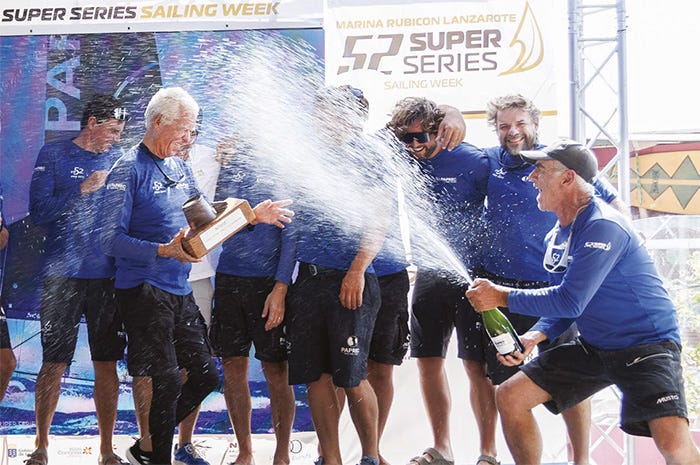
Main image: Loïck Peyron (right) seems to have officially completed his transition from oceanic racing god to outstanding Grand Prix tactician as a now longstanding member of Jean-Luc Petithuguenin’s (with trophy) Paprec team, winners in Lanzarote… If Banque Populaire and Macif lead the way with commercial support for sailing, Petithuguenin is surely among the most prolific private campaigners. As well as a winning TP52 team that tirelessly promotes young French sailing talent, there is the brilliant Yoann Richomme’s second Vendée Globe Imoca programme coming up shortly plus sponsorship of both the Figaro Solitaire (for now) and two-handed Transat Paprec.
That said, as one of the original teams to have transitioned from the MedCup to becoming a staunch supporter of the 52 Super Series in 2012, perhaps there were some within the Paprec camp who questioned if a regatta victory would ever come their way, even after finishing on the overall podium for the first time at the end of the 2025 season.
So when they finally made it happen in Lanzarote there were more than a few emotional French sailors docking in to enjoy the champagne showers ashore, not least Petithuguenin who, through the company he founded, Paprec, has given so much to French sailing over the years. Just to remind us, that longterm support, year in year out, has included sponsoring La Solitaire, the Transat Paprec two-handed race to St Barts and of course supporting Yoann Richomme who has a new Imoca in build funded by Paprec.
Stéphane Névé, mainsheet trimmer and project manager recalls, ‘Jean-Luc was just so happy. As was the case for all of us… It has been such a long time since we first started on the circuit. And, yes, sometimes we were thinking, “OK, it’s nice to be here, but maybe winning is not for us.” But finally we have done it.’
Paprec were among the fastest downwind in the breeze last year and they were again in Lanzarote. Another fundamental asset was reliability – helpful when their rivals were regularly blowing up sails; one team destroyed four chutes during a single two-race day.
Névé continues: ‘We have been working a lot on our sails. And unlike most teams we work on our own. We try to analyse what was good last year and the conditions where it was good, and when it was not so easy. We took our baseline from those sails, and we said, “OK, on the J1 we want this much change. On the J1-5 we want this. We keep it as simple as possible.”
‘But in the end we stayed close to the North baseline. We didn’t change much. In hindsight we didn’t change much at all!
‘But you can see that, especially with the kites, we had no issue during the event in Lanzarote when some of the teams were working their way through kites like they were going out of fashion.
‘That was the target we also gave to North Sails, including the choice of sail cloth. They had to be reliable. We knew it would be windy and we did not want to have to hold back.
‘I mean, on the A4, for example, we only use nylon while most of the fleet are using polyester. But we felt that in these conditions polyester is too risky, especially with frequent shock loads that can pop a polyester chute in an instant. If you hit a wave… poof! I mean, you have all seen the footage!!
‘Of course, on paper polyester is always better because it doesn’t stretch so much. But to win the race you need to finish the race and to finish with all your sails.
‘As well as sails, we have been working quite a lot on the hydraulics, the pedestals, the winches and everything else in the systems. Again, our call to the technicians, the shore team, was to make things bulletproof. That was our thing. Don’t try to save some weight. Try to make it as reliable as possible. In Lanzarote we really wanted to be able to push hard, no compromising.’
It has also been fascinating to watch Paprec tactician Loïck Peyron learn and improve regatta by regatta, year by year. Since joining the team in 2024 Peyron has brought a remarkable energy and team spirit – Loïck is of course a famous ocean racer, but he has learnt to love the new challenge of grand prix inshore racing.
The way the French go about their TP52 racing is both unique and admirable. For a nation so steeped in the greatest traditions of blue water racing, when taking on the toughest Grand Prix circuit – the 52 Super Series – not for them the call out to the brightest international stars and those enormous invoices. Barring emergencies, Eric de Turckheim’s Teasing Machine (above) and Jean-Luc Petithuguenin’s Paprec both go racing with 100 per cent French crews. And the heavier conditions of Lanzarote suited them to a tee 36
His own satisfaction at winning was obvious: ‘Finally I can die happy now,’ Loïck laughed at the prizegiving. He is of course an instinctive racer who reads the racecourse more by eye and feel. But Peyron contributes in every area.
‘Loïck is not a lifetime fleet racer like Terry (Hutchinson) or Vasco (Vascotto),’ says Névé. ‘So when we get close to the top mark and there are many boats around it’s more difficult for him. So, in that situation, most of the time he’s telling Cedric [Château], “OK, now I’ll let you decide.” It’s generally when we get to the upwind mark or the downwind mark and there is a lot of traffic. This is the kind of situation where Loïck is not as comfortable as he could be in other conditions.
‘However, on the trimming and the set-up of the sails Loïck is truly excellent. He quietly tells us what he sees and what he would like to do. Sometimes we do not agree. Sometimes we explain that we have been trying what he’s suggesting and that it doesn’t work. But always we talk together and between us we find the best option.
‘Loïck has recently been doing a lot of multihull sailing… so not surprisingly on the trimming, especially downwind, sometimes the way he sees things is not the way Cédric and I see it! The dynamics are different, especially on the main. But most of the time the comments he’s making are very relevant and useful.’
Helm Cédric Château is a sailor whose broad overall talents are maybe overlooked outside France. What other grand prix helm is a match racing champion, a dinghy and offshore coach, and a shorthanded Transatlantic race winner (Château won the 2025 Transat Café l’Or with Guillaume Pirouelle)? He also talent-spotted and coached the young Charlie Dalin in the 420 class and became a key influence during his early career.
‘Cédric’s very clever,’ Névé adds. ‘Because he’s not just a helmsman, he’s a coach and also a good match racer. He really knows the crew, he knows those guys because he has also been coaching them. He can say, OK, try this or try that. He has a really good feel, and he will tell the jib trimmer, “OK, I would like to see if this is an improvement. So we talk a lot together. Most of the time it’s easy communication with Cédric which then brings more performance.’
Again, coming from a nation of great offshore sailors, Paprec are very much a self-contained, self-reliant team. They have no big-name coach but instead work with a young Figaro sailor, Pierrick Letouzé, who brings his own raft of skills.
‘Pierrick’s on the chase boat. He’s looking at the sails, he’s looking at the trim of the boat, at the trimming of the sails. He’s our personal geek. He’s also a drone pilot, and he’s watching everything everywhere. All the data, everything,’ Névé explains. ‘He’s only 25. And he’s largely self-taught. But he’s very, very clever, and he’s bringing a lot of new things to the team. New ideas, new techniques. He’s constantly analysing sail shapes, sail design, the trimming of the sails compared with the other boats.’
Stéphane Névé: ‘We have not made any big changes. Our big goal for this season was to have no issues. Because we knew that the conditions would be tough in Lanzarote we tried to make every technical area as reliable as possible on the boat. And it paid off.’
Going forwards, the second half of the season looks set to be as fascinating as ever. Sled shed a dozen or so points of their hard-earned lead over the last two races in Lanzarote and look a lot more catchable than they perhaps did after winning in both Puerto Portals and Porto Cervo. Harm Müller-Spreer’s Platoon Aviation are making their customary late-season charge. Although they lost more spinnakers than any other team in Lanzarote they looked fast and otherwise are sailing very well!
So too Andrea Lacorte’s Alkedo, second in Lanzarote and third in the season standings. But there are more than the usual number of teams that have yet to show their very best at the midway point, notably Joakim Sundberg’s Trinity, Pieter Heerema’s No Way Back, Tony Langley’s Gladiator, Ergin Imre’s Provezza and Andy Soriano’s Alegre. All will take inspiration from Paprec and all will be pushing hard in every area to finish the season with a regatta win.