


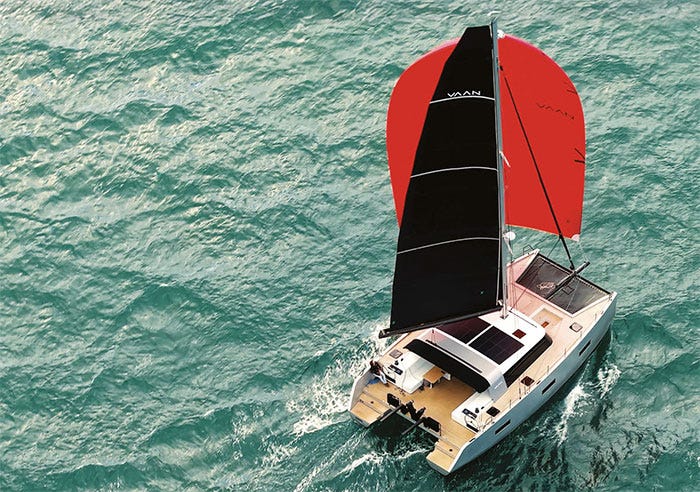

Today’s performance cruising multihulls are faster, lighter, and more highly loaded than their predecessors. They carry larger sailplans, sail at tighter apparent wind angles and often spend extended periods operating at speeds once associated primarily with racing yachts. At the same time, owners expect these boats to remain manageable offshore with small crews, long reefing intervals and high levels of reliability.
For sail designers, this combination presents a unique challenge. Unlike monohulls, multihulls do not heel significantly to dissipate load. With the loads transferring more directly into the platform, the rig and the sails themselves, fabric strength, reefing geometry, sheeting angles and load distribution all become more critical factors for performance, durability and handling.
Quantum Sails has been at the forefront of addressing these challenges through its highly customised approach to sail design and its proprietary iQ Technology platform. A design and validation system originally developed for high-performance racing programmes, iQ is now used as part of a broader design process that enables Quantum Sails’ designers to simulate, refine and validate the behaviour of complex sailplans before they are built.
This capability is particularly relevant in the performance cruising multihull market, where each project demands an individual balance of speed, reliability, handling and owner expectation.
A different type of design challenge
Modern cruising multihulls routinely operate at apparent wind angles and boatspeeds that create substantially different aerodynamic environments from traditional cruising monohulls. Large square-top mainsails, overlapping reaching sails and highly refined deck layouts create systems where relatively small geometry changes can produce meaningful differences in sail shape and load distribution.
Reefing adds another layer of complexity. Offshore cruising multihulls often spend extended periods at sea, which means that the sailmakers are not simply designing for a single full-power condition. Instead, they must consider how sail shape, twist and structural loads evolve across multiple reefing states and wind ranges.
Using iQ, Quantum Sails’ designers can evaluate those reefing states and wind ranges virtually, helping identify not only how a sail will perform when reefed, but also the conditions where a reefing transition may become the more efficient, controlled or safe option.
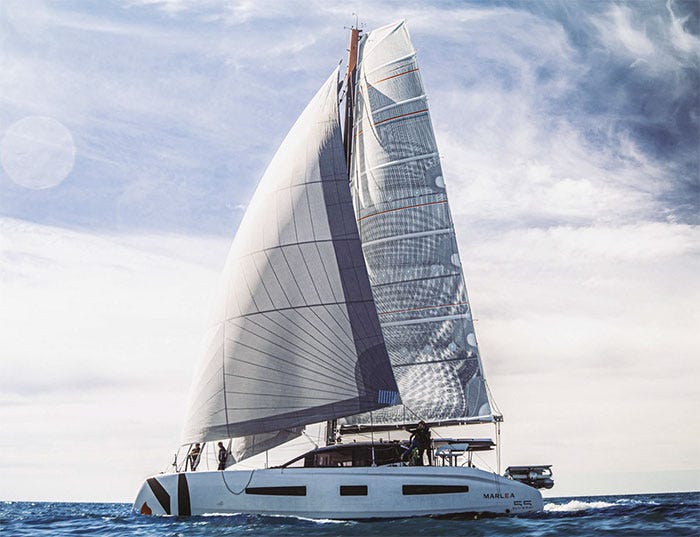
‘Multihulls don’t provide sailors with the same “feel” that monohulls do, to help them to identify when to reef, which can often lead to breakages or failures,’ Quantum VP of design Doug Stewart explains. ‘By looking at shroud loads, sheet loads and loads on the sail fabric, iQ can give owners the exact numbers they need so they know when to reef. Otherwise it’s just guesswork.’
Historically, much of this process relied on accumulated design knowledge and seatrial refinement. Experienced sail designers developed instinctive understanding of how certain sailplans would behave on certain platforms. Quantum’s approach builds on that experience with digital validation tools capable of modelling not only sail shape, but also the interaction between sails, rigging, deck geometry and aerodynamic loads.
Modelling the entire system
Quantum’s iQ Technology platform approaches sail design as a fully integrated system rather than an isolated exercise.
For projects such as the new S/V Delos expedition catamaran, that process begins by constructing a virtual model of the yacht which includes detailed deck geometry and rigging layouts. The longrunning sailing channel operated by Brian and Karin Trautman is building a new 53’ aluminium expedition catamaran designed by David De Villiers and built by Stradbroke Yachts in Brisbane, Australia, for extended offshore cruising and circumnavigation.
The project presented an unusually broad design brief. The yacht needed to combine offshore durability and manageable handling with the performance characteristics expected of a modern performance cruising multihull. Sailplan and rigging decisions therefore became closely interconnected from the outset.
Doug Stewart worked with the Delos team during the early development phase, helping evaluate both sailplan and rigging configurations before the final geometry was locked in. Once the configuration was established, Quantum designer Joan Subirats and the design team created a complete digital model of the platform within the iQ environment.
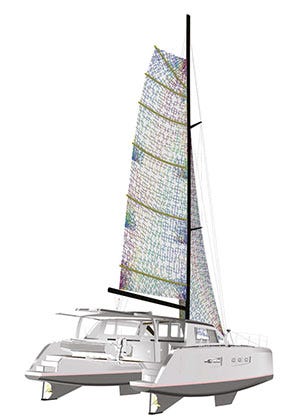
Winches, chainplates, sheeting tracks and hardware locations were incorporated into the model so the software could reproduce precise sheeting angles and trim geometries. Once the sailplan was established, designers could simulate airflow across the sails over a wide range of wind angles and velocities while simultaneously analysing structural load paths throughout the sail.
Subirats describes the process as a balance between aerodynamic and structural requirements. ‘It’s a kind of dance between the structural side and the aerial one,’ he says. ‘We adjust until they are in harmony at each stage.’
The practical implications are significant. Rather than estimating how a sail may behave under various reefing conditions or sheeting configurations, designers can evaluate those scenarios virtually before construction begins. Changes to running rigging geometry, sheeting angles or sail structure can be modelled and tested digitally, allowing designers to observe how loads move through the sail and where shape distortions may occur.
‘iQ helped us to understand what size patches we actually need for the different reefing configurations,’ Stewart explains. ‘For an offshore programme like Delos, those insights are really going to impact the overall strength and long-term durability of the sails.’
Another area of focus for Delos was fabric selection for the mainsail and headsails. Early discussions had pointed toward Dimension-Polyant’s Hydra Net radial fabric, a woven hybrid material combining polyester with Dyneema and Spectra fibres. Using iQ, Quantum modelled various Hydra Net weights against alternative constructions while observing how each behaved structurally across projected operating loads and reefing states. According to the designers, the simulations reinforced the choice not only from a performance standpoint, but also from a longevity and reliability perspective.
The same process allows sailmakers to compare construction and fabric options with greater precision. Different constructions and material weights can be modelled against identical sailing conditions to evaluate how each behaves structurally and aerodynamically across a projected operating range.
While the software itself does not replace the sail designer’s expertise, it acts as a validation tool that allows experienced designers to confirm assumptions and refine decisions using measurable data. For the sailor, the outcome is a sailplan intended to feel more predictable and controlled in the conditions where the boat will actually be used. A better-supported shape can result in smoother steering, more consistent autopilot performance, easier trimming, more confidence when reefed, and a construction plan designed around longevity rather than generic load assumptions.
Proof across the multihull category
While Delos provides a detailed example of the process on a custom expedition platform, Quantum’s work in the performance cruising multihull segment extends across production, semi-custom and owner-led projects.
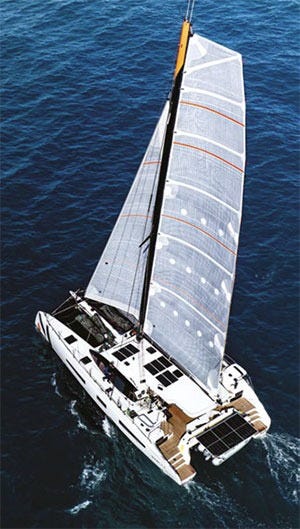
For builders such as Vaan Yachts, which has specified Quantum sails across its range for a number of years, the value lies not only in sail construction but in the ability to support the boatbuilder’s broader design and performance objectives. A builder must deliver not only performance, but also a consistent sailing experience across boats, owners and conditions.
‘On a modern cruising catamaran, the sailplan strongly influences the overall onboard experience: how a boat accelerates, balances, handles and ultimately how intuitive and enjoyable it is to sail,’ explains Igor Kluin, co-founder and CEO of Vaan Yachts . ‘That is why we value working closely with Quantum from an early stage in the design process.’
The same approach can be applied to well-established performance cruising platforms. On owner-led projects, the design objective is not simply to replace sails, but to tune the sail package around the owner’s real use case: fast passagemaking, manageable loads, and confidence across a wide range of conditions.
On a recent project for an Outremer 55, the owner wanted to fine-tune his setup. ‘We worked from the sailplan and analysis on what has been done on similar boats and used iQ to estimate loads and refine all the systems,’ says Quantum sail designer Adrien de Belloy. ‘The boat is fast while easy to handle in all kinds of wind and sea conditions. The owner is particularly impressed with how the sails retain their shape and allow the boat to accelerate.’
Together, these projects show the broader relevance of Quantum’s process. The value of iQ is not limited to one-off custom programmes, nor is it confined to grand-prix raceboats. In the multihull segment, production partnerships, owner-led upgrades and custom expedition projects all contribute different kinds of insight into how modern cruising catamarans are actually sailed. Those data learnings can then feed back into future designs, creating a continuous loop between design, validation, real-world use and refinement.
Continuous evolution
For offshore cruising multihulls, the key objective is not always outright speed. Many owners are equally focused on stable sail shapes, predictable reefing behaviour, manageable loads and long service life over the course of their extended cruising programmes.
As performance cruising multihulls continue evolving, sail design is becoming more integrated with rig engineering, deck layout and offshore systems planning. Sails are no longer being designed independently from the rest of the core platform. Instead, the boat’s entire sailing system is increasingly evaluated as a connected structure.
For large multihulls, that can mean modelling apparent wind ranges, validating reefed sail shapes, analysing square-top mainsail load paths, comparing cloth weights and understanding how changes in sheeting geometry affect both trim and structure. The goal is not to remove the designer from the process but to give the designer a more complete picture of how the sailplan will behave before the boat goes offshore.
For owners preparing for passage-making, the result may be less about extracting another half-knot of speed and more about reducing uncertainty. And for a new generation of performance cruising multihulls, that shift from estimate to validation may prove just as important as outright pace.