


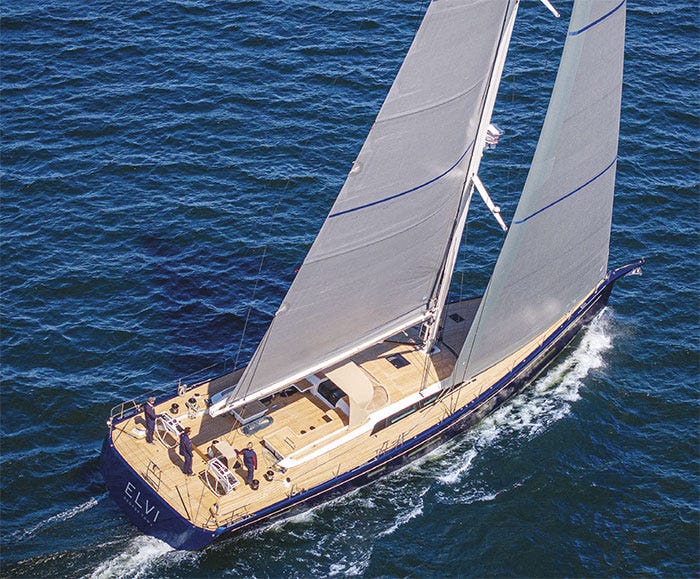

The new Swan 80 is a pivotal yacht in several ways. It’s positioned as both the flagship of the Classic Swan range and the entry-level Maxi Swan model. It’s a brand new hull, developed from the Swan 78, but takes its styling cues and deck design from the recently launched Maxi Swan 108.
In practical terms the new Swan 80 looks, feels and functions like a maxi in all ways but one. The hull length is barely a centimetre below 24 metres, avoiding the constraints of EC superyacht regulations, and thus allowed to anchor close to shore in the Mediterranean.


It’s also a pivotal yacht in the sense that this model completes a remarkably long running and successful evolution of Swan yachts designed by Germán Frers, which has been ongoing since 1981. The Nautor shipyard has a wealth of experience, both historic and recent, of building sailing yachts in this size and style.
Heritage
The early Swans of around 80ft LOA were maxi ocean racers, which differed from most of their rivals by having exceptionally well-designed and built living quarters for both owners and crew. Over the next three decades they gradually evolved into racer-cruisers, then cruiser-racers, while managing to steadily improve their sailing performance even as the levels of onboard comfort, luxury and refinement increased. The new generation of both Classic Swans and Maxi Swans are conceived, designed and built primarily as performance cruisers but the racing aspect of their heritage is still apparent in their hull shapes and sail area : displacement ratios. Big Swans are still keenly raced and competitive in major regattas, square-top sail plans and race-spec sailing hardware are popular options, and the cockpit furniture can be removable to allow a transition between cruising and racing modes.
Design
The conceptual phase of creating the new Swan 80 began in 2023, when Germán Frers was commissioned to design a replacement for the Swan 78. That was a notably successful model with 10 built since 2016, all of which are true sister ships – it says a lot about the quality of the design that none of the owners requested any modifications.
The new 80 has a significantly different hull shape from her forebears, with maximum beam carried further aft and a wider transom. Powerful aft sections provide a lot more form stability when immersed at a moderate heel angle, as well as giving a more spacious interior. A narrow waterplane when the boat is upright ensures low wetted area and thus good boatspeed in the lightest of winds.


That much is in line with current design trends for both racing and performance cruising yachts.
The bow profile, however, is different. ‘We wanted to preserve the boat’s gentle motion at sea,’ Nautor’s Swan 80 project manager Kim Sundkvist explains. ‘To avoid it slamming when sailing upwind like an outright racer, the forward sections are rounder and softer in shape.’
The deck design makes it clear that the new Swan 80 is part of the Maxi Swan range. The shape, styling and ergonomics of the deck and cockpit are by Lucio Micheletti, who designed cars for Zagato before moving into yacht design. The technical and functional aspects of the deck plan are by Germán Frers.
Below decks, the general arrangement is developed from the layout of the Swan 78, which has proven to be excellent in 10 years of use on the water by owners, crews and charter guests. Significant improvements were made possible by, among other things, the extra hull volume in the aft quarters of the new hull. Styling is by Nautor Swan’s go-to interior designer, Misa Poggi.
Construction
Frers delivered the hull lines to Nautor in April 2024. The structural engineering was done in house before the build team started work on the plug, then made the female mould.
The foam-cored composite hull is a glassfibre, epoxy and Corecell laminate reinforced and stiffened with generous, strategic use of unidirectional carbon fibre. This is the largest new-generation Swan with an e-glass hull, its larger sisters having full carbon hulls. The Swan 80’s deck and most of its load-bearing internal structures are full carbon composite, further strengthened with wide bands of unidirectional carbon.


On a boat of this size decisions about the use of carbon fibre or glassfibre are a balancing act, Sundqkist explains, and here Nautor’s great depth of experience comes into play. ‘As with all areas of the boat, attention to detail is something we take a lot of pride in,’ he says, ‘because that’s where quality is perceived in the end. Carbon is of course very light, very stiff but also transmits noise more easily. When we use carbon we also need to add more sound insulation, for example.’
Several keel options are offered. The standard one, with 4m draught, is a lead bulb on a fixed, high-aspect steel fin, bolted to an internal matrix that’s bonded into the hull for strength and stiffness. A 3.5m shoal draught keel is available, or alternatively a telescopic lifting keel can be fitted. This reduces the boat’s draught from 4.3m to 2.5m without any intrusion into the living space of the interior. The lifting keel mechanism retracts into the engine room, beneath the sole of the saloon, and Sundkvist says it doesn’t impose any constraints on an owner’s choice of engine or equipment options.
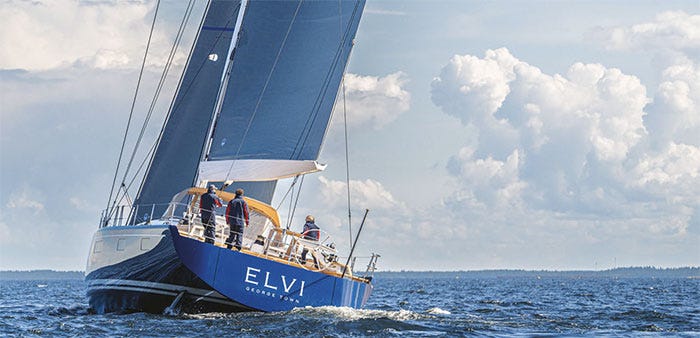
The Swan 80 has twin rudders, like the rest of Nautor’s current fleet. Here, two Swan signature design features hint at the overall quality of design, engineering and build. The rudder blades have sacrificial tips, designed to leave the boat with adequate steerage if they break off in a collision with an underwater obstruction like a shipping container. And their stocks are housed aft of a watertight bulkhead that prevents any ingress of water even in the event of serious damage.
On Deck
Micheletti’s sculpted curves give the Swan 80 a fresh, contemporary look that hints at her performance potential and works well with the subtle sheer that is a distinctive hallmark of hull lines drawn by Germán Frers. The foredeck is flush and the rise of the cabin top is neatly concealed with a teak finish, which matches the decks, on the lower half of the cockpit coamings as well as the coachroof.
The cockpit flares out at the transition from passenger seating to sail-trimming area, where two large Harken winches on each coaming handle the halyards and the sheets of headsails and offwind sails. Another big Harken drum on the centreline takes the mainsheet. The sail handling systems are all hydraulic, not electric, with oil pressure running at 250 bar. The deck layout and sailing systems are designed for routine operation by a professional crew of two, ‘but it’s a size of boat where the owners often like to participate,’ Sundkvist says. ‘So it’s designed for that too.’
Note the flared working cockpit, the outboard helm positions for a clear view forward, and the discreet crew companionway between the wheels
Further aft, it’s a step down to the twin helm pedestals, which are set quite far outboard to give an excellent view of sail trim and an unobstructed view forward outside the passenger cockpit. ‘It’s definitely more comfortable at the helm,’ Sundkvist says. ‘We have managed to get the coamings at a very good seating height.’
Between the twin wheels on the aft deck is an almost invisible crew companionway, and the general impression on deck is made neater and cleaner by mounting some of the fine-tuning sail and rig control systems below deck. The hydraulic backstay tensioners are in the lazarette, for example and the headsail car pullers are driven by cylinders under the side decks. The sprayhood and its frame are also out of sight in an almost invisible coachroof hatch until they’re deployed.
The design of the transom garage and stern platform derives from the Maxi Swan 88. ‘A 3.6m tender fits inside and stows athwartships,’ Sundkvist says. ‘We have an improved system for rotating the tender as you bring it in.’ A key Maxi Swan feature is the option for a double-folding transom that creates a large, sea-level beach club area when the yacht is anchored.
Down below
The electrically operated sliding glass of the yacht’s main companionway is a signature feature of the new generation Maxi Swan range. It’s a grand entrance to the saloon, with the practical benefit of also being a very large skylight. With another skylight hatch in the coachroof and large windows at two levels on both sides, the saloon is impressively bright.
Misa Poggi’s design concepts for the Swan 80’s interior have evolved towards softer, more organic lines, creating living spaces that feel warmer and more fluid while preserving the refined elegance that defines Maxi Swan’s distinctive style
Misa Poggi has developed four interior design concepts and there’s a wide range of layout options. In this latest project, her design language evolves towards softer, more organic lines, creating interiors that feel warmer and more fluid while preserving the refined elegance that defines the Maxi Swan aesthetic.
‘As this is a maxi, we’re very open to owners’ requests for customisation,’ says Sundkvist. ‘One improvement made possible by the new hull shape is the option of fitting one of the aft cabins with a double bed. On our previous yachts of this size, the aft cabins were configured exclusively with twin beds.’
Two standard layout arrangements have already been designed, one with four guest cabins, the other with three. Both of these have the master suite in the bow, and each cabin has its own private en suite heads and shower. In the threecabin version, the starboard-side forward guest cabin becomes a study or lower saloon. The crew area is aft, including the nav station and galley. One of the aft guest cabins is designed as a flex cabin which allows up to five crew to be carried separately from the owner and guests.
One stand-out feature of Nautor’s hotel system design, which isn’t yet widely known, is forced ventilation throughout the interior. ‘It works very well and keeps our boats much fresher inside,’ Sundkvist says. ‘The smaller yachts have forced extraction, the bigger ones and especially maxis also have forced ventilation with fans strategically located and fresh air coming in through concealed grilles and vents.’
The first Swan 80 is due for delivery around the time this issue of Seahorse hits the newsstands. She will make her boat show début at the Cannes Yachting Festival before joining the rest of the Swan fleet on the Costa Smeralda for Nautor shipyard’s 60th Anniversary celebrations at the Rolex Swan Cup, from 13 to 19 September.