


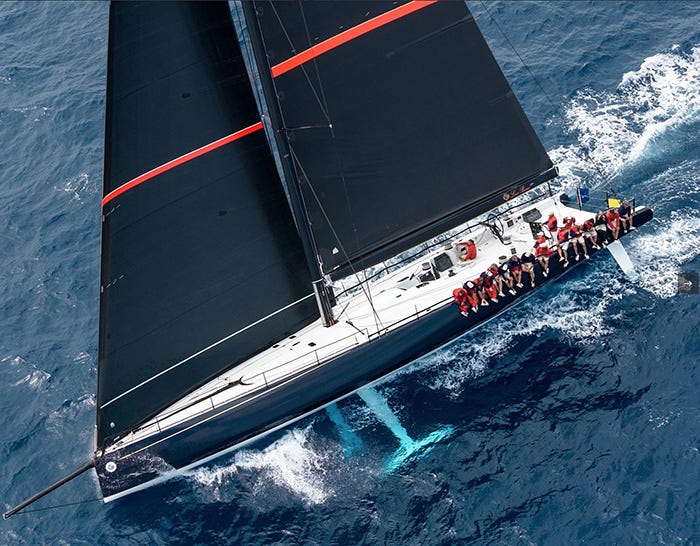

It has been a great year so far for maxi racing, first in the Caribbean and now in Europe. That said, because of the unexpected turbulence in global shipping, our first events were less well supported than usual – the PalmaVela particularly suffering despite the imaginative addition of La Larga, a distance race around the Balearic islands. One day perhaps this could be tried as an alternative to our present IMA Maxi European Championship in Sorrento?
There were some changes to the format of the 2026 edition of our Maxi Europeans, organised jointly with the Circolo del Remo e della Vela Italia in the Bay of Naples and kicking off with the Regata dei Tre Golfi offshore race – the start always being memorable with the fleet departing from Naples with Mount Vesuvius as backdrop.
As so often with Mediterranean distance races it was a tactical battle to avoid as many shutdowns as possible – some teams suffering six or seven park-ups this year. It was a constant game of lead changes between the 100-footers Galateia, V and Leopard 3. The first two, both modified Wallycentos, have been arch-rivals for the last few seasons. V was only beaten on the water right at the finish and that left Galateia winning both line honours and on IRC corrected time. In the Maxi Grand Prix class similar battles were being fought. In the end Jethou got in first but Peter Dubens’ North Star achieved an impressive third win in a row on corrected time.
For the subsequent four days of inshore and coastal racing the wind remained very light and at times fickle but PRO Stuart Childerley held his nerve and the series was completed, with all planned races sailed including the traditional circuit of Capri.
The main change for this edition was to try to achieve fairer results by not mixing up the classes with their impossibly wide-ranging ratings – from the highest, the new Magic Carpet at 1.870, down to the lowest, the 50-year-old Swan 65 ketch Shirlaf at 1.102. Replacing the previous mass start this year the fleet was split into two, Maxi 1 and Grand Prix in one start and Maxi 3 and 4/5 in the other. We also scored the four classes separately, thereby creating not one but four new Maxi European Champions.
On the penultimate day V and Galateia continued their sparring but the smaller Capricorno was only one point behind. In Maxi Grand Prix Jethou was having a much better week although Jolt, North Star and Django7X were closing in behind. Class 3 was dominated by the canting-keel Mylius 60 Cippa Lippa X, chased home some way back by the new Manticore (a previous Jethou). These two raceboats were usually far ahead of their more ‘cruisey’ competitors.
It was down to the final race for the Maxi 1 and Grand Prix classes and the weather kept its best to the last. The forecast had suggested it would be too light to race but in the end reality served up the best wind of the series, touching 19kt at times. Leopard 3 relished these conditions and won; this result propelling her up to second overall sandwiched between V and Galateia. In Maxi Grand Prix Jolt also had a great final day allowing her to win overall by just one point from North Star, in turn one point ahead of Django 7X. There were no new surprises in Classes 3 and 4/5, won respectively as expected by Cippa Lippa X and Fra’ Diavolo. Unfortunately, the Tre Golfi Multihull Trophy only attracted three entries – won again by Irvine Laidlaw’s Gunboat 80 Highland Fling 18.
Barely two weeks separated this event from the Yacht Club Italiano’s Loro Piana Giraglia; what started in 1953 as an offshore race to help thaw post-WW2 relations between France and Italy is today preceded by a four-day inshore/coastal series held out of St Tropez. Sadly, entries were significantly reduced by an unfortunate clash with both the Rolex TP52 World Championship and the Sardinia Cup which ruled out a high proportion of professional crew.
As is often the case in Saint Tropez, winds were very light all week, one day lost to lack of wind and the final day reduced to a very short coastal race.
Class A’s inshore series was won by V – their fourth regatta win in a row. Second was Jethou and third Galateia although third to fifth were all on equal points decided on countback, with My Song and Proteus losing out. In Class B one unusual entry was Baruna, built in 1938 but recently immaculately restored. It was a test of the IRC rating system but she was able to compete and ended up sixth out of 11 in her class. The veteran Atalanta II also had an outstanding regatta winning all her inshore races, knocking recently crowned European Champion Cippa Lippa off the top spot.
At least all IMA maxi regattas are scored using the simple and efficient IRC system, with fixed TCCs, and so not dependent on the vagaries of the weather. However, the ORC classes in the Giraglia were relying on ‘predicted expected finishing times’ for each boat according to the weather forecast at the beginning of the race.
And the outcome was entirely predictable, the weather models proving wildly inaccurate with more wind than expected for the larger boats which arrived in many cases substantially ahead of their routeing while the opposite occurred for the smaller boats. Weather forecasting may be better than it used to be but to calculate – let alone try to predict – results in this way defies understanding.
Maxi racing is looking a lot healthier than some other areas of the sport. For owners there was further encouragement when the IMA Technical Office recently circulated a document confirming that no major changes are envisaged in the rating system, clearing the way to build new boats. IMA’s clear conclusions are:
1. IMA is not considering any changes to the rating systems.
2. IMA is not seeing instability in the rating systems.
3. IMA is not planning to change any of the class splits.
4. IMA is seeing one of the most stable periods in the past 35 years in maxi racing, with the fleet growing at unprecedented rates and events expanding. The IMA will continue to act to maintain this encouraging environment.
Finally, after 13 years in the role I am passing on the baton of running the International Maxi Association to my successor, also well known in the Maxi world, Giorgio Benussi. I wish him every success in continuing the development of international maxi racing with the excellent supporting team and relationships that we now have in place.