


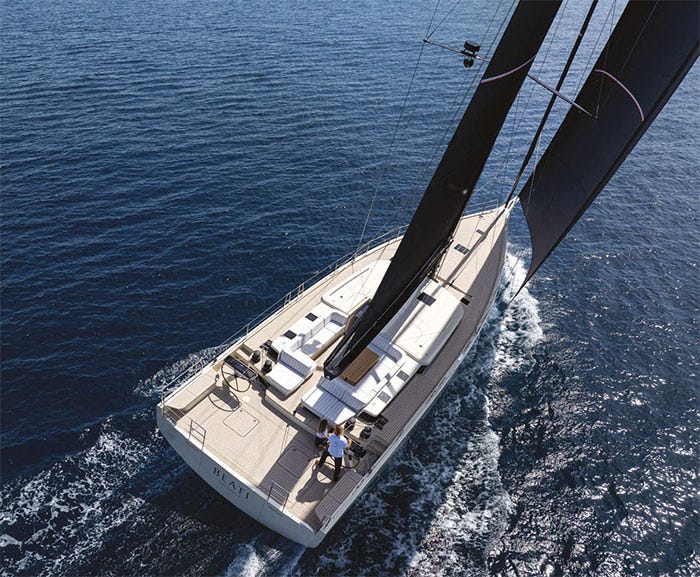

Her predecessor established YYachts as an international avant-garde boatbuilding brand. The new Y7, designed by judel/vrolijk, takes the game a notch higher.
She proved her worth twice early on. And on both of these occasions, in a strong breeze and also in very light wind, her sailing performance exceeded all expectations.
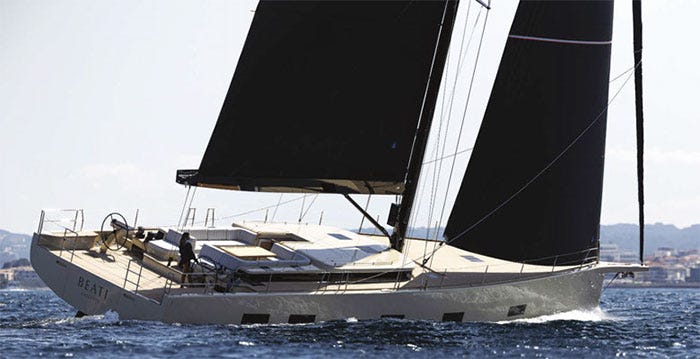
In April, when under way from the Baltic Sea to the Mediterranean, where she would make her debut at the Palma Boat Show, the English Channel set the stage. This being a delivery trip, the new Y7 sailed conservatively canvassed for the solid force six from astern, under selftacking jib and reefed mainsail only. But it didn’t seem to tame her much.
For almost four hours non-stop she sat on a continuous plane, averaging more than 16kts of boat speed, topping out at 20.7kts through the water even without any help from the rather unruly sea state.
‘She sailed like dream, like on rails’, recalls Klaus Kurzweg. The skipper who has logged nearly 50,000 nautical miles on previous Y7 models met the new design “with a bit of scepticism”, as he admits. ‘I was really in love with the old boat’, he says, not sure the wider, bigger sister would match his expectations. ‘But she really does have significantly more power.’
Ten days earlier, during the very first sea trial in her home waters near the city of Greifswald, an ice-cold high-pressure system across the Pomeranian coast threw a pointedly different challenge at her. Together with YYachts founder Michael Schmidt, a highly experienced team of engineers from judel/vrolijk & co who were working with the yard for the first time, stepped aboard to get a feel for the Y7’s sailing performance.
As the 22m yacht slid away from the jetty under engine there was hardly any breath of wind. Further out at sea, the anemometer at the top of the 34.6-metre tall mast began to turn sluggishly, recording four to five knots, with puffs reaching seven to eight knots true. However, the light breeze did not reach the water’s surface.
Any conventional cruising boat would have become a drifting buoy in these conditions, even for the Y7 it appeared challenging. This 72ft luxury performance cruising yacht is full carbon sandwich construction and lighter than most of her competitors. The backstay-free rig, braced by extremely wide, aft-swept spreaders, allows for a square-top mainsail the size of a volleyball court. During the test, with the code zero unfurled, the boat projected a total of 500 square metres of jet-black Technora membrane. Yet it was also pulling the equivalent of a loft-style flat through the water, complete with four bedrooms, just as many bathrooms, a kitchen, living-dining room, boat office and separate crew quarters.
So, expectations were, shall we say, cautiously subdued. But no sooner had the sails been trimmed in than the log figures on the mast display started ticking merrily upwards. Before you knew it they roughly matched those of the wind sensor: 5.0 kts… 5.8 … 6.4… 7.0… 6.7. It felt like a quiet miracle in this wintery cool, almost motionless weather.
Matthias Bröker, who played a key role in designing the new Y7, was still marvelling at that moment weeks later: ‘The way she created her own wind on the oily-calm patch of water was truly surreal.’
Of course, the yacht was designed for this: challenging wind speed in the light stuff and outpacing most of her competitors. But experiencing first-hand the combination of tenderness and power on such a colossal scale is something else still.
Easily accessible performance has always been one of, if not the very essence of the brand. The boats are also distinguished by their own signature aesthetic. Clean hull lines and the flat superstructure with recessed, vertical coachroof windows define YYachts’ appearance. Michael Schmidt calls it “timeless elegance”, and rightly so. Even at 10 years old, the marque’s first designs still look fresh and distinctive today. Schmidt, a restless entrepreneur who has never been shy to challenge conventional wisdom, built the very first boat in 2015 for himself: Y8 Cool Breeze. It was to be his retirement project after 20 busy years as founder of Hanse Yachts, during which he had developed the yard into the world’s third-largest production builder and successfully floated it on the stock exchange.
Why did he not just buy from another yard, and happily cruise the Med, the Caribbean, the world? ‘The yachts available at the time just didn’t spark my interest’, he says. ‘Too heavy, too cluttered, too complicated’. He wanted a yacht he could handle on his own, one that is easy for a small crew to operate – ‘as easy as it goes for an 80-footer, a boat you can feel’.
It apparently wasn’t just Schmidt who liked the idea of sophisticated simplicity. A year after Cool Breeze was launched, he sensed demand – and an opportunity to postpone early retirement. He founded the company in 2016 as Michael Schmidt Yachtbau and then later rebranded it more internationally as YYachts. Today it is arguably one of the hottest brands in big-boat sailing.
Y7 technical specifications
Naval architect: judel/vrolijk & co
Interior design & styling: YYachts Design Team & David Thulstrup
CE classification: Category A
Yard: YYachts GmbH
Hull length on deck (LOD): 21.99 m
Length overall (LOA): 23.80 m
Length waterline (LWL): 20.55 m
Beam: 6.10 m
Draught standard/shallow keel: 3.50 m / 2.85 m
Displacement31.8tBallast / Ballast ratio: 10.7t / 34%
Ballast telescopic keel approximate: 10.4t
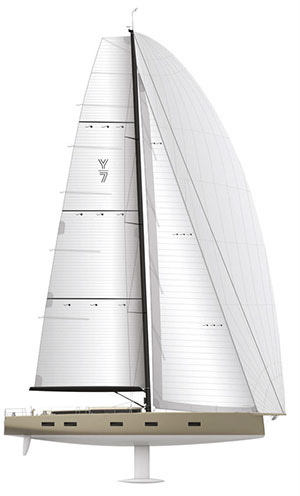
Mainsail: 180m²
Self-tacking jib (Std.): 126m²
Jib 105%: 147m²
Code 0: 320m²
Gennaker: 500m²
SA/D upwind with jib / genoa: 31 / 33
Displacement/LWL: 102
Engine (Yanmar 4LV SD15 saildrive): 150 hp, 110 kw
Fuel tank approximate: 850 litres
Fresh water approximate: 850 litres
Black Water approximate: 240 litres
The original Y7 was launched in 2018, a design by the American naval architect Bill Tripp. It became the shipyard’s bestseller: both a style icon and a highly successful business model. No other boat of this size and configuration has sold a total of two dozen units in just eight years. So it is no coincidence that the yard kicked off its 10-year anniversary with a new, refined version.
Judel/vrolijk designer Jan Kuhnert compares designing the successor to the task of “developing the next generation of a Porsche 911”. It’s a balancing act between sensitively preserving the heritage on the one hand and resolutely modernising the product experience on the other.
The design and engineering team, who also undertook the structural analysis, have mastered this thoroughly challenging task remarkably well. From every angle the new Y7 appears more taut, more defined, more elongated, more exciting while still maintaining the family DNA.
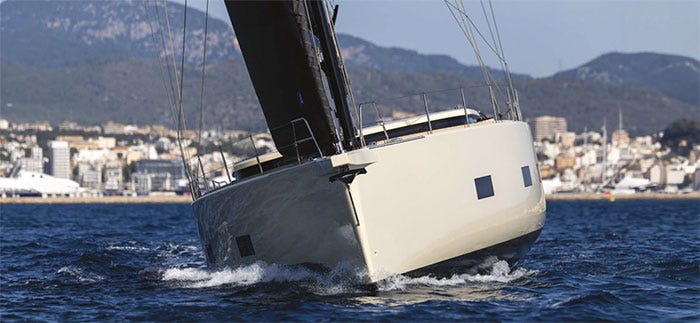
The reverse sheer line suggests agility. The forward section of the hull and deck look nicely tensioned, poised to spring forward. It also brings down the tack on the bowsprit for more sail area in the asymmetric spinnaker and the code zero. The transom is wider but significantly slimmer, giving the boat a distinctive lightness from the stern.
Not visible but certainly noticeable is the significantly higher stability. Matthias Bröker puts the increase at 30 per cent. This is due to nuances in hull design generating more form stability and a lower centre of gravity. These measures allow for more upright, efficient sailing in moderate wind conditions. The ratio of righting moment to heeling moment is improved by no less than 25 per cent.
The judel/vrolijk & co team optimised a total of 11 parameters relevant to sailing performance over dozens of iterations before finalising the Y7’s design in collaboration with the shipyard’s development team. ‘As naval architects we were tasked with creating much more space below deck without compromising sailing performance and ideally improving it,’ says Bröker.
The sail area to displacement ratio sits at 31 with the self-tacking jib, reaching 33 with the optional 105 per cent genoa. Displacement to length is 102. By common standards these indicators put the new Y7 firmly into the category of racing yachts. She can provide for pleasant daysailing in the notoriously light-wind Mediterranean as well as crossing oceans at pace.
On hull number one, only the rather stiff steering dampened the fun somewhat. The twin-rudder set-up had noticeable initial resistance even when operating without load. While it improved during delivery, the shipyard has now modified the push-rod steering system to deliver that light yet precise feedback which is part and parcel for a luxury performance cruiser.
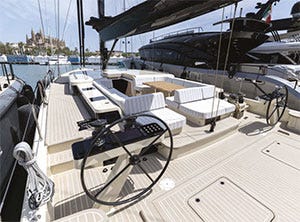
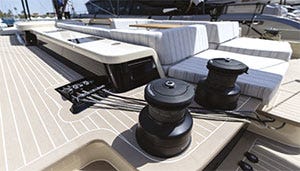
Pedestals, electric winches, halyard clutches and line storage are situated aft of the guest cockpit, ensuring that the deck area remains clearly segmented. A companionway offset to port leaves the seating area around the large cockpit table as a relaxation zone, free of any traffic by other crew passing.
Access to the winches is excellent. They are mounted on pedestals further inboard than on most yachts, so to actively sail and trim the genoa sheet no one needs to brace all the way out and down on the side deck to leeward, allowing for more sheltered sheeting and easing. Features like this show the depth of experience and refinement in the design team as well as within the yard.
The Y7 has also gained enormously in terms of space below deck, far more than the 30-centimetre increase in beam would suggest. In fact, the increase is closer to 20 per cent in volume, due not only to the more powerful hull shape and wider forward sections but also to a more efficient layout.
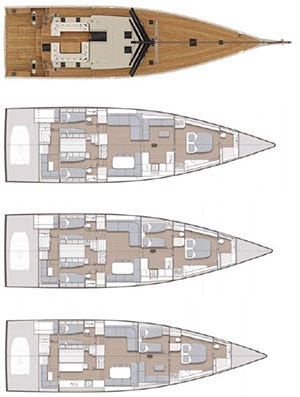
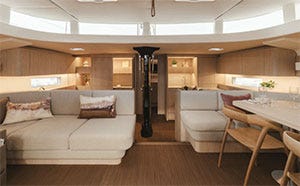
This is particularly evident in the saloon, where in the yacht’s standard configuration the U-shaped galley adjoins the main bulkhead on starboard side. On the port side there is a lounge that can also be converted into an office or partitioned off to create a guest cabin. Those who do not choose the latter option retain the open character of the saloon, which then appears as spacious as on a typical 80ft yacht.
Equally impressive is the owner’s cabin, located forward in all layout variants. It features a slightly off-centre double berth, accessible from three sides, and has an en suite bathroom. A walk-in wardrobe is available on request. The optional VIP guest cabin aft on the starboard side is also a new and highly attractive feature. However, it does restrict the crew quarters aft a bit, as the crew lose their own mess.
Owners can choose from three basic layouts, which allow for a further five variations. All of this is available in four different styles – from dark and dignified (Baltic) to fresh and light (Glacier, as on hull number one). So the Y7 offers nearly three dozen different combinations without moving bulkheads or racking up extra cost and complexity for custom solutions – which the yard is, of course, still able to provide.
No matter what you choose, crew on the new Y7 can access the deck from their cabin via their own companionway, located in front of the mainsheet block. It is so seamlessly integrated into the aft end of the cockpit that it remains almost invisible.
The carefully insulated engine compartment is also accessible via this route. There is a second access from the forward end, via the central service tunnel, which houses the washing machine (on rails!) and much of the electrical system.
Whilst the first boat in the series is already sailing under her owner’s flag following the Palma boat show, the second is due to be launched in Greifswald shortly. Orders for three further yachts have already been placed. Ready to sail, they generally cost between €3.2 million and €3.6 million ex tax.
It looks as if the Y7 is continuing her successful course in swift style. So YYachts have given themselves a fitting gift for their 10th anniversary. And there is yet another one in the making. The new Y6, which at 65ft will become the brand’s smallest model yet, is set to be presented this fall.