


Anniversaries are best when there’s a success story to celebrate, as is the case for components specialist Rondal. Five decades on, the company remains firmly established in its niche, and continues to redefine what is possible. Here, we look back at Rondal’s history and key milestones, and consider what lies ahead for a business that refuses to rest on its laurels.
Backstory
Rondal’s story began in 1976 when Wolter Huisman, the late owner of what is now known as Royal Huisman, spun his shipyard’s mast-making department into an independent business. He called it Marquip.
Wolter founded Marquip with a dual focus: mast building and the supply of licensed components. His aim was control, over both product quality and delivery.
It did not take long for the company to become more than a production and distribution unit. It evolved into a launchpad for new ideas, setting it on the path to becoming an industry leader in masts, booms, hatches, and hardware.
A legacy of invention
The first hydraulic mast jack system, fitted on Flyer II in 1981, was one of the earliest outcomes of this inventive drive. Developed to the specifications of Germán Frers, the yacht’s designer, it made rigging work faster, safer, and easier. It still does today.
The mast jack was only the beginning. By the early 1980s, growing demand for larger, more luxurious yachts, combined with the push to sail them with fewer crew, triggered a wave of product innovation. Furling masts, developed for large yachts for the first time, and hydraulic furling systems that allowed sails to furl and unfurl at the push of a button were among the advances to emerge during this period.
Can we do better?
By 1983, Marquip had outgrown its original premises and moved into a larger facility. The new space allowed the team to build bigger masts and equip a machine room with a full range of tools, from lathes to milling machines.
Wolter, known for his sharp technical eye, made daily rounds through the machine shop. He followed every process closely, stopping to ask how a weld was executed or why a particular technique had been chosen.
Outsourcing would have reduced costs but Wolter was unwilling to compromise. He kept production in house, measuring every decision against the same question: ‘Can we do better?’
Reviving a legend
By 1989, the company had evolved beyond its original identity and was rebranded as Rondal. The name is a nod to both the yard’s birthplace (Ronduite) and Marquip’s pioneering use of aluminum.
It reflected reality. The focus shifted firmly to the Rondal range, which by then encompassed hatches, hardware, booms, winches and masts.
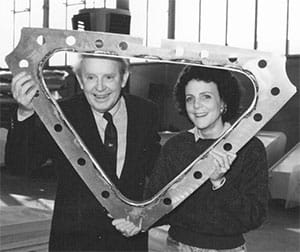
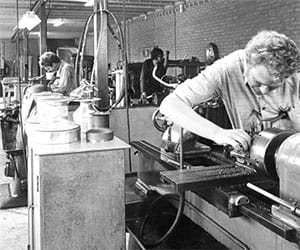
1. Wolter Huisman and Elisabeth Meyer, owner of Endeavour, with a component that shows the shape of the yacht’s boom as launched in 1989. 2. Rondal’s workshop was state of the art in the 1980s and has been upgraded ever since.
That same year Rondal built a 53m mast for Endeavour, the J Class and historic America’s Cup challenger, its tallest to date. No standard commercial profile could accommodate the section and producing a custom extrusion for a single mast was not viable.
Instead, Wolter Huisman opted to construct the mast from curved aluminum plates. The approach offered clear advantages: varying plate thicknesses allowed for a smooth, accurate taper, reduced overall weight and lowered the mast’s center of gravity.
Dozens of masts followed using the same technique, including those for Cyclos III and Juliet.
The new mast not only brought Endeavour back to life and back to legend status, it also marked a decisive step toward taller, fully custom-made rigs.
Visionary thinkers
Much of Rondal’s progress can be traced to Wolter’s inventive drive but clients also played an important role. The owner of Juliet, for example, was an early adopter of new technology. His vision inspired the development of a single-drum, single-layer reel winch design. The system ran smoothly, proved reliable, and required virtually no maintenance. A recent servicing of Juliet’s winches confirms that record. After more than 30 years in service, they required little beyond minor cosmetic work.
Then there was Jim Clark, the Silicon Valley entrepreneur behind Hyperion. His brief was bold, forward-thinking, and unmistakably high-tech. For the mast, only carbon fibre would do. With Clark unwavering and Rondal’s competitors ready to seize the chance, Wolter agreed to build the mast in carbon. True to form, he was determined to do it better than anyone else despite having no prior composite experience and no facility large enough for the task.
Enter carbon
To tackle the challenge, the company built a composite oven capable of reaching 100°C and accommodating Panamax-length masts. They also invested in new technology, bringing in specialists from the upper tier of the composites world, a clear message to the industry that Rondal was entering the carbon era.
The team developed a two-component prepreg material in collaboration with resin engineers from SP Systems (now Gurit) and refined an out-of-autoclave curing method that later became standard practice in superyacht construction. Hyperion’s mast was a game-changer. At 60 metres, it was the tallest ever built at the time and followed the same principles behind the seamless, single-piece structures Rondal continues to build today.
Tumbling records
In 2010, the team temporarily extended the oven to build the 61m mast for Athos, a solution that soon became standard. The hall was extended again for the build of the 70m-plus masts for Sybaris, Pink Gin VI and Ngoni.
Targeted investments helped Rondal stay ahead in the construction of one-off masts. These included an ultrasonic non-destructive testing (NDT) machine, seven-metre and nine-metre autoclaves, and a fibre cutting machine.
The investments, combined with the team’s expertise, resulted in a portfolio that now extends well beyond masts. It includes the world’s largest carbon rudder for Sea Eagle II, the complex keel trunk for Nilaya and the curved superstructure for Sarissa.
Weight savings that matter
By the early 2000s, competitiveness had become an increasingly important consideration for superyacht owners. Rondal, originally founded to supply components for racing yachts, was already well positioned through its long-standing focus on high-performance components.
The performance furling boom installed on Saudade in 1994 is one example. Its clew slider connects the clew to the outhaul system, optimising mainsail foot tension at full hoist and in all reef positions. Another was the furling boom fitted on Visione, offering a lighter yet stronger and stiffer construction. The mast for Ngoni, developed to carry a square-top mainsail, pushed this thinking even further.
The weight savings on Nilaya, delivered in 2023, went further still. A double-tapered mast top alone saved 50kg compared with a standard taper. The running backstay system enabled the use of lighter ropes and components, while lightweight winches contributed additional savings. In total, Nilaya’s configuration delivered a 1,200kg weight reduction compared with more conventional arrangements.
What’s cooking?
In 2023, Rondal rebuilt its curing oven. Spanning 1,000 m², it became the world’s largest single-piece carbon mast manufacturing facility, a timely upgrade for ever-larger projects including the mast currently under construction for Royal Huisman’s 85m Project 410. Details of this project remain under wraps but one thing is clear. To manage the loads involved, the team had to develop the largest sailing system in Rondal’s history.
Work continues on captive winches as well. The latest systems offer a simpler integration and strike a refined balance between lightweight performance and durability. The team can also build a relatively lightweight captive winch that is able to pull 40 tons.
Rondal recently installed a new test bench capable of simulating loads of up to 150 tons, reinforcing the company’s commitment to unconstrained thinking.
Fresh from the drawing board
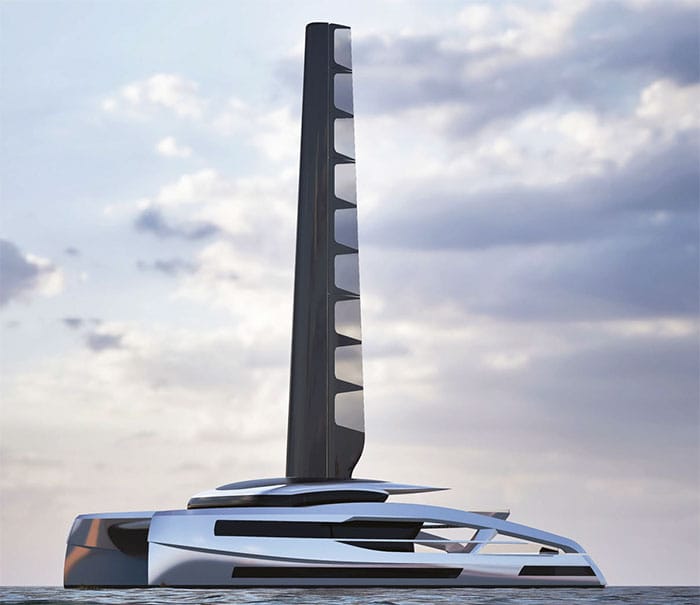
The Aero Wing Sail and Hydro Generator are Rondal’s responses to increased demand for energy regeneration and alternative means of propulsion.
The Aero Wing Sail, a freestanding solid carbon wing, drew significant attention at the 2025 Monaco Yacht Show where it appeared on multihull concept designs by Royal Huisman and Dixon Yacht Design.
The Hydro Generator is an electric pod using turbine blades to supply a yacht’s full hotel load while under sail. Four units have already been sold, with strong interest emerging from the 50-60ft segment.
Expanding horizons
Rondal expects its niche expertise to find increasing application beyond yachting, including in the shipping, offshore, and automotive sectors.
The mooring winch, derived from the captive winches developed for Juliet, is one such crossover product, now meeting demand in the motor yacht market. The same applies to the exterior sliding door system, originally developed for Athena in 2004 and now updated to meet motor yacht market requirements, including track-free configurations.
Interest from outside the marine sector is also growing. Recent projects include a crank assembly capable of accelerating at 100 G, for a hi-tech company, and the design and construction of carbon composite components for a Formula One race simulator.
Eyes on the future
Looking back on those formative years and the path since, one thing stands out. Rondal has never shied away from challenges, regardless of scale. For the company’s managing director, Harald Lubbinge, the way forward is clear. ‘We need to stay innovative and keep driving new developments, collaborating with knowledge institutes, clients and suppliers,’ he says.
Innovation at Rondal also means ensuring that new and improved components continue to uphold the company’s signature pledge of ultimate reliability, a principle that has in place since the very beginning. ‘Our products are fitted on yachts that face everything from shifting plans to unpredictable seas,’ Lubbinge says. ‘They must be built to endure and deliver uncompromising performance, end of story.’


