
Very few offshore sailing yachts from the 1970s and 80s are still in production today. The Contessa 32, Rustler 36 and Breehorn 37 are a handful that spring to mind.
What all three of these have in common is that they’re exceptional boats of their type, brilliant designs with remarkable sailing qualities, whose legends have grown so large that they remain commercially viable – there’s still enough demand for a new hull to be built at least once in a while.
Even rarer is a classic glassfibre yacht so highly esteemed that it’s brought back into production after decades of obsolescence. For there to be any chance of that happening, it must be a very special yacht indeed – like the Omega 42.
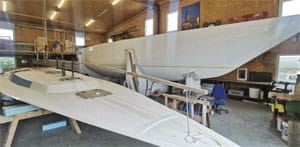
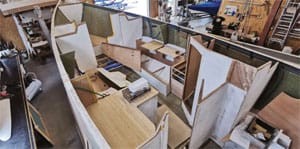
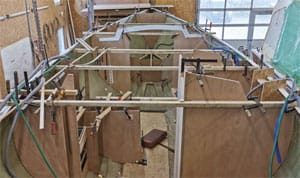
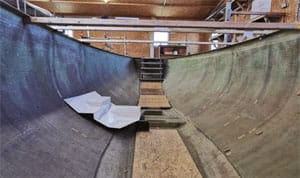
After the initial moulding of hull and deck, the boats are put together and finished at Müritz Bootsservice in Germany.
Peter Norlin’s masterpiece is an extreme, uncompromising boat and there’s nothing else quite like it on the market today. Nor was there anything quite like it back in the days of its initial production run from 1978 to 1998, when 160 of them were built.
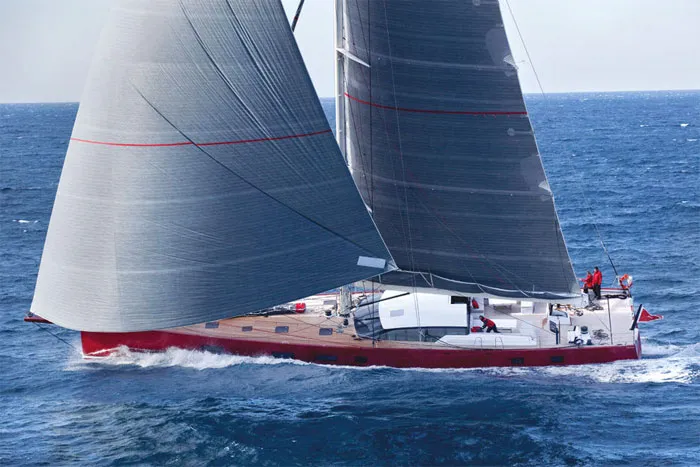
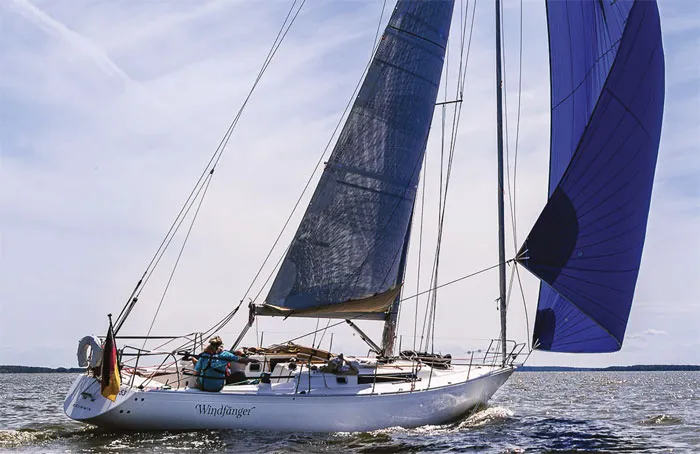
Almost 13m long but barely more than 3m wide with long overhangs, low freeboard, and only full standing headroom in about half of the saloon, a towering rig and a touch less than 1.7m draught, it’s the absolute antithesis of a modern performance cruiser. And yet the Omega 42 is faster than many of those boats on most points of sail. When going to windward it’s quicker and points higher than almost any of them.
Making nine knots of boatspeed at less than 40° TWA in 11 knots of breeze is business as usual for an Omega 42. You can expect the same performance when slicing through choppy seas in a headwind of 20kts-plus with two reefs in the mainsail and, compared with most boats, it’s a remarkably comfortable ride: No slamming, no pumping of the mast, just a smooth motion even when slicing through steep, unpleasant Baltic Sea waves.
With a displacement of just seven tonnes, on a reach with a modern kite up you have a real chance to keep pace with modern yachts. Beamy cruisers which aren’t light enough to properly get up on the plane will become easy prey.
The fine sailing qualities that have made this boat a legend in its home waters of the Swedish Archipelago include a light, responsive and very engaging feel on the helm – having a tiller instead of a wheel does help with that – and remarkable directional stability. The hull shape is so well balanced that even a strong gust of wind won’t cause an increase in weather helm unless the sails are badly trimmed, let alone any tendency to round up into the wind.
This is also an excellent sea-boat, exceptionally stiff with a ballast ratio of more than 50 per cent but with a soft, easy motion in a seaway on account of its shallow draught – which is also a great asset for cruising. Some have sailed as far as Australia and at least one has competed in the Sydney Hobart Race. With very little form stability it does have some tendency to roll when running downwind but is not prone to broaching like an IOR racer of the same era and is much easier to steer.
With the masthead almost 15 metres above the deck and at least 73m² of upwind sail area, this is a powerful beast of a boat. Unsuitable perhaps for a novice skipper and crew but quite easy to handle for a competent couple, or even an experienced solo sailor. The cockpit layout is designed with shorthanded sailing in mind and the original sailplan has the convenience of a self-tacking jib, though it’s only a few square metres smaller than the genoa.
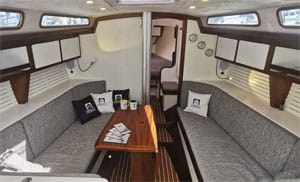
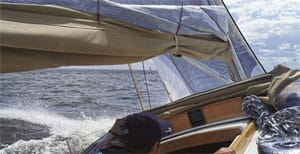
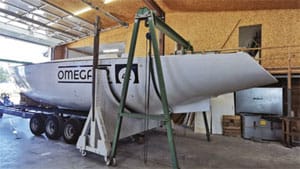
1. The interior can be customised but the first new boat is close to the original layout. 2. Performance to windward is very impressive, remarkable for a shoal draught boat. 3. The new Omega 42 hulls are laminated in Sweden using the original mould.
The design heritage of this unusual boat is a point of interest. Its designer, Peter Norlin, is most widely known for his 30ft Scampi, probably the most successful IOR half-tonner of the early 1970s; for his Albins which were produced in huge numbers; and for designing the entire fleet of Sweden Yachts from 1980 onwards.
The Omega 42 is a watershed in his career, designed after most of his IOR raceboats but before his main focus shifted to cruisers and cruiser-racers. Unlike all the others it’s just a pure high-performance offshore sailing machine, designed with no regard whatsoever for either rating or interior volume. It was his personal favourite of all his designs and he owned one himself for many years.
Norlin’s inspiration for the hull shape was largely drawn from Firebrand, an Admiral’s Cup winner designed by Sparkman & Stephens in 1964, whose lines and length-to-beam ratio he reportedly used as a starting point. Firebrand of course was famously owned and loved for many years by another eminent naval architect, Ed Dubois.
The last Omega 42 was delivered in 1998 and that should have been the end of the story but a happy coincidence two decades later set in motion its revival.
A group of German sailors and boatbuilders were discussing their favourite yachts. One of them, Heiner Francke, the owner of a boatyard on Lake Müritz, described the Omega 42 and how he’d love to build a new one: classic lines but modern day materials and technology.
As the story goes, a weekend later an Omega 42 sailed into the same harbour, witnessed and admired by the same group of friends. That set the project in motion: one of the group, Berlin-based businessman Stefan Gossing was smitten with the boat and said if Francke could build it he’d buy one.
A scheme was hatched but it wasn’t easy. Despite a lot of research the plans for the Omega 42 could not be found. Peter Norlin had passed away a few years earlier and they couldn’t get in touch with his family. Eventually, though, they located the original moulds at a boatyard on Lake Vänern in Sweden – Lidköpings Båtsnickeri, the builder of Swedestar Yachts.
A deal was made and the moulds were bought, but rather than transporting them to Germany and building a lamination hall, they would remain in Sweden. The Swedestar builders clearly had the skills to produce a first-class composite hull on site; two were ordered, made and delivered by road to Francke’s yard, Müritz Bootsservice, for the interior build, fit-out and commissioning.
Omega 42 Key Specifications
• Length: 12.84m
• LWL: 10.00m
• Beam: 3.10m
• Waterline beam: 2.70m
• Draught: 1.70m
• Upwind sail area: 73m² or 78.5m² (mainsail 39m², self-tacking jib 34m², genoa 44.5m²)
• Spinnaker: 115m²
• Displacement: 7,000kg
• Ballast: 3,750 kg
• Ballast ratio: 54%
• SA/D ratio: 19.5
• D/L ratio: 206
Price: sail-ready without sails starting at €430,000 (£375,000)
The new version of the Omega 42 is in most respects very close to the original. Not just the dimensions of the hull and deck – the long-chord fin keel, semi-balanced spade rudder and sailplan are identical. The hull is foamcored composite, rather than balsa-cored or solid glassfibre. The keel is solid lead and performs a structural function as well as providing ballast. To preserve the exceptional feel and response of the helm, it’s steered with a tiller.
The interior structure and standard layout are based on painstakingly thorough measurements taken from one of the last original boats, which has a heads compartment abaft the companionway instead of an unenclosed heads in the forecabin like the older model variant. Very unusually, nearly all the interior joinery is built not in plywood, but in solid mahogany timber.
The interior is fully custom built for each individual owner, with a free choice of materials. Other than moving structural bulkheads, almost anything is possible. The first two owners have both stayed close to the original arrangement, though one has cabin doors and the other has chosen an open plan layout from quarter berth to forepeak. Like most of the original boats, both new Omegas built thus far have an ethanol spirit cooker, hob and heater, but owners are free to choose according to their preferences.
A modern 30hp Volvo saildrive is fitted in place of the original 20hp shaft drive engine. It’s quieter and transfers less vibration to the hull, drives the boat more effectively and the extra low-end torque makes it much easier to manoeuvre. Francke’s motto is: stay true to the original where possible, switch to the year 2025 where it makes sense – electronics, autopilot and laminate sails. Exceptional build quality and standard of finish is a matter of course.
The rig was the Achilles’ heel of the original boats. With an extremely narrow shroud base and just one set of spreaders, it was fragile and prone to buckling under load in rough weather. A new rig was engineered from scratch by Seldén, with two sets of spreaders and running backstays to provide extra support when pushing the boat hard in racing. The deck plan stays true to Norlin’s design, though without a small mainsheet traveller bisecting the cockpit, and with an electric halyard winch to ease the burden of hoisting the huge mainsail.
A fixed bowsprit would ruin the boat’s appearance but a removable one can be fitted to fly code sails and gennakers.
The first new Omega 42, Windfaenger, has become a familiar sight on the Baltic regatta circuit in recent years with Stefan Gossing at the helm. She is also well used as a family cruiser.
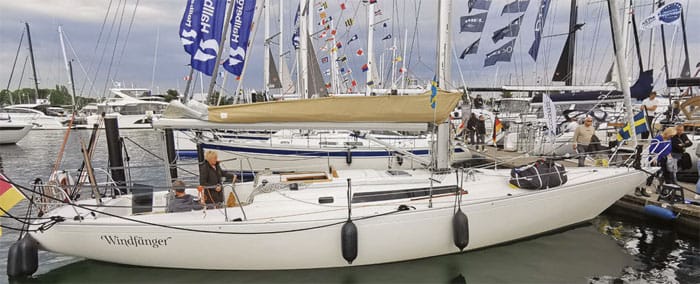
The second boat, Alpha, is currently under construction. Sailing journalist and former boat dealer Lars Reisberg signed the contract in late 2023 after a couple of test sails with Gossing, switching from his previous plan to buy a brand new Beneteau First 36.
Alpha’s hull and deck will be bonded together as this issue of Seahorse goes to press. Her maiden voyage is planned be the Midsummer Sail, the longest non-stop race on the Baltic Sea from its southernmost point at Wismar in Germany to Sweden’s northernmost buoy, Thöre. It’s a worthy shakedown passage for a boat like this.
‘Every time we pop up at a regatta the Omega 42 is an instant head-turner,’ Reisberg says. ‘This extravagant, exciting, aggressive, fast, and no-compromise character will surely find a few more owners. I bet hull number three will also be something special. Anyone seeking the uniquely thrilling and engaging sailing experience that only an Omega 42 can deliver is welcome at the shipyard.’