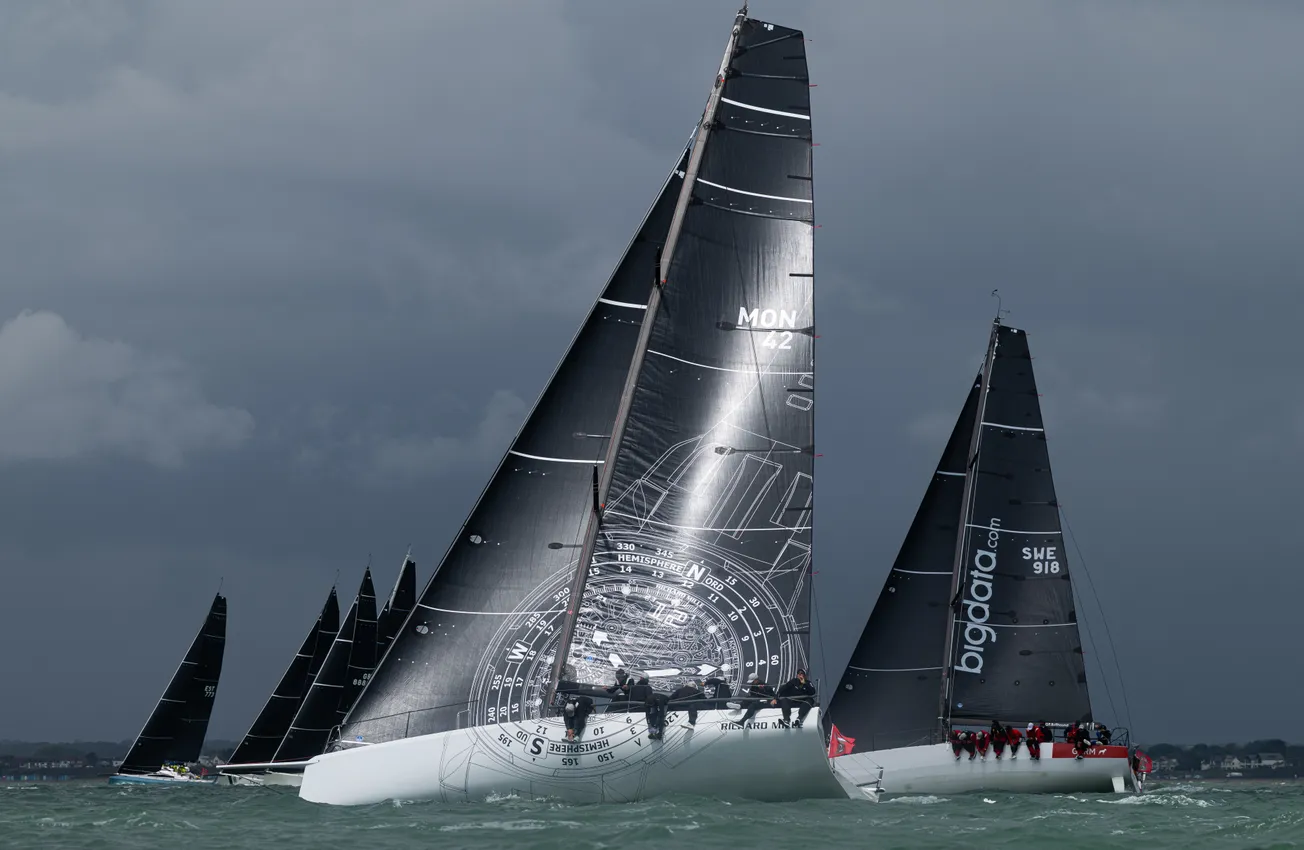
It’s more than two decades since the Admiral’s Cup tested crews over both inshore and offshore racecourses. During that hiatus there has been a polarisation of events, with some owners choosing to campaign offshore in distance ocean races like the Fastnet and the Sydney to Hobart and others focusing on inshore regattas like the 52 Super Series and 44Cup.
Speaking with the Admiral’s Cup sailors in the Cowes Yacht Haven this morning as they were prepping their boats for today’s opening salvo of inshore races on the Solent, there was plenty of enthusiasm for the return of the Admiral’s Cup and its mixture of offshore and inshore courses.
New Zealand sailor Rodney Ardern’s last Admiral’s Cup was 30 years ago. This time he is sailing aboard the Yacht Club de Monaco TP52 Jolt 3, which finished fourth in Saturday’s Admiral’s Cup opener, the 165-mile RORC Channel Race.
Ardern – a veteran of the Volvo Ocean Race and multiple America’s Cup campaigns (most recently with Alinghi Red Bull Racing in the 38th edition) – has been splitting his time between the 52 Super Series and dedicated offshore campaigns like Rambler 88.
He said he was glad of the opportunity to combine the two disciplines this week in Cowes at the Admiral’s Cup.
“This is a really good combination of all of that and a pretty compact week,” he told me. “Everyone has spent a lot of time developing the boats for this event: the reaching sails, the staysails, the jib tops – and all of that stuff that you don't really spend a lot of time on unless you're on a pure ocean racing boat. So it's been good fun and a good challenge to be a part of this.
“I think everyone's enjoying being back here and to be involved in the development, to race the boats, and to catch up with each other in different circumstances.”
Racing on the Wallyrocket 51 Django WR51 for the Yacht Club Costa Smeralda is the highly experienced mainsail trimmer Chris Hosking, who also says he is delighted to be back at the Admiral’s Cup after 22 years of “pretty much exclusively doing windward/leewards in one design classes.”
“It's great that the Admiral’s Cup has been rejuvenated,” he told me. “Because it gets us back into boats that have different styles, different strengths, in certain different conditions. So it's all about optimising your boat and sailing around something other than a windward/leeward course all the time.
In the Admiral’s Cup there's a lot of reaching and sailing at a range of different angles and in different modes. So it brings back an element of the sport that's been missing for a long time.
Were there, I wondered, some skills that the past-Admiral’s Cuppers were having to recall from memory? And perhaps some that the younger contingent of sailors were having to learn new?
“Absolutely, there's a lot of that going on,” says Hosking. “A classic one is when you're offshore, just having one person getting off the rail at a time to do their jobs. It's all about performance. Every second around the racetrack counts and doing things efficiently and effectively onboard is what the game's all about.
“There’s lots of little things – like running the zipper on a jib bag before it gets put away, so that it’s ready to use when that sail comes down again – a lot of stuff like that some of the newer kids haven't learned, because they haven't done a lot of offshore stuff, just windward/leewards for so long.
“This event brings a lot of stuff back into play – like spinnaker peels, for example – and with these new modern boats there’s a new dynamic type of sailing that even us old guys have to think about a bit.”
Ardern recalls his last Admiral’s Cup in 1995.
“We were bashing our way to the Fastnet Rock on Mumm 36s. Now we are back for more. But the boats now are awesome. The 52-footers in this Admiral’s Cup probably go as fast as an 80-footer did back then, probably. So we get around the track pretty quick these days.
“We used to sit on the rail all day and all night. We will be doing that for less days, hopefully, this time, but I think doing the Fastnet on the 40s is going to be probably be like what it was on a Mumm 36 back in the day. So it’s going to be a tough, tough battle for them.”
When you are running an event that used to be referred to as ‘the unofficial offshore sailing world championship’ there can be no better venue than the ultra tricky waters of the Solent.
Littered with sandbanks, rocky ledges, and even military forts, uniquely the Solent has four tides per day that generate unpredictable currents up to four knots, making it a body of water that rewards the brave – but also punishes the foolhardy.
“The Solent is a tricky place to race and that's what makes it so great,” says Hoskings. “There's a lot of local knowledge required here. You've got to have a good understanding of the current and how it affects the breeze on the water. So it's a real ‘heads out of the boat’ sort of sailing style you need around here, to make sure you're minimising the damage that the current's doing to you if it's adverse, and maximizing it when it's going with you.”
Hosking said he and the predominantly Italian crew on the Wallyrocket 51 were still learning and understanding how to sail their new boat, even now the regatta is underway.
“Particularly with a boat like this, that is so new, even when we're racing we are learning what the thing likes and what it doesn't like. So it’s a constant process of evolution. It doesn't matter how old you are, or how much you know, we're always learning in this sport.”
Today’s opening day of inshore racing saw two races sailed under mostly leaden skies and in 15 to 20 knots of wind.
In the opening windward/leeward race Stefan Jentzsch’s New York Yacht Club entry Black Pearl took the Class 1 win on corrected time by six seconds from Peter Harrison’s Jolt 3, sailing for the Yacht Club de Monaco. Giovanni Lombardi Stronati’s Django WR51 took third for the Yacht Club Costa Smeralda.
In Class 2 it was James Murray’s Callisto representing the Royal New Zealand Yacht Squadron that took the line honours and corrected time win ahead of Royal Hong Kong Yacht Club’s Beau Ideal in second on corrected. Third was the Family de Graaf’s Dutch entry Baraka GP representing the Royal Maas Yacht Club.
In the second race – a two and a half hour around-the-cans course – Jolt 3 took the win from Gordon Ketelby’s Cruising Yacht Club of Australia-entry Zen, with Django WR51 in third.
Beau Ideal was first home in Class 2 after a nip-and-tuck line honours battle with Callisto that saw the Hong Kong boat finish four seconds ahead. However it was the New Zealand crew who celebrated the win on corrected time by one minute and 10 seconds. Sean Langman’s Back to Black took third for the Cruising Yacht Club of Australia.
After three races sailed the Yacht Club de Monaco sits in first, but tied with the Royal Hong Kong Yacht Club on 26 points apiece. In third is the Royal New Zealand Yacht Squadron, but tied on 34 points with Yacht Club Costa Smeralda in fourth. Fifth is the Royal Swedish Yacht Club with 44 points.
An identical programme is scheduled for tomorrow (Wednesday) with racing expected to be in nearby Christchurch Bay. However that will be dependent upon the weather forecast, with super light northerly winds predicted around race time.