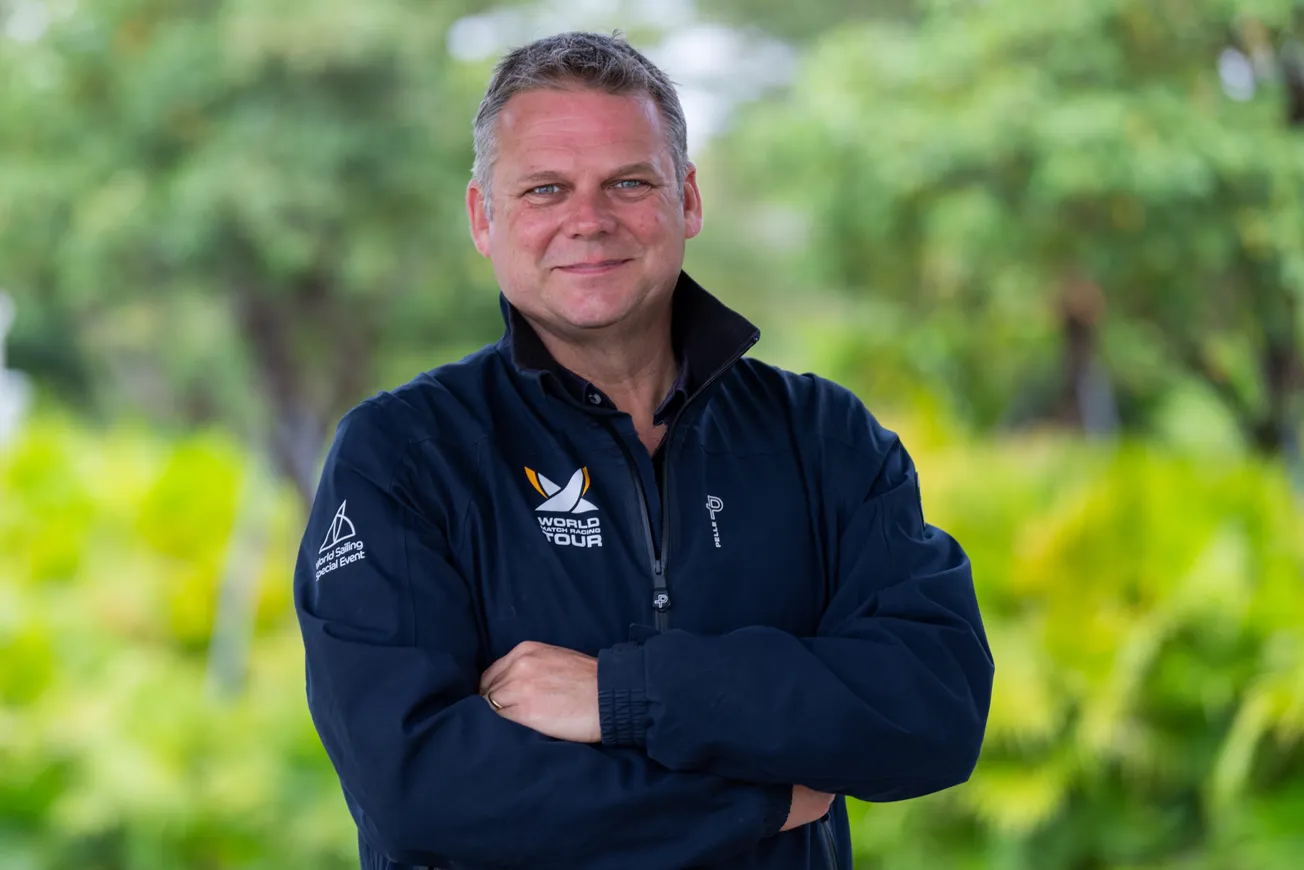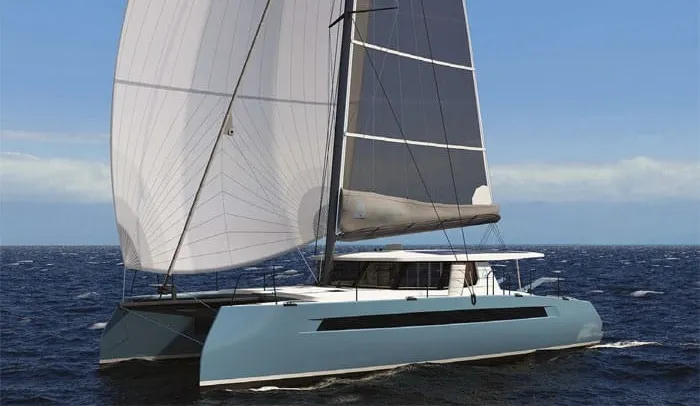

It’s an interesting point to realise,’ says Balance Catamarans’ Dean Paarman during the 2025 Cannes Yachting Festival. ‘Cape Town is second in the world only to France for the number of leisure catamarans built – and we’re a city, not a country.’
Cape Town is home to the Balance Cats yard that builds the all-new 502 CC, a 15.25-metre performance bluewater cruising catamaran that builds on the success of the company’s 482 model. And Balance knows a thing or two about performance cats – company founder and president Phil Berman is a former Hobie world champion.
The 502 retains the performance-focused naval architecture that has marked Balance models as favourites not only for cruisers but also for those with racing in their blood. It takes the form of chine-free wave-piercing hulls that carry a gradual flare and, as the brand name suggests, balance minimised hydrodynamic drag with improved payload capacity.
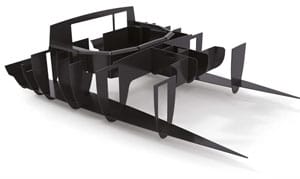
That improved capacity stems in large part from the fact that the entire internal substructure of the new 502 CC is 100 per cent carbon fibre, what Balance calls the Carbon Core. In essence, this means that if owners opt for the Intergrel E-Drive solution and an expanded Li-ion battery pack (more on that later), the yacht will accommodate the extra weight with little penalty on performance. It also means that owners who opt for a lighter payload – from a more conventional spec, for example – benefit from incremental performance gains.
On account of that additional weight, the 502 has grown by a couple of feet from the 482 model that it replaces. ‘The 502 is not just an upgrade of the 482, it's a completely new design,’ says Paarman. ‘The main reason was the Integrel hybrid option – we elongated the hulls to be able to carry that extra weight. And as we were doing new hulls, we thought we might as well add in all the customer feedback we've had from the last decade, which has led to a lot of other small but quite meaningful changes.’
Perhaps the most significant shift, as noted earlier, has come in the construction of the 502. Central to the new design is an all-new carbon core – the “CC” of the official model name. ‘Phil Berman codesigned the 502 with Anton du Toit of Du Toiy Yacht Design, and for them it was very important to put as much carbon into the boat as possible but for it not to be an all-carbon boat,’ Paarman explains.
‘Before now, we basically had carbon reinforcement in all the high- load areas. If a client wanted more, they could add optional carbon soles, decks or cabin tops to bring the weight down. But what we’re doing now is building an entire inner skeleton in carbon – it’s made like a tray, with frames and bulkheads, which is then glassed in to the hulls.’
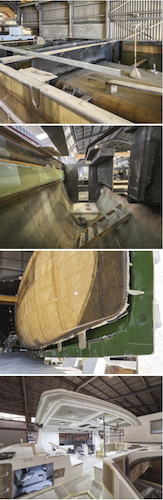
Phil Berman adds: ‘All the bulkheads are in carbon, the cabin soles are carbon, the daggerboard trunks are in carbon, and the daggerboard and rudders are carbon, in addition to all the other carbon strengthening elements that we used in our previous boats.
‘The vinylester resin we use gives great strength properties when working with the carbon, so it leads to a lighter, faster and stiffer boat. And it allows us to retain the exceptional interior and exterior storage capacity our catamarans are known for.’
Rather than simply extending the moulds from the 482, Balance crafted all-new tooling for the 502 with considerable investment in finishing the moulds to very fine tolerances and in reducing the number of moulds needed. Further, the hulls have additional carbon stringers which allowed the laminate schedule to be reduced, and new resins and cloth have improved the build quality even more.
The carbon skeleton is wrapped with closed-cell foam core and E-glass, and vacuum-infused with vinylester resin. This also confers another benefit in that it mitigates the potential for noise transmission, for which pure carbon hulls are infamous.
‘As light as these boats are, they're still over-engineered,’ Paarman adds. ‘Safety is something we take seriously, because these are bluewater cruisers and people are taking them to the far-flung places around the world. We don't want to see cracks – the yacht needs to be one solid structure. The challenge,’ he continues, ‘is always: how do we keep it over-engineered but as light as possible? Everything you see on the 502 is an answer to that question – I think Phil came up with a great brand name in Balance!’
‘The most important thing for us at Balance Catamarans is remaining true to our DNA of building liveable performance catamarans,’ Berman says. ‘We’re always trying to find that balance between creating a boat that’s super liveable and easy to sail, and a boat that is also strong, light and fast.’
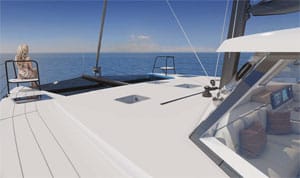
This drive is reflected in performance upgrades to the 502 that take advantage of the underlying design changes. ‘We’ve supercharged the 502’s rig,’ Berman enthuses. ‘Not only are the hulls longer and leaner, we’ve lowered the pelican striker, raised the bowsprit and have been able to push the forestay forward 18 inches.’
This increased foretriangle size adds more than 100 square feet (9m2)of extra jib, which powers up the boat when going to windward in light airs. That in turn means the foresail can be kept as a self-tacker rather than switching to a larger and less easily managed genoa. This added versatility – plus the increased size of the mainsail on the 502 – is not just great for performance, it also keeps the 502 squarely in the realm of interest for short-handers.
The polars suggest solid performance all round with this sailplan – over six knots of boatspeed close-hauled at 40 degrees true in 10 knots of wind, up to more than 20 knots on a broad reach in a good 25-knot blow. Confirmation of the 502’s performance will come shortly, with the first hull – called Tiger Lily, which was built for Berman himself – leaving the yard in Cape Town in October.
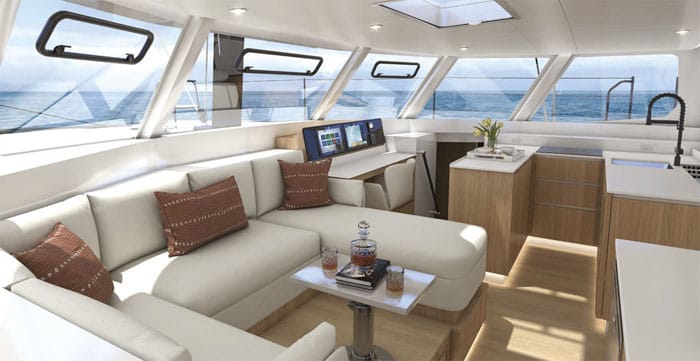
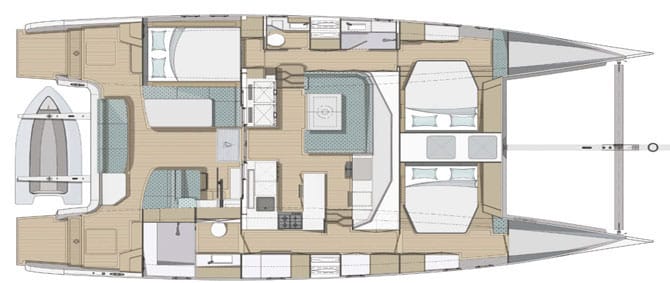
None of this has come at the expense of cruising comfort. The 502 still has Balance’s lightweight but handcrafted interiors that use foam cores and real wood veneers. However, although the 502 retains the popular layout configuration of U-shaped galley and saloon area with a table that drops to make a daybed, there have been significant tweaks both to the layout and the functionality of the 502 compared with the 482.
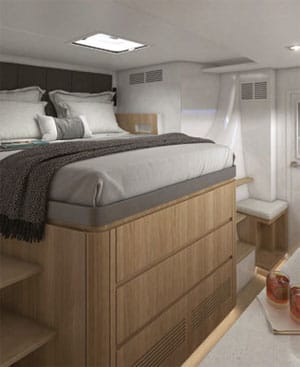
‘We worked with an interior designer who specialises in Italian design and we’ve changed our cabinetry to be more of the frameless Euro style which adds a really nice, clean look,’ says Berman. ‘We’ve also learned that most of our owners are dining outside and lounging inside, so we’ve widened the saloon seats, made the backs more like a living room couch and upgraded the fabrics.’
Other changes include pushing the shower compartment in the port hull outboard for more light and ventilation. This also creates space for an inboard hanging locker. There is now also an option to remove the inside nav station and instead spec it as cabinetry or a desk. The USB charging ports in the saloon and cabins are now hidden so you’re not, as Berman says, ‘looking at kind of an electronic junkyard’.
Airflow and ventilation have been improved by putting opening ports in the windscreen, fitting a large wind scoop hatch into the coachroof that encourages a blast of air through the saloon, and adding opening ventilation ports in the cabins that draw air from the forward deck lockers. When those locker hatches are opened at anchor, air flows through into the cabins and out through the hull-side and aft ports. ‘It’s going to be like forced air cooling,’ Berman enthuses. ‘You’re not going to get any better ventilation on a cat than on these new Balance Catamarans.’
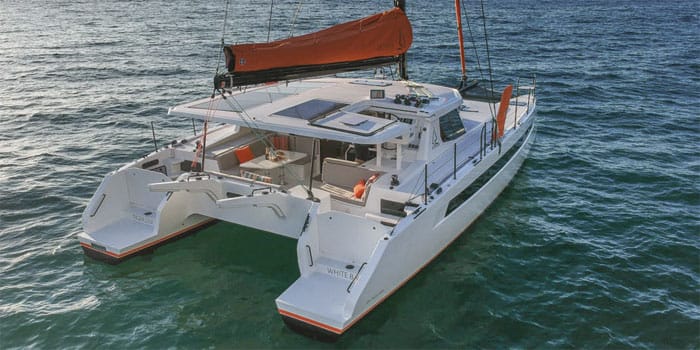
The popular VersaHelm system allows for easy switching between up-and-down helm positions in the cockpit. As Berman points out, others have copied it. The 502 introduces a new feature that Balance calls the VersaStern. Essentially it allows for an open transom design that can be easily closed off in the event of following seas, or for safety, without having to fit (and find storage for) washboards. The VersaStern is a door that hinges down into a recess over the engine compartment hatch. When not in use it sits flush with the deck. In use, it allows water to drain off the deck without any water incursion from the stern.
Talking of Versa, the 502 has been designed around the option to specify the VersaDrive Hybrid system, for which Balance draws on its long-time partner Integrel Solutions and which has come from several years of research. ‘We were disappointed with most of the hybrid options on the market, but then began engaging in deep discussions with Integrel,’ says Berman. ‘When they came out with their new E-Drive system, we realised it was perfect for us – we can put the E-Drive on the back of a Yanmar engine, which enable us to use saildrives and have the engines away from the living spaces, which was very important to us.’
Integrel’s systems comprise the E-Power, which essentially pulls spare power from the main engine to store in a lithium battery bank; and E-Drive, which extends the principle to include an electric propulsion motor fitted between the engine and gearbox. This can pull out up to 30kW of power for charging or deliver 40hp of electric propulsive power. ‘Balance cats haven’t had conventional generators since the very early models,’ Paarman says. ‘Between the Integrel systems and solar panels – which are recessed into the coachroof on the 502 – we have enough power to comfortably run what you want while only needing to run the engines for an hour a day – and often a lot less.
From a propulsion point of view,’ he continues, ‘it’s not something you’re going to use in isolation at sea because it drains the battery bank too quickly, but you can run one diesel engine and use the electrical charging from that to run the other engine in electric mode, essentially running two props on one engine. We’re seeing 30 to 35 per cent fuel savings with the system, and that’s huge – it also gives you a lot of extra range.’
The 502, then, is both novel and familiar. ‘The 502 is a fully new boat from the ground up in terms of her design and her tooling, although we have stayed very close to our brand DNA and the designs of our other models,’ Berman concludes. ‘I used to sit up at night and think, if I had to do another boat, what would I do differently?
I’ve always been happy with the 526 and the 482 so what we’ve done with the 502 is simply make enhancements to the way we construct the boat, and we’ve made a lot of design tweaks in the boat itself.’ Evolution, as the saying goes, not revolution – it is all just a matter of balance.