



The history of offshore sailing has many examples of how event organisers and rating rule systems have helped to generate interest in new high-performance, offshore-capable designs, and to encourage their development. In fleets around the world there are hundreds of race boats built as TP52s, Imoca 60s, Class 40s, GP42s, Class Minis and others that continue to compete with success in the world’s great races.

The latest chapter in this long history is represented by a partnership between two respected and established firms in this genre: Genoa-based Sangiorgio Marine and San Diego-based Reichel/Pugh Yacht Design. Both are well positioned to offer the very latest in event-inspired raceboat design: the new Admiral 42.
Just as the Transpacific Yacht Club developed a box rule in 2001 for a new-generation first-to-finish boat for its biennial 2,225-mile race to Hawaii that spawned the TP52 class, this all-new 42ft design has been inspired by the parameters announced by the Royal Ocean Racing Club for its Class 2 in the 2027 edition of the biennial Admiral’s Cup.
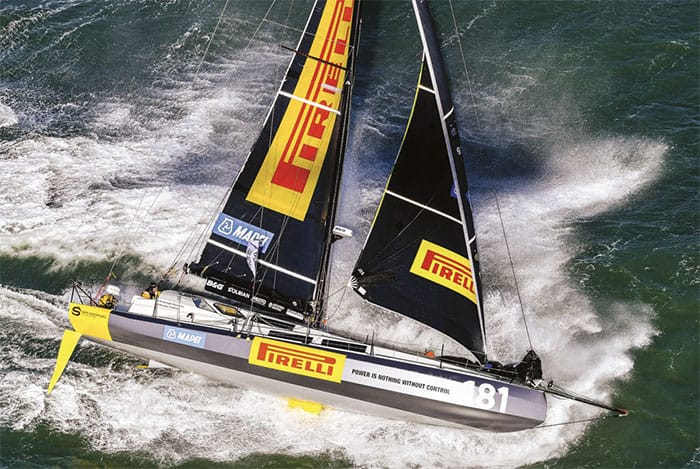
Yet unlike the last 42ft box rule that was introduced by the ORC in 2007 as the GP42, and since refined among several current-generation Fast 40s, this latest design will take advantage of some new ideas and technologies to produce even higher performance capabilities for inshore and offshore racing consistent with the Admiral’s Cup format.
The Admiral’s Cup Class 2 box
As specified by RORC, Class 2 designs for the 2027 Admiral’s Cup must fit into these basic parameters:
(1) Hull length: 11.50m to 13.40m
(2) Maximum draft: 3.40m
(3) Rating: IRC TCC 1.125-1.282
The challenge for Sangiorgio Marine and Reichel/Pugh has thus been to develop the fastest possible standard design that fits this box and is achievable in modern carbon composite build and engineering technologies suitable for competitive inshore and offshore racing.
With their strong background in achieving this inshore-offshore balance in design, Reichel/Pugh have devised a modern hull shape that can deliver fast upwind, reaching and offwind pace in all wind speeds. This all-round performance potential is important for lengthy events like the Admiral’s Cup since a wide range of conditions may likely be encountered throughout the inshore Solent racing and the long races in the programme, which also includes the Fastnet Race.
To achieve this, Sangiorgio Marine must also deliver the lightest and strongest possible hull, deck and structures to accommodate what will be a powerful boat to sail.
The hull and deck composites, for example, will be made from intermediate modulus carbon (IMC) and maybe some high-modulus stiffening tapes, pre-preg carbon-foam core laminates and cured at 90 degrees to achieve optimal strength to weight.
The deck design is focused not only on being an efficient platform for sail handling, but also watertight: water ingress on modern raceboats sailing offshore can be not just annoying, but can lead to serious problems with excess weight, degradation of electrical systems etc, so this feature has received serious consideration in the design.
Teams that commit to the Admiral 42 will have flexibility in working with the team at Sangiorgio Marine and Reichel/Pugh to tailor their boat to their specific needs.
The standard package assumes tiller steering, but twin wheels can also be specified for teams that anticipate a higher percentage of offshore racing or have some shorthanded races in their programme and may therefore need an autopilot system installed.
The standard package also assumes a single pedestal winch system. Likewise for deck hardware and sail handling systems: the specifics are decided by the client with help and guidance from Sangiorgio and Reichel/Pugh as needed.
Three spar makers have been asked for their quotations on a carbon mast and boom package that must use high-modulus carbon in the laminates and fibre standing rigging, a requirement to achieve the stiffness needed to accommodate the generous sailplan and the boat’s high righting moment.
Given these inputs, the teams at Sangiorgio Marine and Reichel/Pugh have arrived at an outstanding candidate design which has features and dimensions that suggest some impressive horsepower ready for inshore and offshore performance:
• LOA 12.80 m • IM 16.60 m
• LWL 11.23 m • P 17.20 m
• Beam 4.10 m • J 5.55 m
• Draft 3.20 m • E 5.80 m
• DSPL 4000 kg • STL 7.83 m
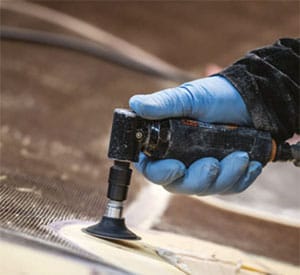
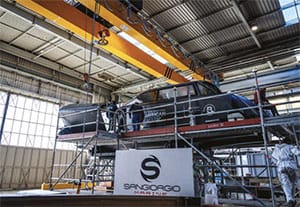
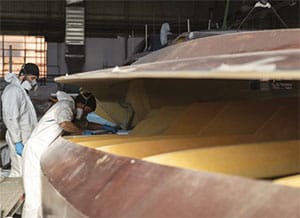
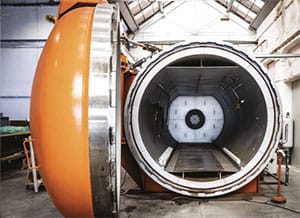

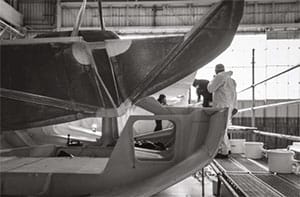
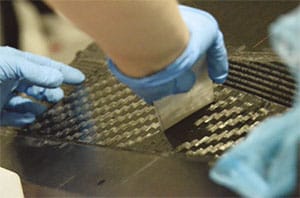
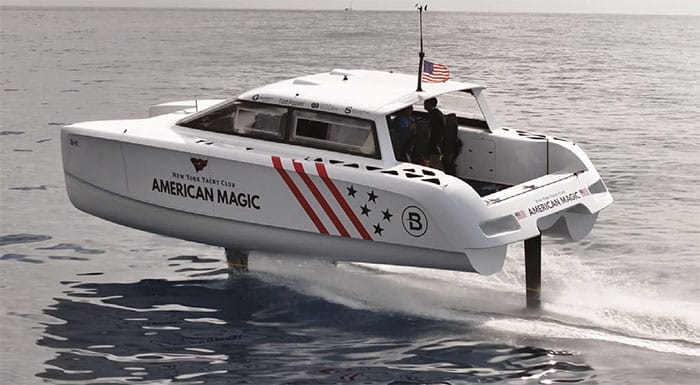
1. Highly skilled, experienced workforce. 2. Cutting-edge composite builds by Sangiorgio Marine include the Bluegame HSVs for American Magic and Orient Express. 3. A critical moment, joining the hull and deck of a Musa 40. 4. Composite components are cured in this 3m x 9m autoclave. 5. The Musa 40 was Sangiorgio’s first series built project, since its launch Sangiorgio have never missed a podium finish. 6. The build quality of the Musa 40s is notably high. 7. Specialist carbon composite boat building expertise.
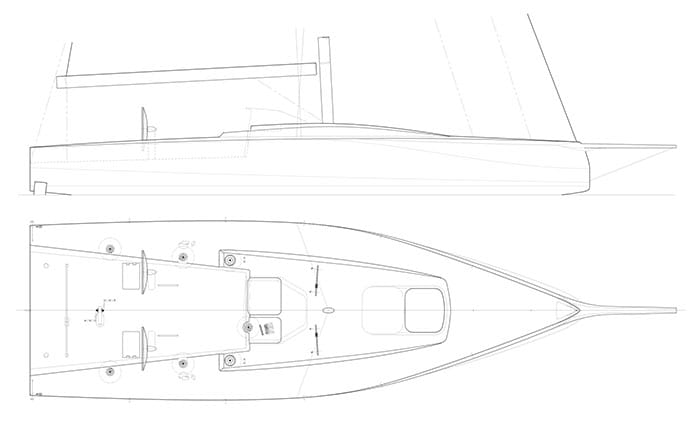
Reichel/Pugh Design #323: the Admiral 42
We have been involved in earlier Admiral’s Cups. Our last involvement was in the 2003 Admiral’s Cup, the last one prior to the very successful return of the event in 2025. Our 2003 entry was the top scoring Australian 60ft Wild Oats IV, the forerunner of canting keel yachts under the IRC rating rule. At the 2025 Admiral’s Cup Reichel/ Pugh was represented by design #143, Sean Langman’s Back2Black, a 2007 GP42. By Sean’s standards an 8th place in class 2 was a disappointment. Upon returning to Australia Back2Black has sped up the learning curve taking three bullets in the 2025 Sydney Short Ocean Racing Championship, then 3rd place in Division 1 of the 172-mile Cabbage Tree Island Race, behind the VO70 Celestial and Comanche 100. Back2Black closed out 2025 taking 2nd place in Division 2 in a brutal Sydney Hobart Race.
At its peak, the Admiral’s Cup was recognised as the most competitive international offshore racing event. It is hard not to acknowledge how challenging it is to race in the British tidal waters comprising Solent inshore races, a medium distance Channel race and the epic 695-mile Fastnet Race starting in Cowes and now finishing in Cherbourg.
The success of the 2025 Admiral’s Cup, raced under IRC, inspired us to develop a design that can be optimised within the Class 2 upper rating limit of the 2027 Admiral’s Cup. This latest design from the Reichel/Pugh drawing board builds upon decades of naval architecture expertise and CFD research combined with onboard racing experience and careful analysis of performance data to deliver the latest in hull form and appendage development. Design 323 is designed to perform across a wide range of conditions. The English summer weather is variable, one week it can be windy and next week light airs.
The Sardinia Cup has been revived by the YCCS in alternate years to the Admiral’s Cup and aligned under the same two RORC IRC rating bands. The June weather of the Sardinia Cup can be expected to be lighter on average than the Admiral’s Cup.
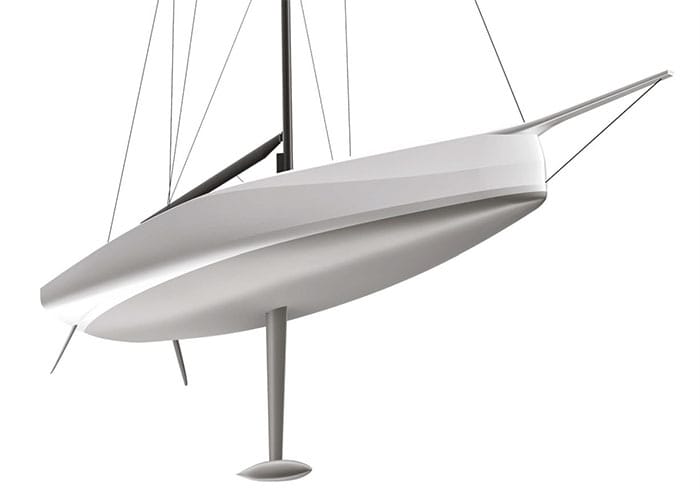
A hull length of 12.8m (42ft) was determined to allow for sufficient sail area and stability, while remaining within the rating band limit for the class. The hull shape has a greater maximum beam to increase the efficiency of the crew weight and the water ballast option.
Design 323’s hull shape demonstrates different attributes in different conditions: minimising wetted surface in low-heel situations to reduce hull drag in light air, but maximising form stability when heeled to provide the best performance through all conditions.
The bow geometry has significant volume forward to maintain a bow-up attitude when running and reaching at higher speeds. Performance has increased dramatically in these modern designs with powerful stern sections and light displacement. This yacht’s hull shape is designed to plane earlier on the waves and not go through them, reducing the drag of water coming down across the deck. The volume forward will enable faster speeds when reaching, again improving planing through better directional stability and control, using less rudder movement.
Design #323 features a deep keel fin and bulb with a CFD-optimised fin section designed for lifting force efficiency while minimising drag. The combined ballast ratio greater than 50 per cent together with significant hull form stability ensures great performance through all conditions.
The design features small twin rudders which are efficient even at lower heel angles, providing improved directional stability. Single rudders have been evolving further forward to keep them immersed when heeled on these flatter hull shapes. The single rudder carries more rudder angle reaching and running, requiring more continual rudder movement for control. The result is all-round improved balance and efficiency with twin rudders. We are studying lifting rudders and the impact on rating and performance.
The displacement of Design #323 in measurement trim is 4,000kg. Water ballast is an excellent option. We have studied the rating impact of 300 litres of water ballast and 3,700kg displacement with two tanks of 150L per side located midships at maximum beam. The IRC crew number is 11, which is more than enough to race the boat efficiently. Water ballast allows you to consider sailing with fewer crew and still have the required stability.
Consideration needs to be given to the amount of additional weight per crew member that needs to be carried offshore in terms of safety gear, clothing, food, liquids and supplies. For offshore racing with a shorthanded crew, a larger water ballast system needs to be prioritised.
The angled stem is an aggressive, contemporary look, which is a statement on the water. It reduces hull and deck weight forward, minimises windage at the bow, and decreases spray drag at the stem.
The exterior features graceful sweeping deck lines that flow naturally from the foredeck to the cockpit. The subtle reverse sheerline is modern, yet elegant, with a chamfer forward reducing windage that seamlessly transitions to a radius aft for comfortable hiking.
This project also provides Reichel/Pugh with an opportunity to work with Edoardo Bianchi of Sangiorgio Marine in the design and build of a next-generation Class 2 Admiral’s Cup yacht. Sangiorgio Marine will deliver accurate, lightweight structures that can win inshore and be confidently raced hard in a Fastnet or Sydney Hobart Race.
Versatility in and around the box
The Admiral 42 will also be available in some interesting variations not seen in both the current and past generations of similar monohull designs. This versatility will broaden its appeal for use in a wide range of events, not just those similar to the pro-level Admiral’s Cup (such as the Sardinia Cup in Porto Cervo) but also any other race or regatta where strong inshore and offshore performance is rewarded.
The classic 600-mile offshore races like Fastnet, Sydney-Hobart, Newport- Bermuda, Middle Sea Race and the Aegean 600 come to mind, along with the slightly shorter offshore races like the Giraglia, Chicago to Mackinac, Bayview- Mackinac Race, and longer oceanic races such as the Transpac. This design could also do quite well in mixed-format championship events like the ORC World, European and North American championships, or the Copa del Rey.
Accordingly, the Admiral 42 is offered with the option to have 300 litres of water ballast built into the hull with two tanks. These are fitted approximately amidships close to the longitudinal centre of buoyancy to reduce any influence on pitching moment in a seaway yet still provide the additional righting moment needed in breezy conditions when just hiked crew weight alone is not enough to maximise performance.
With this option, target displacement is reduced to ,700kg. A reduction of keel bulb weight is possible because stability will be boosted with the water ballast.
And there is another interesting advantage of this option: in conditions when the ballasting is not needed the boat will be racing 300kg lighter. This versatility could be a decidedly strong advantage in the occasional light air conditions found in a typical Admiral’s Cup and what can be prevalent conditions in a typical Sardinia Cup, not to mention elsewhere in the world at many other mixed offshore and inshore racing events.
‘This is a serious passion project for us,’ says Pugh, ‘because a big part of our heritage is in the Admiral’s Cup and its mix of highly competitive inshore and offshore racing in one event. Forty-two feet is a proven size to have a balance between what is at an achievable level for serious offshore and inshore racing while at moderate cost compared with larger platforms. We’re excited to be part of this rebirth in interest of developing new designs for the mixed styles of racing exemplified in this new class.’
Exceptional build quality
An excellent choice of partner to realise the goals of the new Admiral 42 is Sangiorgio Marine, where state of the art composite technologies and engineering solutions targeted for a grand prix sailing clientele are combined with the strategic vision and impressive resources of a major shipyard. Based in the port of Genoa, Sangiorgio Marine’s parent company San Giorgio del Porto is part of Genova Industrie Navali, a firm that has a broad portfolio of skills that range from commercial ship repairs to the high-tech world of modern composite fabrication.
This latter sector is where Sangiorgio’s founder and CEO, Edoardo Bianchi, has brought an impressive skillset: a passion for performance honed as an Olympian in the Tornado class in Athens in 2004 and Beijing in 2008; an eye for innovation and technical training in fitting a Tornado with foils as part of his Master’s degree earned in marine engineering at University of Genoa; and more than 10 years of recent experience at Persico Marine as manager and director of America’s Cup projects for both Land Rover BAR and Luna Rossa.
Bianchi’s acquaintance with the designer Gianluca Guelfi led to a partnership which proved that innovation in Class 40 development is not only located in France and the UK. Bianchi in partnership with Guelfi drove a young Sangiorgio Marine to achieve success in their very first collaboration on a series-built design: the Musa 40. Ambrogio Beccaria and Nicolas Andrieu sailed Alla Grande Pirelli to victory in the 2023 Transat Jacques Vabre, with three sister ships built thereafter. Since the debut of Ambrogio Beccaria’s Musa 40 four years ago, Sangiorgio Marine boats have never missed a podium finish.
This success and several other projects have quickly earned Sangiorgio Marine an international reputation as a high-tech composite boatbuilder. This is helped by their having generous space (4,000m² under roof), plus all the equipment needed for high-tech composite fabrications. This includes a 9m x 3m autoclave, expandable modular oven, clean room, refrigerator for prepregs, plotters and cutters, and a dedicated area for milling operations. They also have the skilled personnel needed for boatbuilding projects of the highest calibre, whether in new builds or repairs.
Sangiorgio Marine also has a dedicated research and development department focused on materials, processes and construction technologies that aims for constant optimisation in product performance. Starting from the design and co-engineering phases, Sangiorgio works alongside the client, providing specialised technicians who assist in finding the best solutions for the use of materials and processes. The goal of this collaboration is to create the very best in high-technology and high-performance products – such as the new Admiral 42.


