
Yacht Racing Life is a reader-supported publication. If you enjoy our free content please consider signing up to receive our free email newsletter, or help the development of the website by becoming a paid subscriber.
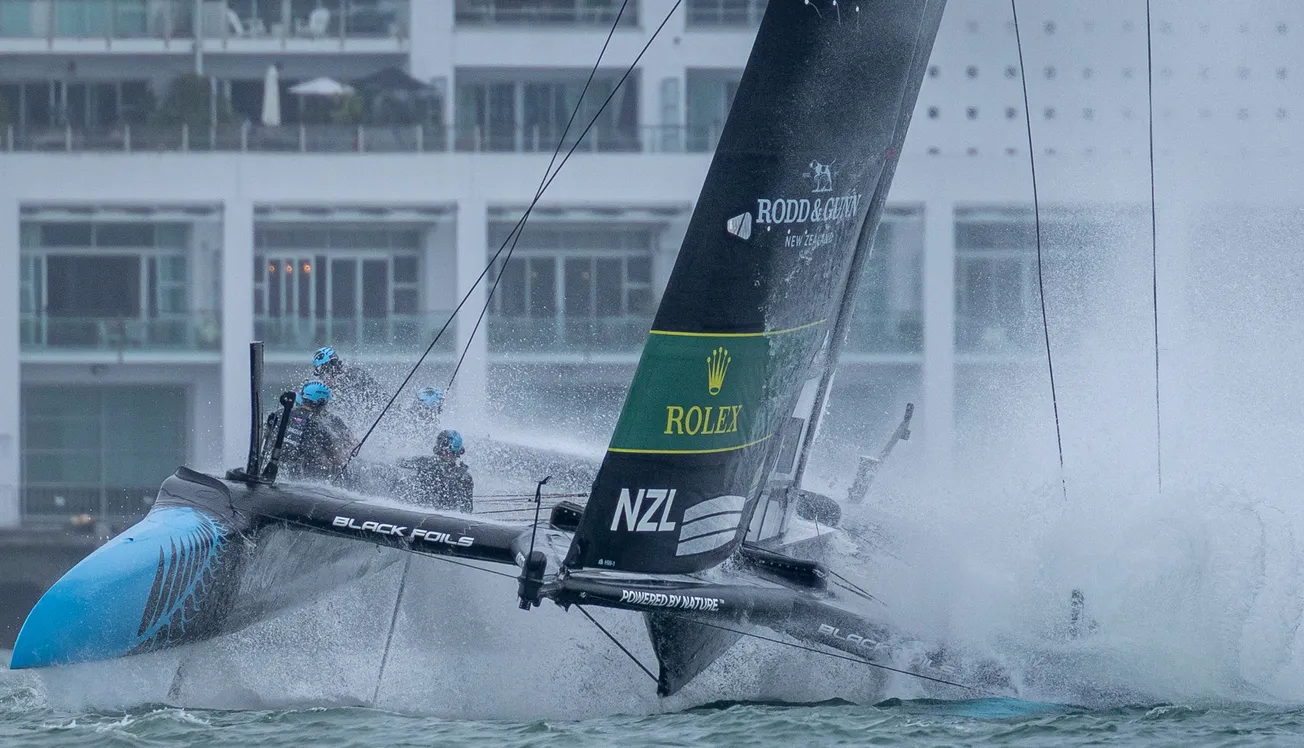
Three teams did take to the water early in the day today. The home team – Peter Burling’s Black Foils – along with Diego Botin’s Spanish Los Gallos crew, and Erik Heil’s Germany by Deutsche Bank, were all allowed some time on the water to system-check their boats after repair work carried out between events. All three are believed to have been cleared to race this weekend.
With the weather forecast for Saturday and Sunday calling for top-end conditions on both days, the event organisers have made the call to bring forward the start of the Sunday race schedule from 1630 to 1100 local time in Auckland to avoid the prospect of un-sailable conditions later in the afternoon.
Missing a day of practice may not seem too significant in the grand scheme of things, but as Red Bull Italy helmsman Phil Robertson commented at the pre-event press conference:
“It’s not ideal. I think every team sitting here and in the sheds right now would be wanting to be out on the water. You have a long list of things you want to train. I think we get about 14 training days a year and that’s one of them down. So, it’s a little bit frustrating, but it is what it is.”
According to SailGP meteorologist Chris Bedford, the teams will face a different challenge in Auckland over the next two days to what they experienced in the previous – albeit also breezy – regatta in Perth, Australia.
“One of the key differences compared to Perth is the sea state,” Bedford said. “Being inside the harbour, we won’t see the deeper offshore swell that played such a big role there. It will still be choppy at times, but without that long-period swell rolling in from offshore.
“The trade-off is that while the wind in Perth was strong, it was relatively steady. Here in Auckland, we’re expecting much more of a gusty profile. That means sudden increases and decreases in pressure, which are often harder for crews to manage. You’re really trading one type of difficulty for another, and that kind of variability keeps teams on their toes.”
Reports coming out of Auckland suggest that the weekend’s southwesterly wind direction is giving the race management team, led by Iain Murray, a headache in terms of the space available to set a long enough course.
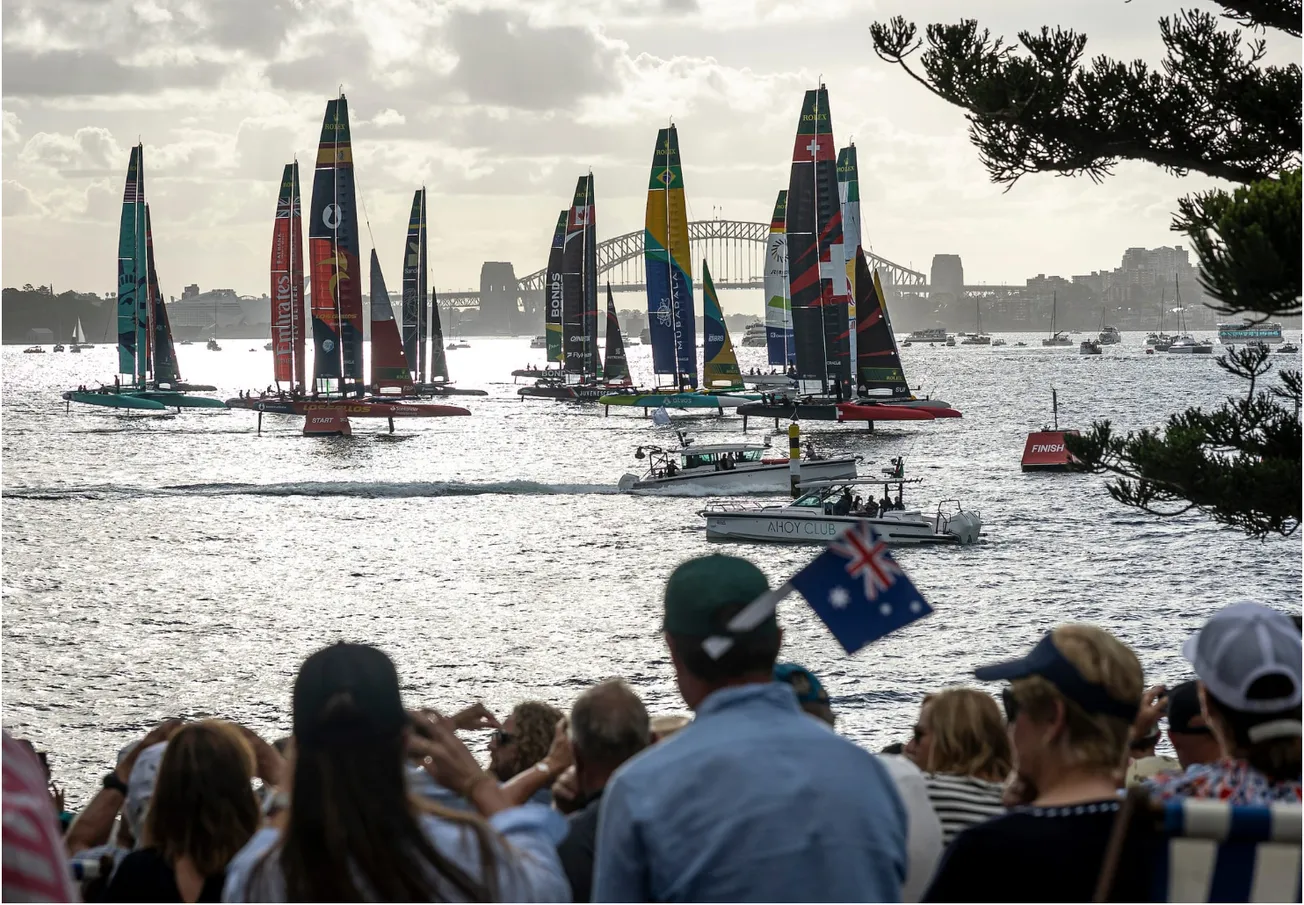
With 13 boats on the start line in Season 6 congestion at the first set of leeward gates has been an issue already – as evidenced by the scary crash between the Swiss and the New Zealand F50s in the first race in Perth.
Rumour has it that the option of splitting the fleet into two unequal flights has been seriously considered. There is provision for this under the rules, but doing so would make scoring complicated with six boats in one flight and seven in the other.
The predicted strong winds and flat water could be viewed as perfect conditions to set a new top speed for the F50 catamarans. The current record of 103.94 km/h was set by Nicolai Sehested’s Danish ROCKWOOL Racing crew during a first mark bear-away at the Germany Sail Grand Prix in Sassnitz last year.
But it seems unlikely that any of the teams will be targetting a new record speed at the Auckland event. Rather, they will more likely be focused on scoring maximum points, or in some cases, trying to survive without breaking their boat or their bodies.
“There’s an important distinction between sailing to set a speed record and sailing to win a race,” Bedford pointed out. “In SailGP, the objective is to be first across the line. Absolute speed only matters in relation to the boats around you. That said, if a record happens along the way, it’s a nice bonus.”
Although there are some clear favourites when it comes to big breeze racing at SailGP events, as Bedford points out, the gusty, unpredictable, winds the 13 crews will be facing off the Auckland city front could deliver some unexpected performaces throughout the fleet.
“With conditions like this there’s a real wildcard element,” he said. “One team might find themselves on the right side of a gust, while another ends up on the wrong side, and that can completely change the race picture. In these sorts of conditions, momentum can swing very quickly.
“As the wind builds and the water gets rougher, the focus shifts more toward simply getting the boat around the course cleanly. You’ll likely see moments where teams come off their foils or lose speed just because of how demanding the conditions are. Tactics always matter, but in stronger breeze it becomes much more about precision, discipline, and not making any costly mistakes.”