Quantum’s collaborative, high-touch, performance-driven ethos continues to resonate as the sport evolves.
Among the many differentiators developed and championed by Quantum is the concept of a “Factory Team” competing at the highest levels of yacht racing. Borrowed from Formula 1 and other professional circuits, the model provides direct access to performance data and collaboration between designers and sailors. Real-time feedback, combined with hard metrics gathered in the most competitive environments, creates a fast testing-and-innovation cycle that optimises performance and reliability.
Lessons from this process flow outward, shaping not only Grand Prix sails but also those for other racing classes and even cruising boats. Quantum's Pablo Campano notes, ‘whatever we learn at the Grand Prix level shows up in every other sail. It’s like Mercedes’s F1 team: eventually, you see that tech in your car.’
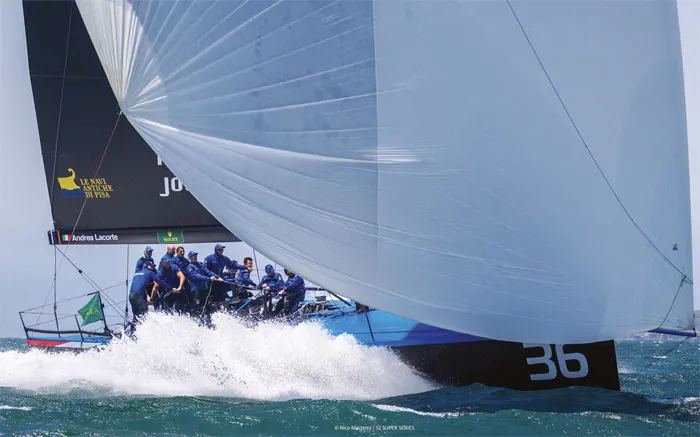
To prove the model, Quantum’s longtime principal, Doug DeVos, established the Quantum Racing TP52 programme in 2008. The team won the world championship in its debut season and, in 2012, joined the newly launched 52 Super Series. The on-the-water results were immediate, and Quantum Racing has stood on the series podium every season since, with seven overall titles, including the 2025 championship.
Most recently sailing under the banner American Magic–Quantum Racing, the team has been the cornerstone of Quantum’s testing platform for more than 14 years. Quantum’s model is now embedded across all Quantum-powered teams in the 52 Super Series, and its effectiveness has been repeatedly proven – not only through Quantum Racing’s accolades, but also in the successes and major improvements of other Quantum-powered TP52 teams.
Each team contributes its own data, insights, and feedback to the collective system, strengthening the network of development. The British-flagged Gladiator, fully powered by Quantum, is a prime example: third overall in the 2024 Super Series, winner of that year’s TP52 world championship in Newport, and victor in the St Tropez opener of the 2025 season.
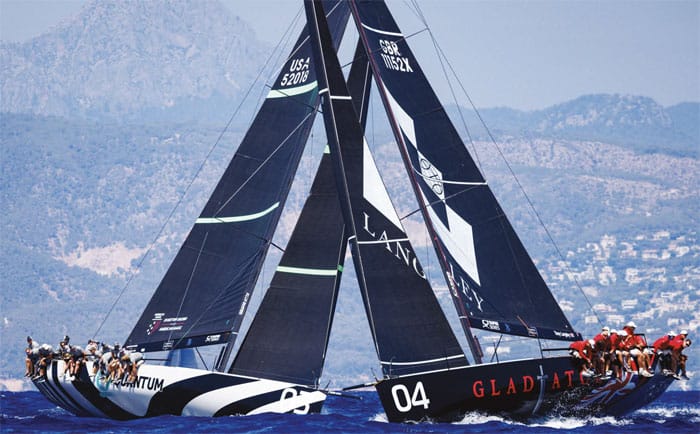
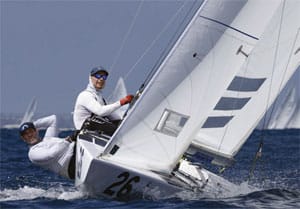
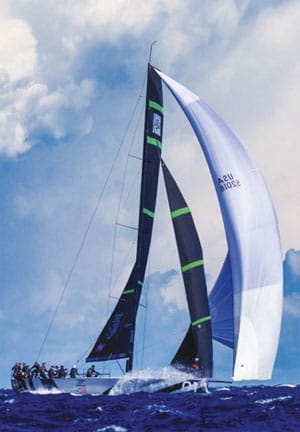
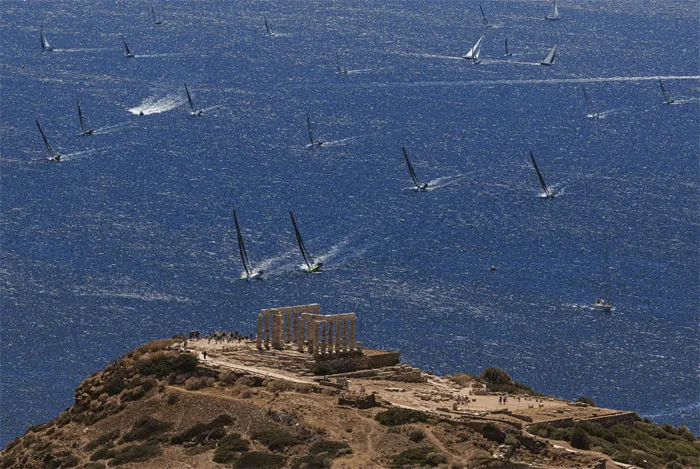
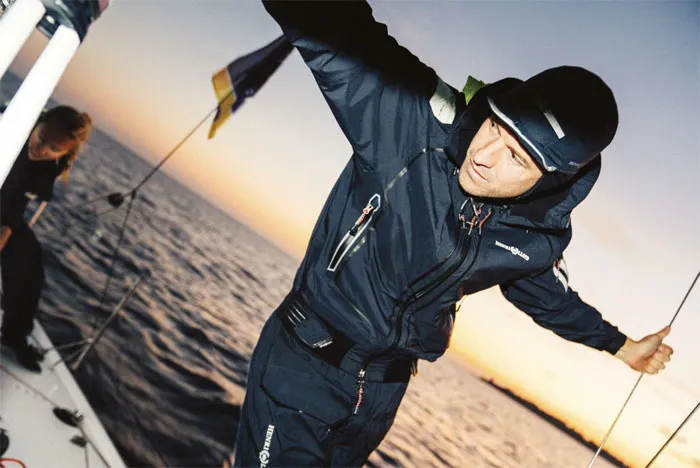
1. Main image: It all started with the Quantum TP52 team – which has stood on the 52 Super Series podium every season since. 2. Powered by Quantum sails, John Kostecki and Austin Sperry won the 2024 Star Class World Championship. 3. American Magic-Quantum Racing won the 52 Super Series for the seventh time in 2025.
At the centre of this model is an integrated coaching programme. Spearheaded by James Lyne, whose résumé includes 24 world championships across seven classes, the system provides real-time observation, data collection, and post-race analysis to every Quantum team. From a chase boat, Lyne photographs sails and trim, while drones capture video from above.
Onboard data streams are logged throughout racing. After racing, the real work begins. Working across time zones with a colleague located in the United States, Lyne crunches the data provided by onboard instruments, studies all available photos and video, and reviews tracking information from each boat in the fleet to compile a 50 to 75-page performance debrief each evening.
These documents are filled with photos of sail trim, snaps of the starting line, and deep dives into every leg, specific roundings, crossings, and other key moments, all overlaid with corresponding onboard data. In the morning before racing, sailors from every Quantum-powered team in the fleet gather for Lyne’s debrief session – an opportunity not only to sharpen individual performance but to share learnings across the fleet.
Quantum CEO Ed Reynolds and sail designer Brett Jones are also nearconstant presences on site. Jones is often next to Lyne in the chase boat, feeding observations directly into both the daily recaps and long-term design adjustments. ‘During training periods, Brett and I are checking sails and are in real-time communication with the trimmers,’ says Lyne.
‘During the racing, Brett and I are next to each other on the water and having trimming conversations. We then translate the output of those discussions into the daily debriefs for Quantum customers and from there into Quantum’s sail development program, iQ Technology.’
Lyne adds, ‘At this stage, in such a refined class such as the TP52, the sail designs are relatively evolved but there is always room for improvement, and this is where Quantum’s unique strengths really show up. The team is always working to make the sails better, in design, structure and construction. When we look back at the winning Super Series sails we used 10 years ago and view them next to this season’s winning sails it looks like there has been a complete revolution in design, structure, and construction.
'However, if you go through year-by-year it is clear that this revolution happened with a constant series of incremental improvements. The overall effect is revolutionary but the gains were made in steps. The culture of the programme and the commitment of Quantum’s leadership have enabled and encouraged this.’
That culture includes more than just Lyne and Jones. As Lyne puts it, ‘while Brett, the trimmers, and I might be at the point of the spear, we are solidly backed by Quantum's Joan Subirats, Pablo Campano, Mario Trindade, Ed Reynolds – and a cast of experts. It’s a team effort, each piece has to be in place for that sail to come back as a world-class product. It’s certainly special, but it’s not magic, it's actually this team working closely together within the Quantum ecosystem.’
Subirats oversees Quantum’s iQ Technology design software. Campano’s work in membrane technology is central to pushing the limits of durability and shape retention. Trindade, one of Quantum’s Grand Prix designers, translates regatta insights into design files that become the next generation of sails.
The direct implications for Quantum’s design and support process are significant. Terry Hutchinson, tactician for American Magic–Quantum Racing and president of sailing operations at American Magic, has seen it firsthand: ‘The sail design and development process used by Quantum Racing is a real benefit to all Quantum customers as there is so much data and information that translates directly to other boats and classes.’
Reynolds agrees: ‘The data and unique insights we gather and share with our customers have proven immensely valuable. Development has always been part of our culture, and we’re continuing to expand these methods across other classes and events.’
Indeed, Quantum’s formula of technology, collaboration and creativity continues to squeeze performance from even the most mature platforms. Beyond the TP52 fleet, Quantum has long extended this Super Series-inspired approach to other classes, running clinics, debriefs, and weather programmes. For example, you may have seen them at ClubSwan and Cape 31 regattas in Europe, at Helly Hansen Sailing World regattas and Charleston Race Week in the U.S., and at one-design championships worldwide.
Quantum’s pattern of using technology, creativity and collaboration to squeeze out improvements in well-developed and fiercely competitive racing classes is ongoing. San Francisco-based Jeff Thorpe, Quantum’s director of western US sales, has outfitted dozens of J/105s with Quantum Sails and regularly consults with owners and programme managers on hardware and gear choices and set-ups and hosts tune-ups and briefings (Quantum’s daily weather briefings at the 2025 Big Boat Series attracted more than 100 sailors to each session).
Like the TP52, the J/105 is a wellunderstood and heavily optimised platform, albeit with even fewer opportunities to reap gains from incremental improvements. The crucial gains here are quite often measured in millimetres and fractions of a knot.
Even so, Thorpe has shown that the same incremental, data-driven method used in the TP52s pays dividends in this fleet as well. Quantum’s strong presence in the huge J/105 fleets at San Francisco, Annapolis and beyond is undeniable.
In mid-September the J/105 North American championship was sailed off Toronto in a wide variety of conditions and a Quantum-powered team handily won the event with a 29-point cushion after 12 races. This was the fourth North American championship in the last five years for Quantum and Thorpe’s clients, all double-digit point victories.
Similarly, in the Star Class, Quantum designer and Star world champion George Szabo supported John Kostecki and Austin Sperry on their path to the 2024 Star worlds, which they won decisively. Szabo’s dual role as both sailmaker and competitor epitomises the Quantum philosophy: theory and design validated by practical results on the racecourse.
‘We went all-in on the Quantum programme,’ Sperry explained after the regatta. Kostecki, an Olympic medalist and America’s Cup veteran, added: ‘we had a lot of confidence in the sails, and with Quantum.’
Factory teams are not new in technology-centric sport. Formula 1 has thrived on the model for decades. What is rare, however, is seeing that same level of investment and infrastructure extended directly to customers outside the core team.
Quantum’s ability to democratise the insights of a Grand Prix programme, to make them available to competitors on the 52 Super Series starting line, to a J/ 105 owner in San Francisco or a Star sailor in San Diego, is unusual and arguably transformative in the sport.
Given this record, it was little surprise when, in 2024, the North Technology Group (NTG) connected with Doug DeVos and Quantum leadership and added Quantum to its portfolio of highperformance marine brands. The move connected Quantum’s culture of innovation with NTG’s global scale. Within weeks of this deal’s announcement, Quantum-powered teams won the Star and Melges 24 world championships and American Magic–Quantum Racing claimed the 2024 52 Super Series title.
Now, as part of NTG, Quantum is positioned to scale its impact even further. Quantum’s message is clear: what happens at the top end of the sport doesn’t stay there, at least not at Quantum. Through their unique approaches to sailmaking, it filters down to benefit all. Sail by sail, race by race, fleet by fleet. Quantum is truly built differently.