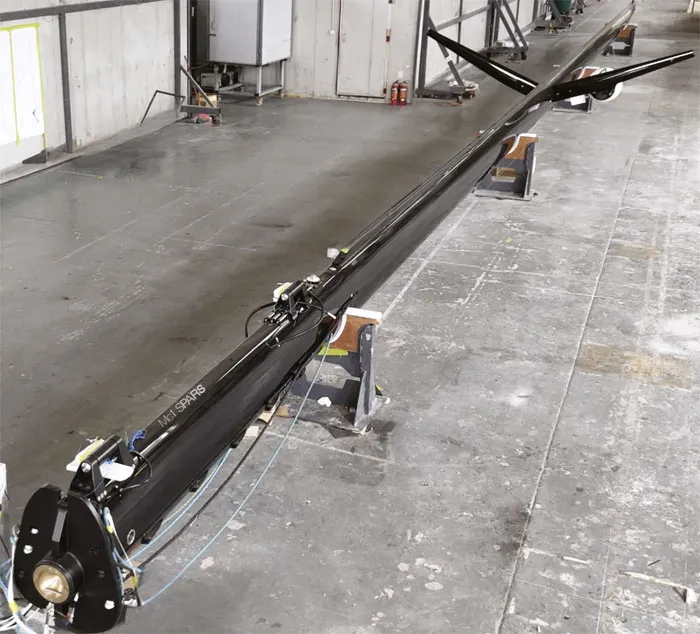

Since its launch only last year, MC1 Spars has established itself as an important player in the demanding world of composite spar fabrications with an order book already full of interesting and diverse projects for all tiers of performance sailing.
This impressive level of initial success comes from a unique approach to customisation that focuses on use of the appropriate talent and tools in design and engineering for each project, the very best in high quality materials and fabrication techniques, and an efficiency in their process that allows for extremely fair and accessible pricing and delivery timelines.
For example, for materials MC1 has committed to using Delta Preg carbon fibre and resin pre-pregs. There are numerous other less expensive suppliers in this marketplace, but as an Italy-based supplier to the high-end luxury supercar and racecar industry Delta is has strength and consistency in its materials, and an ease of use when having to operate in field environments that do not have the same temperature controls as at their main fabrication facility.
MC1 also uses a talent base of designers and engineers that can be assigned to projects that suit their particular strengths, from relatively simple budget-conscious projects to those that are at the cutting edge of the sport.
Weaving these sometimes disparate elements together is not easy, yet it’s a challenge that Trent Justice, sales director at MC1 Spars, takes on as a matter of course since this is at the core DNA of the company and its values, inherited from its parent company McConaghy Boats.
‘Our mantra is to put our customer’s needs first and find the best solution available within constraints of timing and budget yet without any compromise on quality. We personally attend to all details of the process,’ he says.
Retrofits, upgrades and repairs to spars sound like easy projects because the boat is not new and its dimensions should be known, yet there is a myriad of other details that need to get sorted properly so that everything will not only fit as planned but perform as planned too. MC1’s approach to customer service has got this right, as illustrated in these examples:
Swan 45 retrofit: Nautor Swan’s Asia Pacific regional director Olivier Decamps is based in Hong Kong and needed a new mast for his recently arrived Swan 45. The goal was to build a spar that would match the class specifications so the existing sails fit, but also with a splice installed so that if the boat were to be shipped again it would reduce the footprint and reduce the chance of damage that full-size spars often risk while shipping.
‘We designed a laminate that was close to the same dimensions and built of the same modulus carbon as the old mast, but optimised in the fibre layout so that even with a splice, the mast had the same stiffness and bend characteristics.’
MC1’s approach to fabricating what Justice calls a “regatta splice” takes full advantage of their dexterity with female custom tooling: the join is moulded to be a perfect fit secured with recessed titanium screws that add minimal additional weight. Most importantly the taper in the design also does not present any change in panel stiffness nor strength.
This was an important detail so that the rig tune could be close to, if not identical, to the existing numbers and the mainsail would not need adjustments in luff curve for its fit, trimming and performance. This mast was also fitted with new Nitronic rod and newly-designed tip cup spreader attachments, and Justice said it was particularly fulfilling that the entire package weighed 33kg less than the old spar, even with the splice. Since a Swan 45 mast weight is typically 285kg, this 12 per cent difference in weight was all in the lighter tube. This in turn will make the boat faster upwind and reaching with its correspondingly higher stability.
Sundeer 60 upgrade: This was an interesting project where Justice flew to Fiji to meet a 60ft cruising boat that needed to upgrade to a modern composite spar package from its previous mast which weighed in at a whopping 620kg. Needless to say, the client knew MC1 could provide a significant improvement to help this boat’s performance.
Using the existing dimensions and the sail load analysis program SailPack, MC1 engineers worked with Auckland Finite Element Analysis (FEA), whose computing power is superior to any spar manufacturer and that enables them to conduct multiple FEA studies throughout the project timeline.
In this process MC1 starts by examining the overall structure and then focuses on the localised high-load areas to create the laminate. The end result was a new mast customised to the boat, which weighed less than half (290kg) as much as the old one. The result is a gamechanger in added performance and motion comfort, with an increase in pointing ability and a decrease in pitch gyradius.
‘This was a perfect example of where we provided direct hands-on customer service,’ Justice says. ‘We did not push the limits to be as light as possible but we needed to have a solution that would be reliable, long-lasting and easy to service yet still deliver significant improvement in sailing performance.’
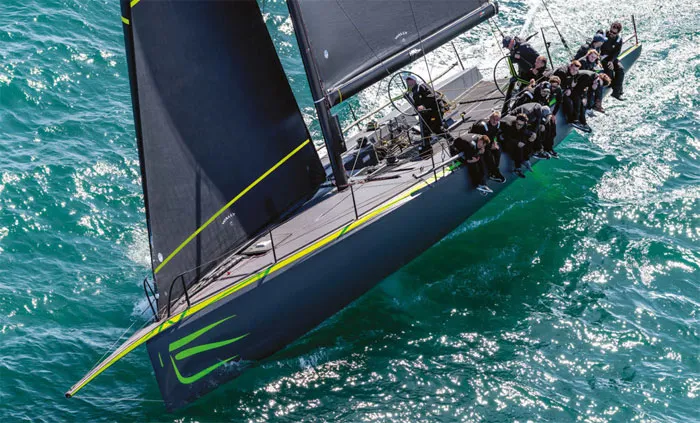
TP52 Red Bandit spar replacement: As winner of the 2024 Middle Sea Race, Carl-Peter Forster’s TP52 Red Bandit went on to show encouraging initial results in the Admiral’s Cup only to have its rig fail during an inshore race in the Solent. This presented MC1 with the opportunity to design and build a replacement spar that would be tailored to the needs of this team, which is active in both inshore and offshore racing where durability is just as important as light weight for performance.
‘For this project Steve Wilson helped Chris Mitchel with the use of SailPack to work out the load modeling, and then then work with Auckland Finite Analysis to refine and optimise the spar shape and laminate schedules. Since this was a replacement rig, we needed to be mindful to match the bend characteristics of the old spar so that the existing sail inventory would fit on the new one,’ says Justice.
‘We also opted for a high modulus carbon rather than ultra-high modulus because high modulus gives you most of the weight saving, but is a more robust rig for offshore racing. We also helped work on some customised halyard locks designed specifically to fit into the new tube.’
With this approach to match the specific needs of the Red Bandit team, the end result is a mast that will be not only light, but more durable for the inshore/offshore programme this team has in its future plans. Oh, and at about half the quoted price of one of MC1’s rival sparmakers.
MC1’s heritage is in having built spars for McConaghy’s boatbuilding operations, and so building spars for new boats has a familiar and proven workflow for the team. Yet they use the same approach of working with the builder and boat designer to customise the design and engineering of the spar whilst also being mindful of cost constraints and logistics timelines.
Some examples include when MC1 was recently asked to come to the rescue in a Schionning-designed Solitaire 1520 cruising catamaran project being built on the Gold Coast in Australia. This 50ft design needed a new carbon mast that would be simple and robust enough to withstand the rigours of extended cruising, with simplified sail-handling systems and a lightweight yet lowmaintenance rigging package.
With the help of the project manager, who had a spar-making background, MC1 helped find a cost-effective hybrid solution where the headstay and diamond shrouds were made of stainless rod and the side stays and shrouds were made of synthetic treated Kevlar. Justice explains that this choice was made because even though the aramid fibre is not as stiff as carbon, the leeward shrouds are less prone to damage from being slack and have an effective working life of five to six years, similar to that of the metallic fittings.
MC1 has done a similar rescue for some series-built Cure 55 luxury performance catamarans, also built in Australia, that have experienced some problems with rig setup in their original spars. New boats will now have MC1 masts and some will have the option for a new product: carbon furling booms.
A sail-handling issue for catamarans is in the high loads on the leech of the mainsail and how to handle this in a furler reefing system. A simple mandrill-driven approach cannot align the full-length battens without twisting and breaking them, so MC1 has come up with a clever locking carriage that takes the load on the outhaul rather than transferring it to the furled sail. This is fully integrated into the boom design so there is reliable strength along with seamless operational efficiency.
Finally, to ensure confidence in the quality of its approach to design, engineering and composites fabrication, MC1 has invested in the training and equipment needed to perform ultrasound testing on all its spars. The iQ report generated is the tangible assurance clients need to trust their spar to be defect-free.