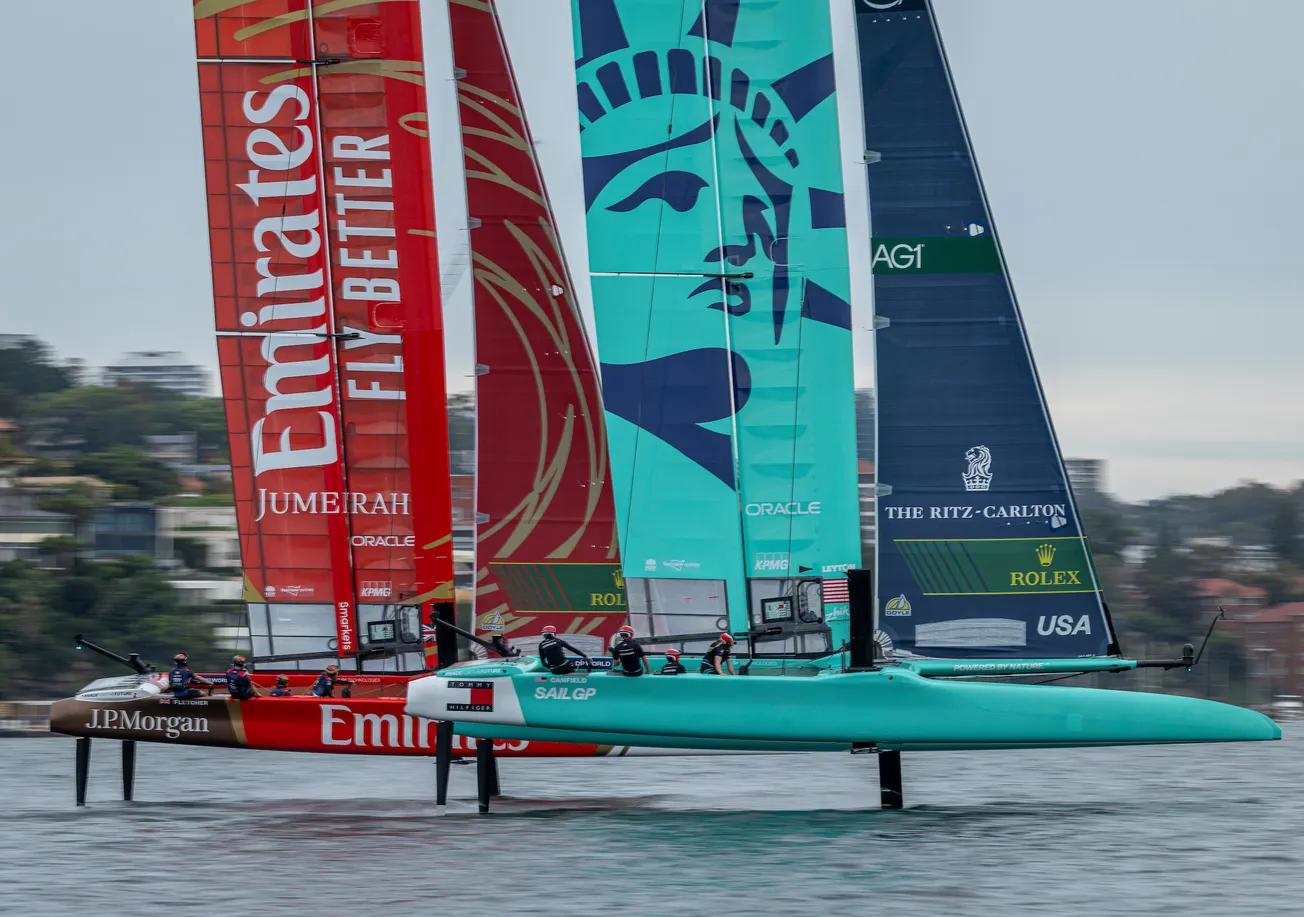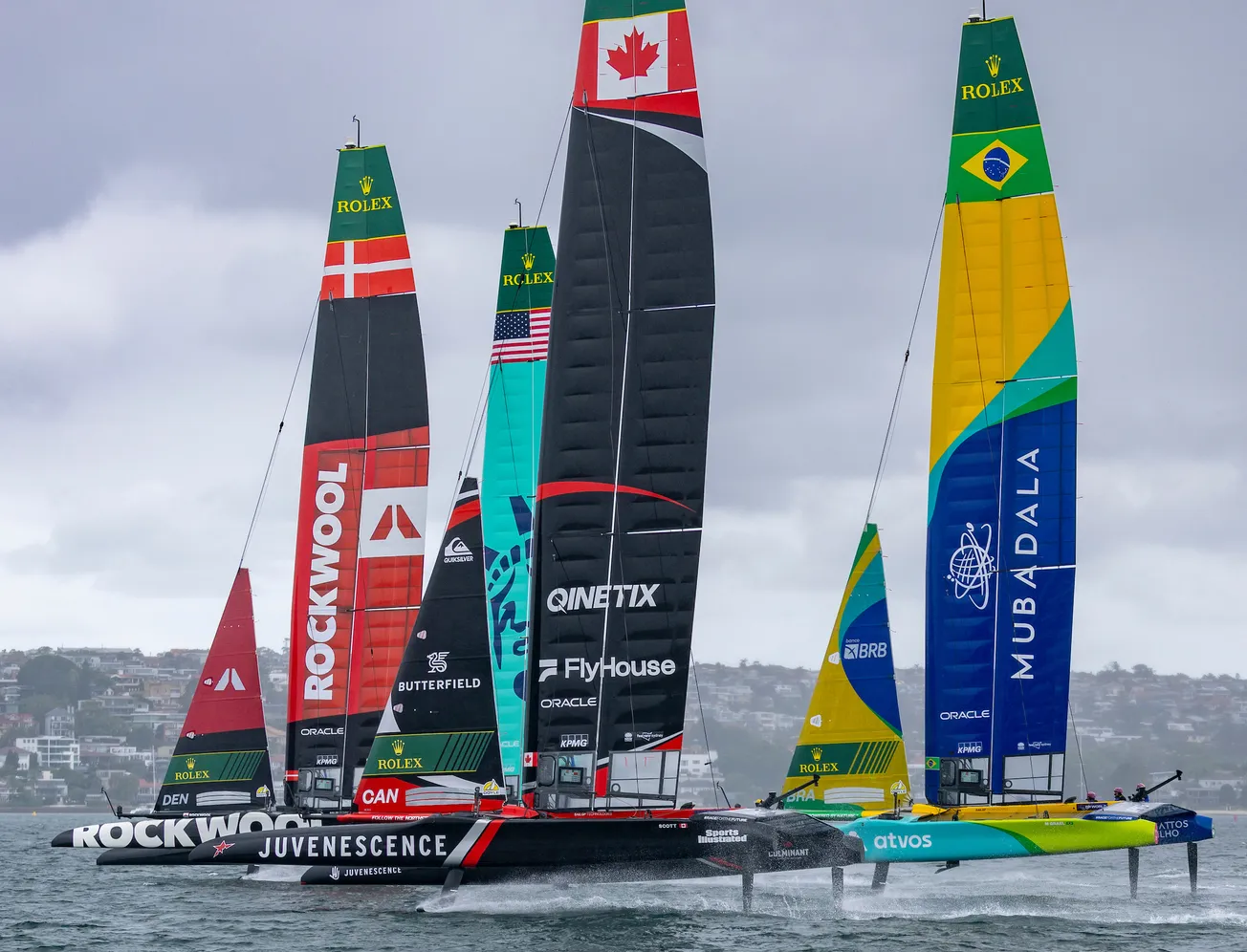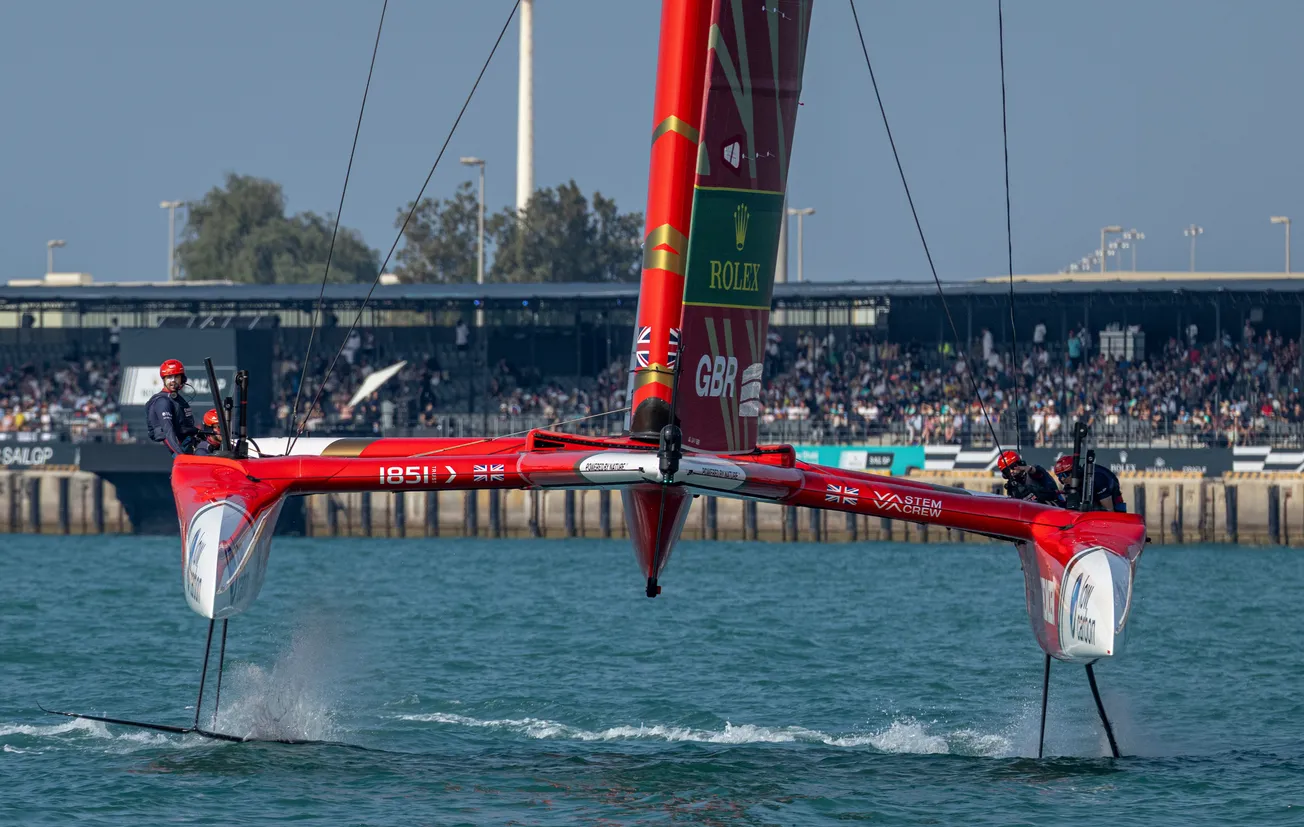
Going into the race Fletcher said the big picture strategy was to be ahead at the first turn mark and try to control the lead from there. However, after being the final boat to enter the start box, the Brits found themselves facing Tom Slingsby’s Australian BONDS Flying Roos and Peter Burling’s New Zealand Black Foils, who had both entered 30 seconds earlier.
The British opted to pass between their two rivals – the Kiwis to windward and the Aussies to leeward – before tacking round with 25 seconds to go to begin their timed run to the start. That left them a few seconds late at the start gun with their bows just off the sterns of the New Zealand and Australian boats who both pretty much nailed the start.
“We obviously didn’t get it quite right,” Fletcher admitted. “We wanted to be the last boat into the prestart and we wanted to approach the line off the back of the others – although, if the option to tack underneath them (like we did in Cadiz) we would have taken it. The plan was to be a second late but at full speed at the gun, but there just wasn’t enough wind for us to get the full launch in time for the start.”
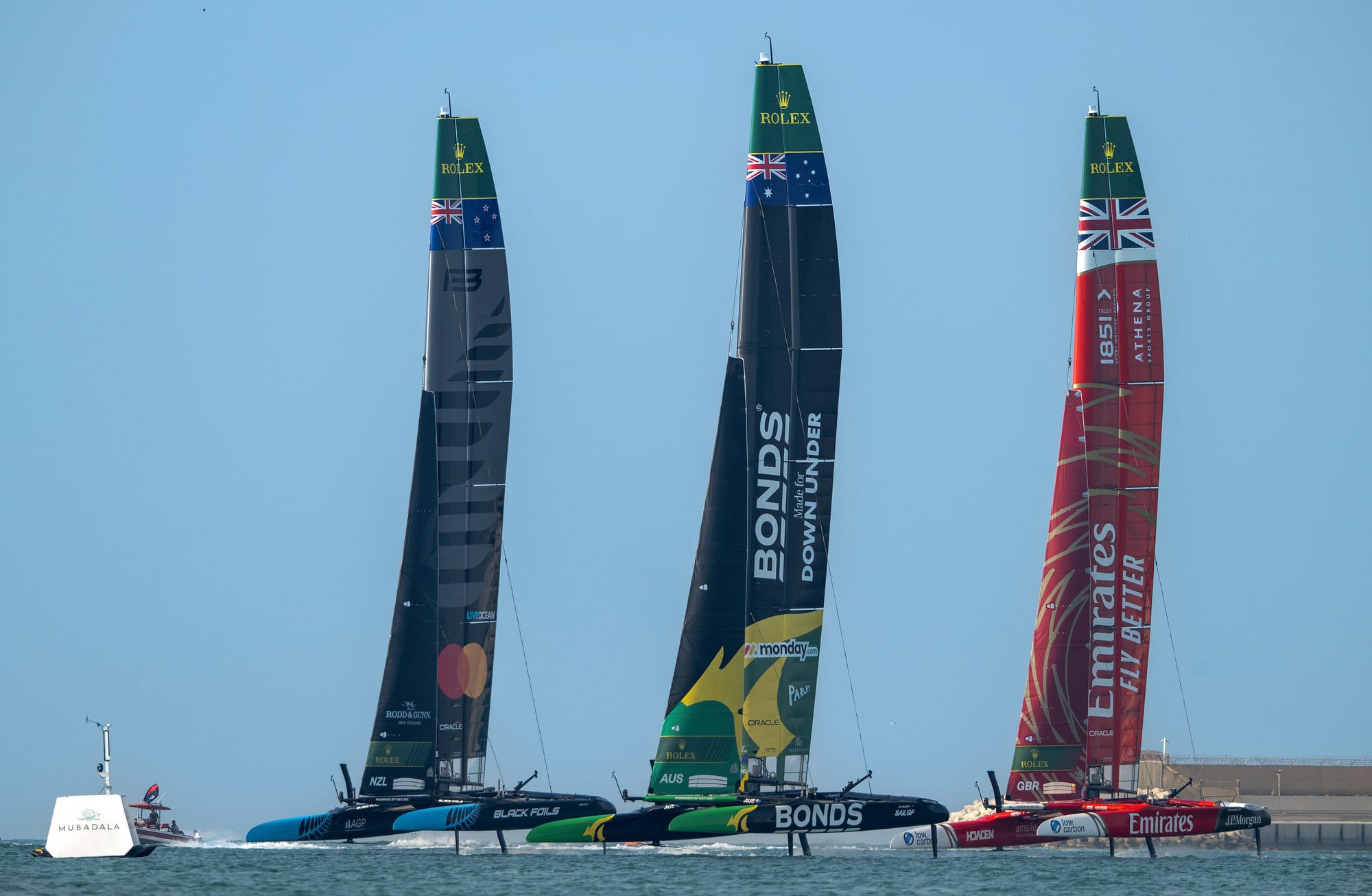
Nevertheless, the British rounded the first turn mark in second – albeit to leeward of the Black Foils – and were first to gybe away. Fletcher says there was no panic on board with the crew having done plenty of preparation on a range of strategies that could be applied at this stage in the race.
“We had done a lot of work on what to do if you are leading, what to do if you are not winning at that point. We had looked at the various scenarios where people had been overtaken – along with a whole host of other set plays. So we knew very clearly that now we are behind, these are our opportunities.”
A key part of the British crew’s big picture pre-race strategy, Fletcher told us, was to make right turns at both the leeward and windward gates.
“So we had done our pre-race routing and we had the options around how we could achieve that.
It was a strategy that would later deliver a massive gain for them on the right-hand side of the course (looking upwind), at the beginning of the final downwind leg. What then had the British identified about that right-hand side over the day’s previous two fleet races?
“It wasn’t necessarily that we wanted the right because we thought there was more pressure there. Actually there were quite often bands of breeze coming down the left side – along with big left shifts. Because of how left the breeze was for the Grand Final the course was sort of slightly skewed, meaning that it was long ports upwind and long starboards downwind. There was also a little course skew on the gates, but what they had done was to close the gates up a lot compared to the fleet racing – and that reduced the bias between the two marks.
“What that all meant was that we thought that if the average breeze was, roughly speaking, slightly to the left of the course bias, then that would produce a right turn bias at the top and the bottom.”
The British were the first to gybe at the start of the first downwind, setting them up for a fast entry and exit to their planned right turn at the leeward. They followed the Black Foils around, with the Kiwis a little slower having gybed much closer to the gate mark, and immediately tacked away on to port to clear their air.
“When you come in fast as the boat behind you are in a quite powerful position,” Fletcher commented. “You have options, basically. The only thing I have been wondering about in hindsight is whether instead of the JK [the 180 degree roundup and immediate tack manoeuvre] we could have been able to live above the Kiwis. We had such an overspeed that maybe we should have climbed up high and maybe been leading them from there. It makes me wonder, but the truth is you never know.”
The British nailed the foiling tack and it was immediately clear that they had made huge gains on the BONDS Flying Roos who were struggling to get foiling coming out of the right-hand corner of the course. On a charge now, Emirates GBR made a fast duck of the Australians and continued out to tack on the right-hand boundary. Meanwhile the Kiwis, now on port, managed to cross ahead of the first Australians and then the British at the half way point of the windward leg.
At this point Burling was heard calling one and in for a left turn at the windward gate and as the Kiwis tacked on the starboard layline, they did so with an around 100-metre lead over the Brits and Aussies approaching on port.
Fletcher reflected on whether more could have been gained on the right-hand side on the first half of the beat.
“When we tacked at the bottom gate I was pretty excited,” he said. “I was feeling like ‘this is on’. I was surprised that we didn’t gain more on that right-hand side after ducking the Australians. I thought that we would have been able to cross the Kiwis from there – and that would have been game over.
“I think we made a mistake on that long port. We should have sailed higher and slower. We kept ourselves above foil tack speed, but in hindsight we probably should have sailed a bit higher with better VMG and that would have put us in a better spot.”
However, as the Australians tacked on to starboard behind the Kiwis, both had to settle for sailing with the leeward hull in the water, opening the door wide for the fast approaching, foiling British boat to duck behind the BONDS Flying Roos to lead around the favoured right-hand gate mark at speed and slingshot off down the final run. Under five seconds separated the three teams at this point.
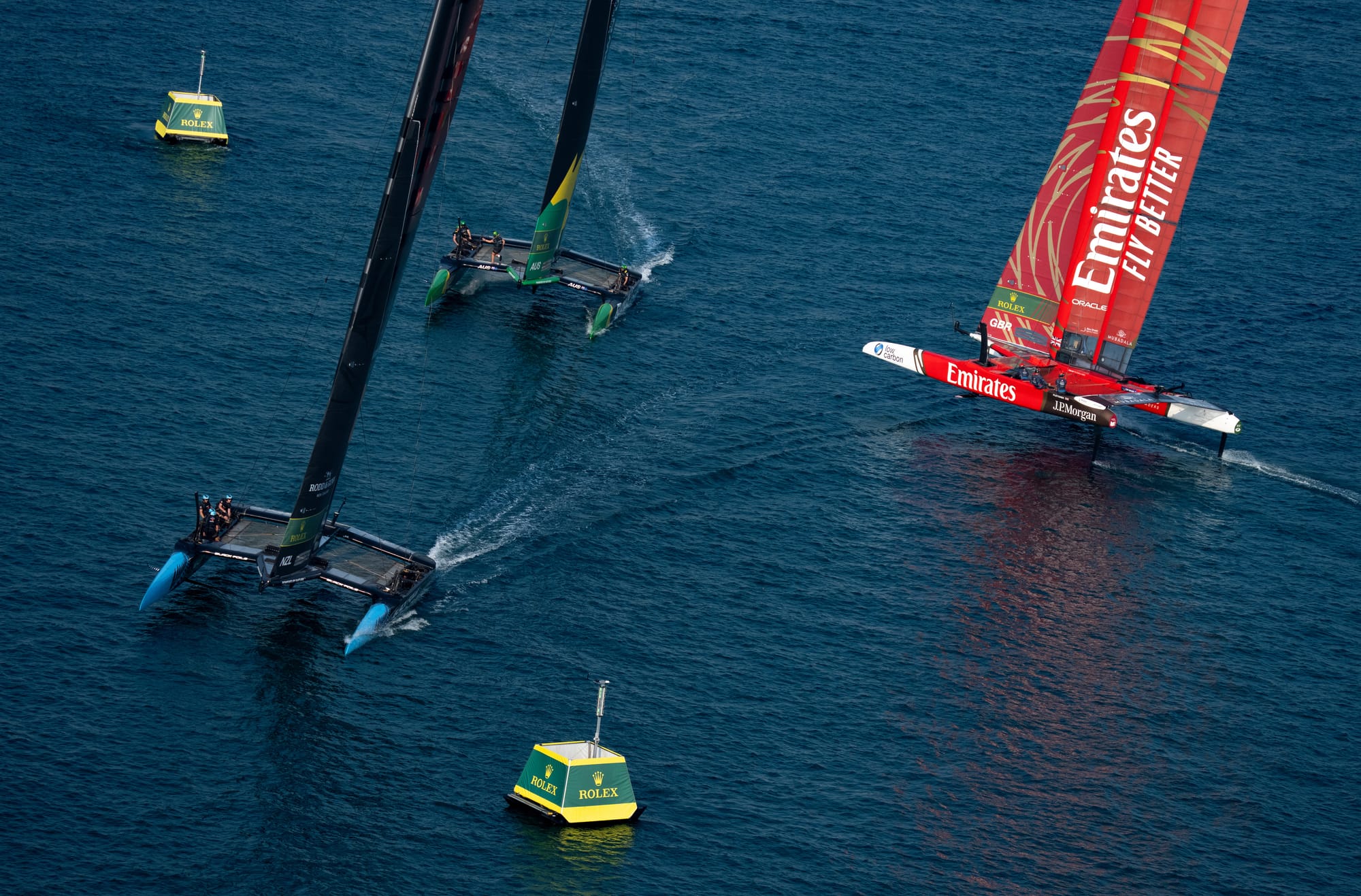
“The Australians were in a really awkward spot for us on the approach to the windward gate,” Fletcher recalls. “If they had been there we would have ducked the Kiwis – we were level with them, basically – but because of the Aussies’ positioning we had to do a high, slow, speed kill to make sure we could duck them and still get around the mark.”
Leading now down the final downwind leg Fletcher knew that a slick gybe as close to the boundary as possible would give them an unassailable lead at the final leeward gate. Everything, it seemed, was in their favour.
“We were gaining straight away,” Fletcher explained. “We had the right gate bias of about 50 to 70 metres, so as soon as we bore away we were ahead. Plus we were the only boat that was foiling – I think that’s where most of our gains came from – and we had seen these left shifts come down throughout the day.
“We thought there was some compression on that right-hand side (looking upwind) that meant there was always a band of pressure along that shoreline next to the Adrenaline Lounge. It seemed like there was always an extra bit of squirt out there. That put us on this really nice long port gybe, while the issue with turning left is that you are straight into the shore and it is all a little bit more hit and miss on that side.”
“We knew that if we pushed it at the boundary we could do one gybe on that final run and get straight into that right turn at the bottom. We really wanted the right turn at the bottom as that meant just one tack on the final leg. So we pushed it as hard as we could at the boundary. I knew I needed to squeeze everything out of that situation to make sure we were on the layline.
“To be honest, I almost pushed it too hard,” Fletcher said with a wry smile. “We were just one metre away from the boundary when we gybed.”
With a 200-metre lead and on layline to the right-hand gate mark the British were in total control of the Grand Final at this stage.
“When we came out of the gybe, I knew it was ours to lose,” Fletcher related. “We were initially talking a lot about how we were getting to the bottom of the course, sailing in low mode a little bit slow just to make sure we got there safely. Once it became obvious that we had an easy layline we knew that the hard work was done and everyone just kind of took a breath. It was a case of: don’t block the airwaves now, there isn’t a lot to talk about now, let’s all just focus on our jobs.”
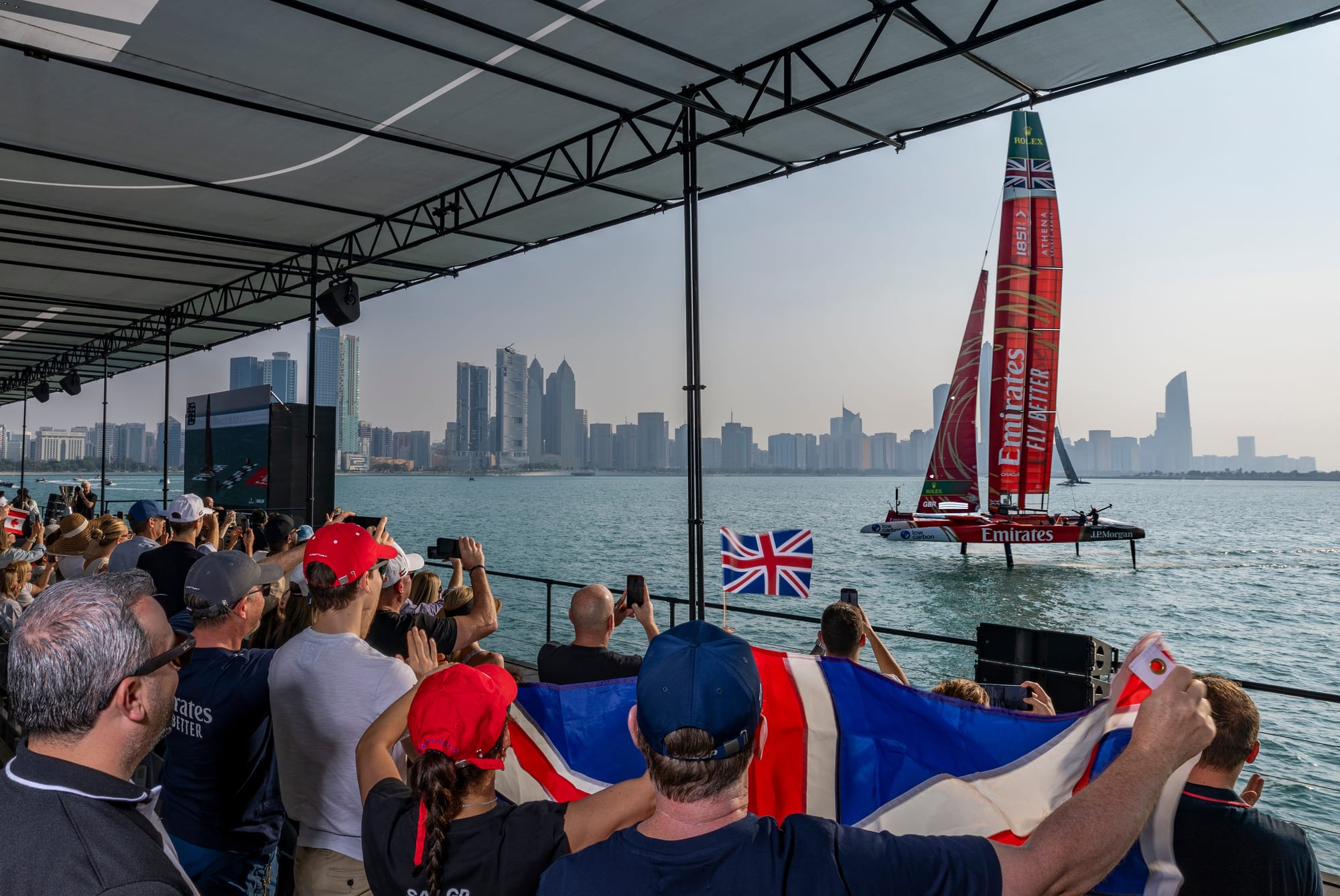
A smooth mark rounding and a slick foiling tack saw the British crew round the final turn mark and head for a victorious crossing of the finish line. Celebrations could be heard from on board.
Fletcher described his emotions at this point as very similar to clinching gold in the 49er class at the Tokyo 2020 Olympic Games.
“Relief and elation,” he said. “Just really proud of how the team has pulled together through our difficult times this season. We have never let our heads go down, or got angry. We just kept chipping away. I think that final race summed up our season: we just kept chipping away all of the time.
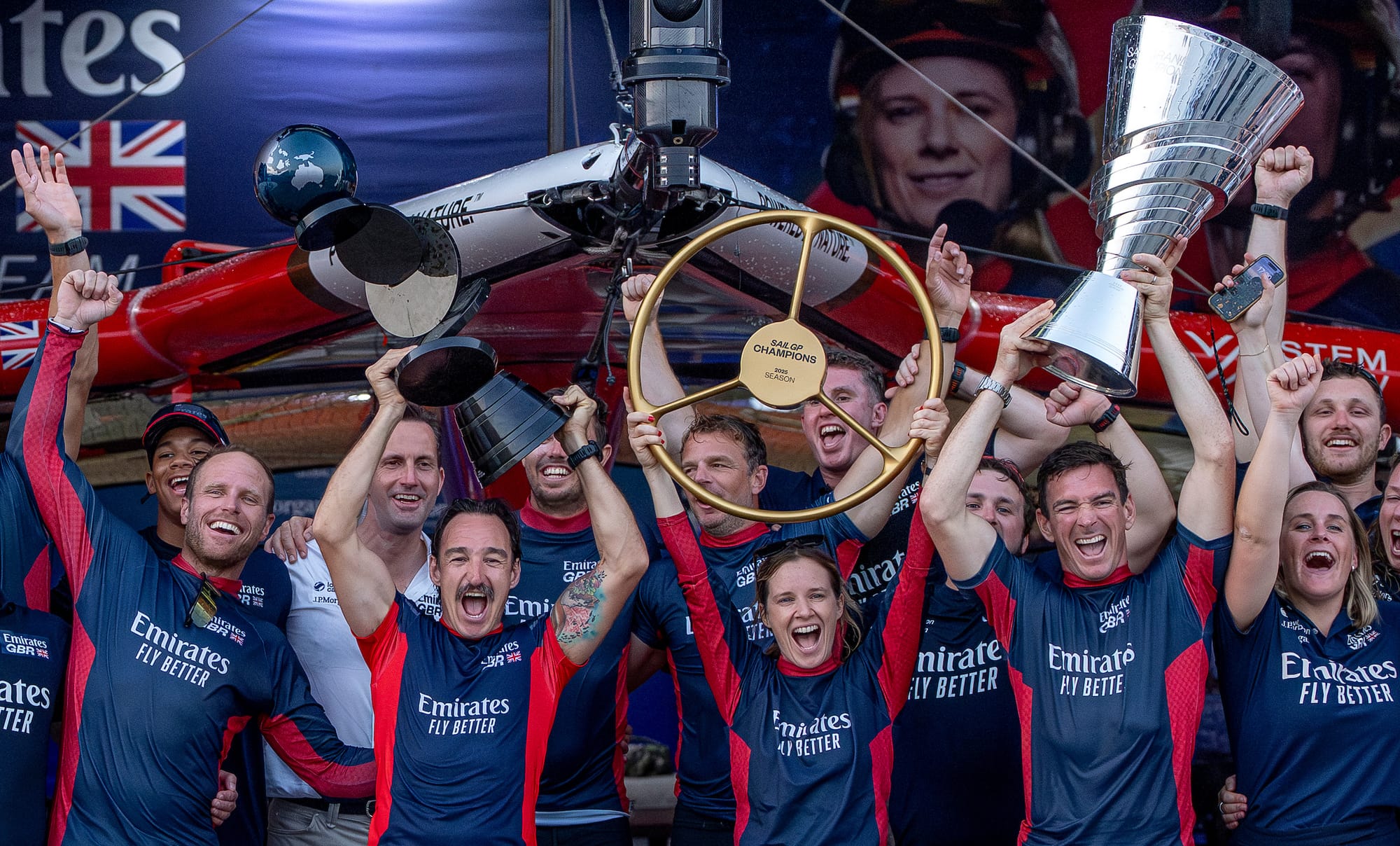
“I feel like this is a team where we all push each other really well. We allow ourselves to make mistakes and it is just a really nice environment. It might sound silly, but we have worked a lot on how to win: what does winning in SailGP look like and how do you increase the chances that we can pull that off.”
For Fletcher, who lost his driver’s seat in the British team at the end of Season 1, this overall victory must taste all the sweeter.
“It feels unbelievable,” he said. “I honestly didn’t think I was ever going to get my seat back. I was looking at all the opportunities out there to drive for anyone. I didn’t find any until I got back with the team so now it feels like I have come full circle. I feel so privileged that Ben [Ainslie] gave me this opportunity ands so proud to be part of what the whole team has achieved.”