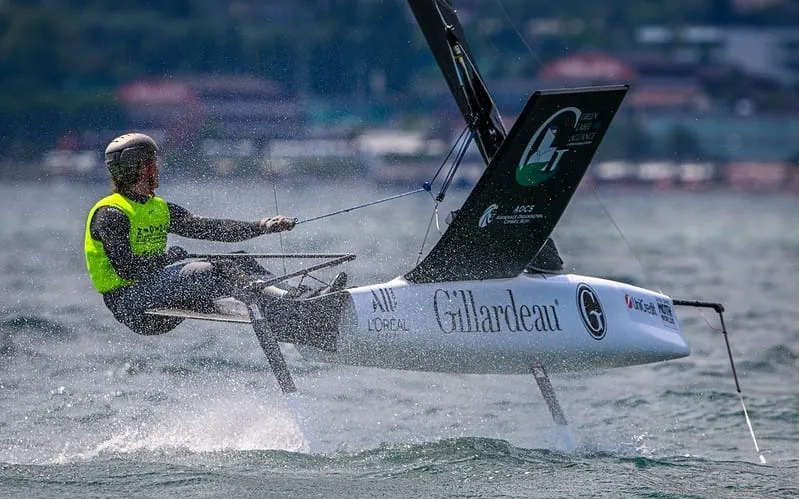



It was June when Balanger first started to hear whispers around the boat park in Malcesine that he was starting to look one of the favourites for the upcoming world championship. There was some justification for the speculation, given that he had just won the Fraglia Vela Malcesine’s Balardi Cup with five wins in six races.
The chatter intensified significantly after he also dominated the 89-boat Moth fleet at foiling week – winning with a counting scoreline of six firsts, a second, two thirds, and a fifth. It was his third consecutive victory at the event. Nevertheless, the young French sailor struggled to imagine himself as favourite for the world title.
“When you are 24 years old and you see the entry list of the Moth Worlds I think it’s not realistic to think you can win this championship. My first priority was to be able to say to myself that I had done everything I could to be ready for this regatta. Then I really wanted to be able to enjoy racing against sailors like Tom Slingsby and the rest of those top guys. Because it is not every day you get to race bow to bow with people as good as that.”
That’s some impressive attitude and it was an approach that Balanger says stopped him feeling too much pressure once the Worlds began and allowed him to race with confidence in his preparation, technique, and boat speed.
“I was really happy with my preparation and I was confident in my VMG and my skills on the water. Before Foiling Week I was ready to fight for a top five spot and if I got on to the podium, that would be crazy cool. Winning Foiling Week gave me the confidence to know that I could beat these guys if I sailed well.”
Balanger may not have been a Worlds favourite in his own mind but he said that going into the world championship series he was “ready to fight for a top five or podium” but also very much at peace with himself and his preparation for the event.
“Foiling Week was a really important week for me. I had already won twice over the last two years. It was my first big senior regatta to win in 2023 and now I had managed a ‘three-peat’. I said to my coach: “I think my summer is already won. I am happy with what we have done and now whatever happens, I’m happy – so let’s go racing.”
That said, the five days between Foiling Week and the Worlds felt like an eternity for Balanger, who was raring to get going.

If you looked purely at the results it would be easy to conclude that Balanger won his world title at an easy canter. Nothing could be further from the truth, he maintains.
“A lot of people told me the same – that it looked like I was cruising around. But I never raced in a tougher fleet in the Moth. If you missed one tack you lose 15 places. That’s what happened to Tom Slingsby in Foiling Week: he was first and then missed a tack – because he was not ready with his boat handling – and ended up 15th. His result in the end was not great but we all knew his speed was really good.”
The event started with racing in a 20-knot northerly Pelèr morning wind rather than the southerly Ora that more commonly blows in the afternoon. In fact, the presence of nearby thunderstorms meant the normally reliable Ora was in short supply all week. Balanger said that starting in 20 knots helped him settle in quickly to the regatta.
“In that much wind you really have to focus on yourself, on your skills, and the technical aspects of sailing the boat,” he said.
Nevertheless, a broken vang during the opening race of the day saw him finish third and then have to race ashore to replace it. With the clock ticking down to the start of the second race Balanger was up against it, but surprise support came in the form of a group of bystanders who helped him quickly affect the repair and get back out in time for the second race – which he won.
“It’s something we all know about the Moth class but it is always a pleasant surprise when you experience it,” Balanger recalled. “There were about 10 people who helped me get my boat out of the water and brought me a spare lever and some rope and helped with the repair.”
Despite going on to rack up a 1,1,3,4,1 score over the coming days, another breakage – this time a snapped forestay – put him out of the penultimate day of the series and could have scuppered the French sailor’s chances of victory. Happily for him the forestay broke while he was 50 metres from the shore and he was able to get the boat back to land unaided.
“It was a four race day and this was the third race,” Balanger explained. “There was a small piece of metal that was keeping my mast up a bit and I was able to sail to shore. Then it was the same thing – about 15 people running into the water to help me get the boat out, remove the forestay and put on a new one. It was really stressful but I feel like all those people gave me a lot of energy to get back in time for the last race of the day.
“I gave it everything I had and I won it. After that race I was exhausted. I spent 20 minutes in the rib trying to recover. But after that experience I felt like: “OK, tomorrow I can win the world title. I was so close to losing it and I survived.”

But with up to four races scheduled on the final day, nothing was certain. An early start saw Balanger finish fourth in a morning race that was sailed once again in the northerly Pelèr breeze. Australian Tom Slingsby won that race to move up from fourth to second.
“The forecast was really bad for the day,” Balanger recounted. “I had a terrible start. I was close to being over the line so I stopped the boat to avoid being disqualified. That meant I started at the back of the pack and I could see that Tom was already in the lead.
“The thing was that everyone else in the top 10 was really close too. That was good for me because it meant I didn’t just have to focus on one guy. So many guys could have caught me that I knew I just had to sail well.
“So I just focused on myself. I managed to find a good lane and pick up the big shift. I hiked like it was the last day of my life and I think I still was carrying the momentum from the rest of the week. I knew that my discard up until then was a fourth so I knew I could afford to take risks.
“I pushed the boat really hard: flying really high and almost losing the rudder maybe five times. But I didn’t care because if I fell off the foil then I fell off the foil and this would be my discard. I think that because it was the last day other people were not pushing as hard as they were maybe protecting their ranking. That allowed me to pull back through from seventh at the final windward gate to fourth at the finish.”
With the fleet sent back ashore to wait for more stable conditions to materialise for the final two races that the race committee hoped to stage, Balanger felt comfortable with a fourth place as his discard, but cannot deny that the pressure of waiting around for a few hours made eating a bit of a challenge.
“I wasn’t hungry but I knew I needed fuel for energy,” he said. “We made a big check of everything on my boat and found that the spare forestay was close to breaking again and had to be swapped. I was ready to go and fight for the title. I knew I was quick.”
However, with thunderstorms circling the area Lake Garda’s thermal southerly Ora breeze had no chance of establishing. When the race committee announced that no more than one race would be possible, Balanger knew he was in an unassailable position in the standings – but he cautiously held off on any celebrations until the committee finally cancelled for the day.
“I knew I had won but I wanted to see the ‘AP over A’ flags [no more racing] because if the wind suddenly came good then maybe they would run more races and I would look like an idiot. They flew ‘AP over A’ and I didn't really know what to do. It’s not the same when you celebrate ashore rather than on the water. Slowly people started to come over and congratulate me and that’s when it dawned on me: “Oh. I think it’s done. I think we did it.”

Balanger said the full impact did not kick in until he called his father just before the prizegiving and heard the Marseillaise being played as he stepped on to the podium.
“My dad said ‘You did it man. It was your dream and now you did it.”
In the days following his world title victory Balanger made a tour of his sponsors in France to thank them for their support. Two weeks later however he was back in his Moth as he began preparing for the 2026 Moth World Championship which is scheduled to take place at Mounts Bay Sailing Club in Perth, Australia next November.
“I want to live this moment again,” he told me. “So yes, I’m already back in training.”