



'Some people still want to have fun in small, fast, simple boats.’ It’s a bold statement of belief, un cri de coeur if you like, from César Dohy, the sales and marketing manager for La Rochelle-based RM Yachts.
And it comes ahead of the premiere of the yard’s new 32ft RM 980, designed with Marc Lombard, in September 2026 at Le Grand Pavois boat show. Expectations are high because its predecessor, the RM 970, won the family cruiser category in European Yacht of the Year 2017, the marque’s second major award having won the same category with the RM 1260 in 2013.
Is it an update or a brand new design? ‘It’s a new boat,’ Dohy explains. ‘It’s important for us because the first RM was nine metres: the RM 900 (launched in 1989). We always wanted to produce small boats, easy to sail and to maintain. Our owners (Grand Large Yachting since 2020) are keen on much larger boats but we have a lot of customers who want reasonably sized boats, like the 30 and 32-footers, and they are growing with the brand. Almost 30 per cent of our current customers have had RMs before.
‘We took the RM 970, which was a 10- year-old design, and we went through the same design process as the RM 1080. We wanted to have a fast reaching boat, that’s why we have the high cockpit coamings. We moved the mast aft quite a bit, 150mm, then we moved the keels and the rudders and she is much more powerful than the RM970. The bow is wider, that’s where we get the power. She will be quite fast reaching and downwind.’
The reverse sheer line is signature Lombard, as are the forefoot volume and raised bow to encourage early planing. The beam is prodigious at 3.7m (12.1ft), bearing in mind that a Sun Fast 3200 has a beam of 3.48m (11.4ft). This beam is carried well forward to increase that power, and create a decent forward cabin in the process.
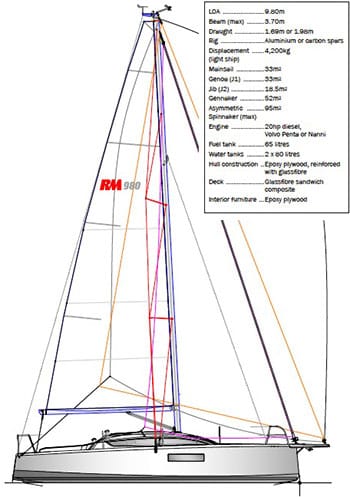
With full mainsail and furling J1 by Incidence on a Z Spars two-spreader aluminium mast (there is a carbon option), the RM 980 has 66m2 (701ft2) of upwind sail area. Offwind, a combined bowsprit/ anchor roller flies a 77m2 gennaker and a 105m2 asymmetric. There is also the option of a 15.5m2 (167ft2) staysail, on a fixed stay or flying on a 2:1 halyard, with a furler and running backstays.
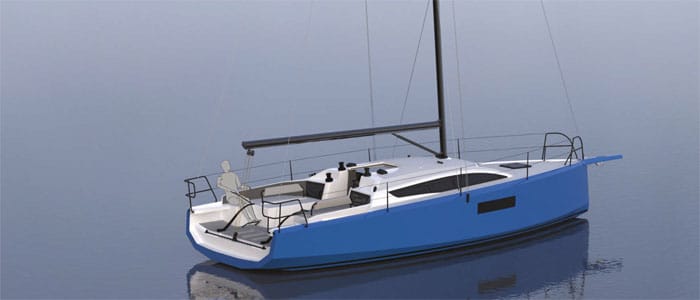
Deck gear includes a cockpit-width mainsheet traveller just above the transom for efficient boom-end sheeting. Halyard and sheet winches by Lewmar are mounted on the coachroof either side of the companionway so that you don’t need to risk kneeling down and leaning outboard as you would with coamingmounted winches. The cockpit seats either side are divided by a backrest so that crew can sit safely inboard while sailbags are stowed outboard, and at anchor the backrests can be removed to create sun loungers either side of an optional cockpit table, fixed or removable.
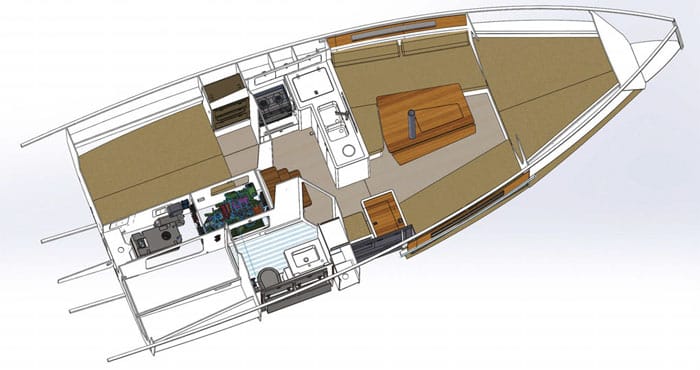
The design process that resulted in the RM 980 was very much a meeting of minds, as Dohy confirms: ‘We have a strong design team within the yard, so we went to Lombard Design with some ideas and they had a lot of ideas as well. We had a target weight, size and price so the design box was quite tight. The boat is quite different inside as well. The saloon area will have a full sofa for the first time. The boats are getting beamier and beamier so you get a lot of space inside, but space can add a lot of weight. We had to find a good compromise for that.’
‘We went through 15 to 20 design iterations. We had to be careful because it’s not a racing boat, it’s not for specialists. It needs to be able to go around the world but it also has to be a family boat, used just for a few weeks in the summer. You have to blend all these different stories into one boat, which is quite hard. Grand Large Yachting is pushing for world rallies and cruises so we had to make sure it’s a Category A boat that can cross oceans without too many changes, which is quite a big task on a smaller boat.’
When asked in which respects does the RM 980 fit with the yard’s philosophy, Dohy is clear. ‘The first thing is wood, you’re in a wooden boat, which is composite at the end of the day because you have epoxy resin infused into the wood, so an RM boat is dry and well insulated inside. The weight is also interesting. It’s like a mass-production composite sandwich boat, which is good because solid plywood is strong, so that’s the beginning of the story.
‘Next, we like fast boats. When we say fast, we’re working on average speeds because a lot of the boats are travelling around the world. You have to make sure they can sail downwind at 9, 10 knots average speed for the 32-footer. You need well-designed keels and rudders, and a boat that is stiff, stable, and easy to steer and manoeuvre.
'On the other hand she needs to be sexy. RM boats owners can be solo sailors, charter companies, or families for a few days a year, more like a Sunday-driving Porsche, so she has to be able to do a lot of things. She takes a lot of ideas from blue water cruising boats, the racing market, she’s in the middle of a lot of different stories.’
In today’s market, nailing your company’s colours to the mast of a 32ft wooden boat may seem certifiable, but it is a decision made with great conviction, and one that is very much in keeping with RM Yachts’ philosophy. This is a quirky shipyard – even in France, which is saying something. It builds and has always built chined wooden hulls, with epoxy-infused okoume marine plywood.
The deck is GRP foam sandwich and a galvanised steel frame laminated into the structure bears the rig and keel loads. Most of its boats have twin keels so that they can dry out on the varied estuaries and beaches that adorn the French Atlantic coast.
While the boat will happily sit on its keels, a laddered post attaches to the transom to provide a third point of support and let her crew get on and off. There used to be a single rudder option deep enough to provide that third point but now all boats have twin rudders.
Its yachts stand out from the crowd in other ways too. Performance is important and the Marc Lombard Design Group has been its design partner of choice since 1995. Interiors are no-frills to save weight (the RM 980’s light displacement is 4,200kg) and finished for ease of maintenance, a theme also seen in the yachts’ tech rooms, dedicated spaces where all systems can be accessed easily.
‘It’s very important for boats that are cruising around the world,’ adds Dohy, ‘because they have a watermaker, batteries, all the stuff, so they have to maintain the boat on an every-day basis. I was surprised when talking with an RM 1080 owner who is sailing around the world, that he spends an hour every day maintaining the boat. You can spend a lot of time in this technical area.’
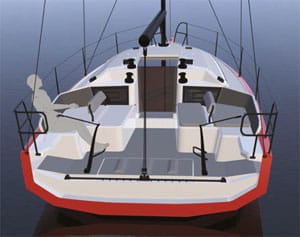
1. The RM 980 carries its full beam a long way further forward than the 970, which it replaces. The cockpit seats convert to sun beds with the backrests removed. |
The amount of natural light, reflected by the white interiors, is remarkable, through the hull ports that have featured on every RM since the RM 1050 launched in 1998, and the huge all-round coachroof windows. ‘It’s a deck saloon actually,’ Dohy corrects, ‘that was the original design principle. When you’re sitting at the chart table with the autopilot remote control, you have to be able to see other boats. It works brilliantly on the smaller boats but on the bigger boats the freeboard is too high.’
What’s more – and this is increasingly rare – they build small. ‘Usually we make 20 to 25 boats a year and we have five different models from 28ft to 45ft,’ Dohy adds. ‘Each year we make three RM 1380s (45-footers) and then it’s a mix of different sizes. These days we have the RM 1080, which is the 36-footer, and she had a lot of success so we’re making 12 every year now. It’s a mix.’
RM Yachts used to be a very local product, one tailored to sailing in Charente-Maritime. But those localityspecific qualities, great visibility, fast reaching and fun sailing, unfussy comfort, ease of maintenance and the ability to dry out, have also found favour elsewhere.
‘It used to be a very French brand but now more than 60 per cent of the boats are going abroad. We have owners everywhere: France obviously, the States, Canada, northern Europe, the UK. We don’t have typical owners. We have racers, cruisers, families, charter companies, sailing schools, yacht clubs. The one thing they all have in common is that it’s not their first boat. They have owned massproduction boats or racing boats before and they know why they want an RM.’
With a kitted-out price estimated at €220,000 ex VAT, it’s not difficult to see the appeal of the RM 980, but you might be wise to place your order sooner rather than later. ‘It’s a small shipyard, we have 40 workers,’ he admits, pointing out that each boat is hand-built. ‘It takes five-to-six months to build a boat, which is very long in this industry, so we have to be clever to make sure the price doesn’t get too high. We’re building boats like one-offs, to order, because we don’t have any stock, so it’s quite a long wait.’
Every yacht marque has its headwinds and RM is no different. What you cannot help but admire is its defiance, its resolute adherence to doing things its own way. Since its foundation by Jean-Claude Oudry in 1989, right at the tail end of France’s leisure boating boom, RM’s vision of sporty cruising in simpler, smaller boats has been ardently retained, to the delight of a nebulous but extremely resilient market.
‘We spend quite a lot of time with owners of different brands and we believe that RM makes simple boats compared with the others,’ Dohy says. ‘You don’t have AC, biminis, fridges all over the place, BBQs and all that stuff. If we stick to the simplicity, the unique principles that RM has had since the beginning, we will survive. We are sure that some people still want to have simple, fast boats that are easy to maintain. I guess that’s why the brand is so strong.’


