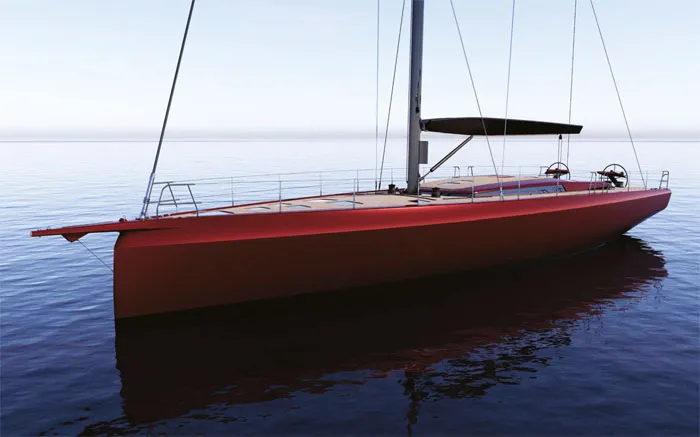

There’s a buzz around the ICE Yachts shipyard, some 30 miles east of Milan. In a matter of months, the shed doors will slide open and out will roll their new flagship: the first Felci-designed ICE 80 Blue Water Sport.
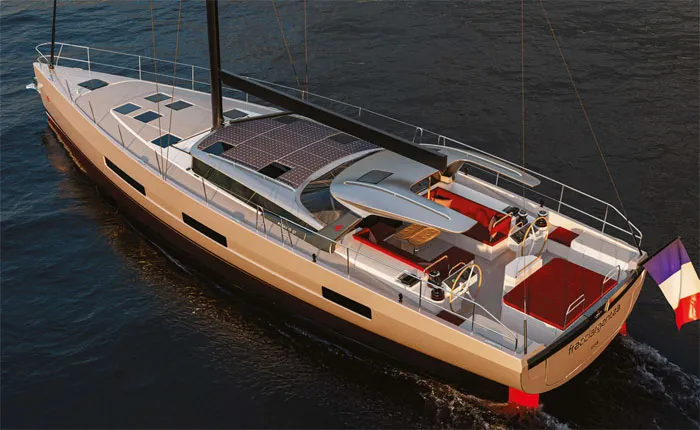
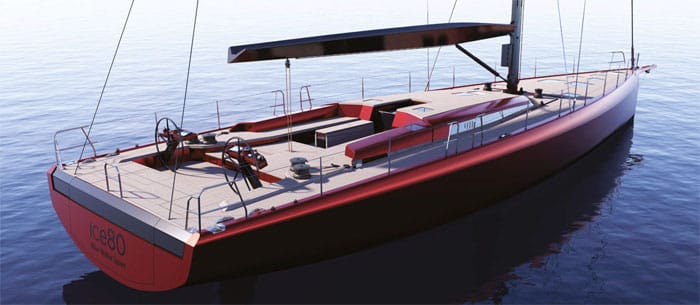
This is a 24m yacht with a 6.5m beam, three en-suite cabins for six guests including the owner’s suite forward with a walk-in wardrobe, and two bunk cabins for four crew aft, also en suite.
Hull, deck and bulkheads are built in carbon fibre on a closed-cell foam core using a one-shot epoxy vacuum-infusion process, with solid carbon laminate around high-load areas. Power comes from an Axxon carbon mast and furling boom flying a North Sails wardrobe featuring a pinhead main, furling self-tacking jib and staysail, with a furling code zero and/or gennaker flown from a 2.1m carbon bowsprit.
Sails are handled by Harken electric winches, a hydraulic captive mainsheet winch, and hydraulics for the vang, backstay, forestay and some halyards. That power translates into speed through an APM-manufactured telescopic T-keel that rises hydraulically from 4.8m, to optimise upwind performance, to a more anchorage-friendly 3.1m, the stroke calculated to protect the 3m-deep single spade rudder, also in full carbon on a solid carbon stock. A single rudder was chosen for a better feel at the wheel and control in marinas, though there are bow and stern thrusters.
This boat’s story began three years ago when the owner of an ICE 70, a fast cruiser on which he spent a lot of time sailing a lot of miles, was looking for something larger and a little more sporty. He was shown preliminary drawings for a performance 80-footer and was instantly seduced. Then plans changed. ‘We like to get to know the owner,’ says Lake Garda-based designer Umberto Felci. ‘After so many years we’re good at profiling clients, we understand quite easily what their expectations are. If we’ve got it right, everything becomes very easy. But if the first shot isn’t close, then you’re not connecting.’
‘We got into the details of how he spent time on board and what he really wanted from the boat,’ Felci continues, ‘and we realised that his expectations were more in line with the 70, a blue-water boat. So the project shifted into a mix between the 80 Sport and a blue-water cruiser where you can live and spend a lot of time.’
It’s also these discussions between owner and designer that begin to anchor a boat in reality. ‘The weight of the boat is not the designer’s choice,’ he adds, ‘it’s decided by the technical brief. You need to know who will build the boat, how the boat will be built, what the customer wants to put into the boat. When you have the weight you can make the best hull shape to bear this weight and create the least possible resistance.’
In this case the technical brief threw out 37 tonnes as the target displacement – 10-15 per cent lighter than comparable 80ft performance cruisers and almost two thirds of more conventional 80ft bluewater cruisers – and Felci began to work his magic. ‘You don't want to sail the boat at 30 degrees’ heel, so form stability is very important. At the same time we need a fast boat so we have developed a hull shape that fits those two requirements: a sort of chalice-shaped hull with stability when the boat heels but with a particularly low resistance when the hull is flat, sailing in light wind or motoring.’
Felci and Giovannozzi (his partner founder in Felci Yachts) have an impressive track record of finding the right balance between design priorities. Racing or cruising, their ability to understand the client’s sailing style is unerring. They have an interesting view on perceptions of compromise too, that inevitably it falls between two stools. ‘This is not our thinking. For us a compromise gives the best of two ideas: performance and comfort. With your customer you can choose, so 80 per cent performance and 20 per cent comfort, or the opposite. You have to decide with the one who has to live with the boat.
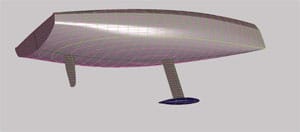
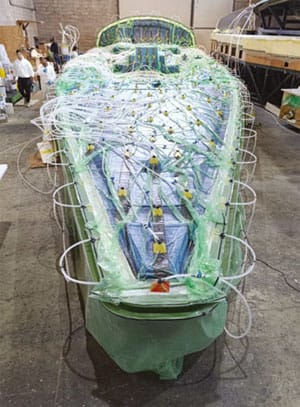
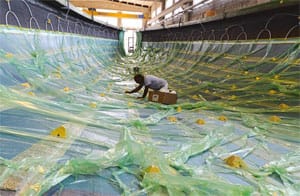
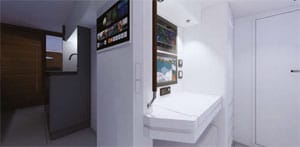
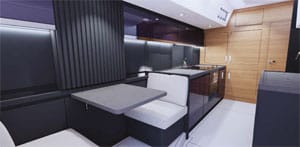
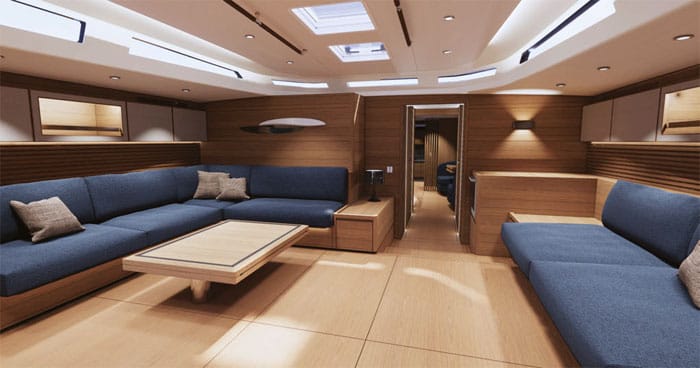
1. Final displacement was set by owner’s and shipyard’s technical brief. On these bases Felci Design Team developed the best possible hull shape to carry it. 2 & 3. Hull, deck and bulkheads are built in carbon fibre on a closed-cell foam core using a one-shot epoxy vacuum-infusion process. 4. The nav station is aft, accessed via the crew companionway. 5. Modern minimalist styling in the saloon and galley.
‘We designed the Felci 61 which won – and is still winning – the Giraglia 25 years after its launch. It means the balance between performance and comfort was correct to make a winning boat.
‘It’s easier with a bigger boat because they are intrinsically faster and narrower. In this case we have a boat that is a fullcarbon build with lightweight sandwich interiors, and an owner who decided to be quite minimalist to avoid a lot of systems and structure, so life was quite easy.’
There will be those who contend that light displacement may make this boat unsuitable for heavy weather. Felci, however, sets the highest standards for his blue-water designs. ‘There are no excuses, the boat must be robust and safe in any conditions. It must sail perfectly upwind in heavy weather. These are the worst conditions and your boat has to be ready for them.’
This same insistence on all-weather capability also applies to the sailplan. The furling staysail and mainsail give the yacht plenty of heavy-weather gears to work through but an enormous amount of thought has gone into redundancy too: what happens to electric and hydraulic-powered kit when the lights go out.
‘The furling mainsail makes the boat easy to sail with a shorthanded crew. Its big disadvantage is failure but today’s furling booms have back-up systems that allow you to drop the mainsail even if there is a power failure. In a 50-footer you could just take it down, in an 80-footer, this may be a problem. We’re working with the producer to make sure that the back-up system works well.’
The same ethos applies to the mainsheet. ‘We use a German system. One of the mainsheets goes to the captive winch below deck so the owner can trim and ease while steering. If there is a power failure, there is a locker in the cockpit with 10-12m of extra mainsheet close to the winch so you can trim the mainsail in the traditional way. It makes the project more complex because you have to think of all these little details, but in the end it’s a plus for the boat and the owner.’
ICE Yachts CEO and co-founder Marco Malgara adds: ‘The 48V electric system is not an undemanding choice for the yard, but during the build of our latest ICE 64 Explorer, we found that it saved about 300kg and improved the functionality of the electrical system. That drove us to use this innovative solution once again.’
In initial discussions with the owner, it emerged that he would sail with family and two crew. How did that influence deck design? ‘We wanted to create two different areas, one for sail handling and another guest area for the family, but we didn’t want to go back to the traditional layout with two totally separate cockpits. We tried to create the feeling of one cockpit but with a crew companionway aft. So we raised the cockpit sole and built a transverse-sliding hatch that, when closed, is flush with the deck.
‘It’s a long companionway with good steps, at least 30 degrees for easy access. It can also be used by the owner if they want to do some navigation, because that’s where the nav station is.’
For ICE Yachts, Felci Yacht Design controls both interior and exterior design, which Felci believes creates a more efficient environment: ‘It’s not the same if you are sub-contracting part of the project, it’s not impossible but it’s more complicated. We like an integrated project: inside, outside, structure – because you can modify the element you need to reach the best result.’
With such a lightweight displacement target, ICE Yachts’ meticulous construction process is carefully monitored. ‘We're keeping track of all the weights and their positions on board through a constantly updated CG file,’ says project manager Arturo Bono, who has been with the company’s technical office for seven years. ‘During construction every weight is double checked, and total weight distribution is monitored through load cells under the boat cradles.’
Cooperation between Felci’s design office and the yard’s technical office has been enhanced by the digital evolution of design technology and the wholehearted way Felci uses it. ‘I like to sketch with the 3D modeller, it’s quite fast and easy for me,’ he says. ‘We have a virtual room in the office where I can put on a headset, go inside and interface directly with the 3D model. Sometimes the yard’s technicians come here because they want to analyse the engine to see if there is enough space around it. They can open a locker, put their hand inside and see if they’re able to replace a filter or not. My customers come to look at the space inside, outside at the wheel to see if they can reach the winch. It opens up a lot of possibilities.’
One of those possibilities is different interior layouts, another is deck layouts: ‘Both we and the yard are absolutely open to customisation,’ Felci adds.
The overriding impression from this project is of a team that is both creative and driven in its desire to reach a goal. Indeed that’s the reason the yard is where it is, as CEO and founder Marco Malgara explains: ‘I was looking for a used 60ft yacht and in my opinion the best on the market was the Felci 61, built by the CN Yacht 2000 yard in Salvirola. After a while I still hadn’t found the boat I wanted so, with Umberto Felci’s support, I rented the yard that built it and created the boat of my dreams, the ICE 62, which was a direct evolution of the Felci 61.’
The yard is planning to sea trial the ICE 80 in July with Felci on board (‘It’s quite a stressful moment, the first time, but I love it’), after which ICE Yachts’ new flagship will make its world premiere at the Cannes Yachting Festival 2026.
So what’s next for the yard? ‘We showed with the 66 and the 70 that we are a top-level brand,’ says Malgara. ‘Now the 80 will raise our profile and underline that we really are the go-to yard for experienced sailors. We are a very exclusive builder, five to six vessels per year. We have had requests to build at 90ft and 100ft, which would be a great opportunity and for sure something we can manage. For the moment we are super focused on the 80, and two potential sisterships at the preliminary concept phase, but we won’t rule out building bigger.’