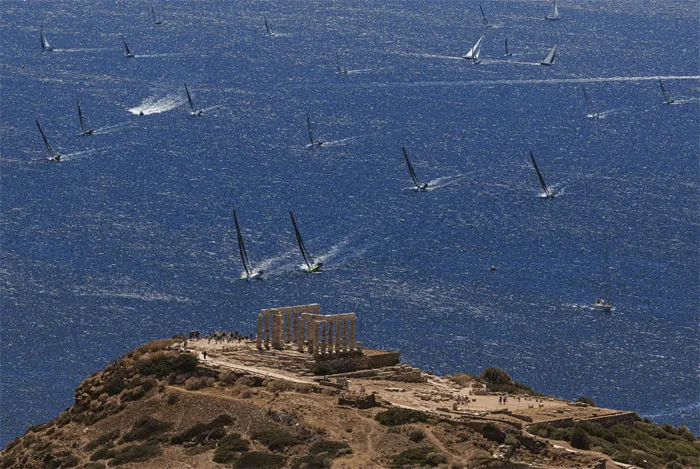

This annual 605- mile tour of the Aegean Sea organised by the Hellenic Offshore Racing Club (HORC) not only continued to attract teams from all over the world who wanted to challenge themselves on one of the most interesting courses in offshore racing, but this particular edition featured the full spectrum of sailing conditions to truly test every team’s skills throughout the race.
To set the stage for this story, first consider the general setting: the crystal blue waters of the Aegean Sea have been attracting seafarers for many millennia. First for trade, commerce and fishing, it was the impressive skills of Greek sailors that were able to sustain and connect the people and cultures of the islands and the mainland to create one of the world’s greatest civilizations. In more recent times sailors from throughout the world still come regularly to enjoy these legendary waters in pursuit of fun, leisure and recreation.
Whether ancient or modern, Aegean mariners have often faced the full range of seamanship challenges to complete their voyages, from the patience and persistence needed to get through drifting, windless conditions to the fury of gale-force winds and rough, breaking seas that can threaten the safety of the boat and her crew. Just as Odysseus faced the Sirens in Greek mythology, the clear warm seas of the Aegean still beckon all of us sailors with a mythical mix of allure and challenge.
Perhaps more than any other running of this race, the fifth edition in 2025 epitomised this fascinating lure of the sea by featuring all conditions of wind and sea throughout the racecourse. No records were set, unlike the previous year when brisk conditions for the fast boats allowed two ultra-fast offshore greyhounds, the MOD 70 trimarans Argo and Zoulou, to zip around the racetrack in their quest to set a new course record. Similar weather in 2023 produced a new monohull course record set by Leopard 100. However, the 2025 edition of the Aegean 600 yielded a satisfying variety of conditions for a wider selection of entries in the fleet.
Besides the Aegean’s legendary sailing conditions, every story about the Aegean 600 begins and ends with the event’s signature culture of Greek hospitality extended to all participants at the event. The world-class facilities at Olympic Marine, co-organiser of the race, must be among the finest in all of offshore sailing. This a new full-service operation with an enormous modern marina for all sizes and types of vessels to meet their berthing needs, including superyachts. It is also a major marine services hub for the region with a complete array of maintenance, repair and fabrication facilities on site to meet every possible need of the racing and cruising sailor.
Greek hospitality is also in full display at the Aegean 600’s two evening social events held under the stars: the opening ceremony at Olympic Marine and the awards ceremony held in nearby Lavrion. Both feature the very best in cuisine and entertainment, first before the race to welcome all the teams and their families and friends, and then again after the race to recognise those who have emerged victorious, to show appreciation for the generous support of the race sponsors and to celebrate the significant achievement of all who have helped create their very own legends in Greek sailing.
Another important feature of every edition of this race is an emphasis on safety, so HORC each year organises a certified safety seminar held in advance of the race to provide instruction on use of the equipment and techniques necessary to meet the standards for World Sailing’s Offshore Special Regulations Category 3 requirements, including liferafts. Since these standards evolve, HORC race organisers will continue to offer this seminar so the information provided is current, relevant and informative.
Organisers also offer an opportunity for teams to practice their boat handling and crew work in the Attica warm-up race held two days prior to the start. This initial test gives teams a small taste of what’s to come later with the main event.
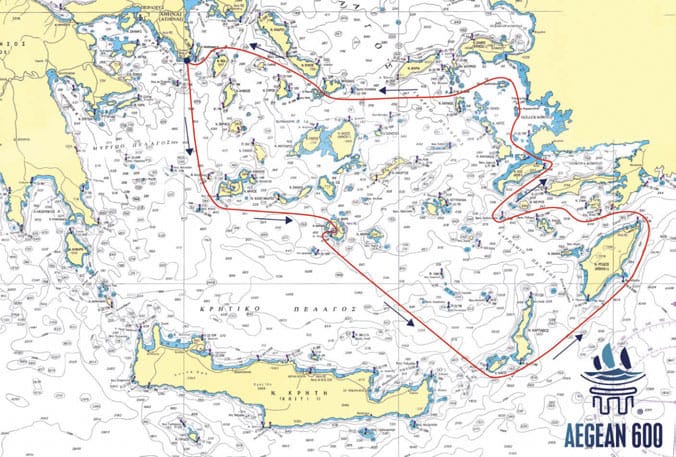
In 2025, in a slightly diminishing Meltemi breeze, it was 60 teams from 18 countries that got off to a fast start under the watchful gaze of the Ancient Temple of Poseidon perched on the cliffs of Cape Sounion. Under a bright blue sky, dozens of fans and spectators lining the cliff edges watched the fleet approach the weather mark then launch their spinnakers to set off downwind on crystal clear seas flecked with whitecaps towards their first turning mark, the island of Milos – the first of 23 islands they would pass on this long course.
With the temple, the cliffs, the cloudless skies and brisk breeze, this starting scene is truly amazing, leading many to remark that there is simply no more beautiful starting venue in all of offshore sailing.
These fantastic conditions started to change in the first evening of 2025’s race as the breeze faded while the fleet approached and then rounded Milos towards the next mark of the course, a route taken through the middle of the collapsed volcanic caldera of Santorini. Just a few months earlier some seismic tremors prompted evacuations on the island, a geological reminder of how nature has created this spectacular landform. The transit for nearly all teams was in light air conditions, giving many the opportunity to enjoy the spectacular scenery.
‘Arriving in Santorini we had amazing weather and very light winds,’ says Diego Di San Giuliano, owner of the 69ft Nacira from Italy. ‘This is the ultimate destination for any racer or cruiser who wants to enjoy the beauty of Greece but at the same time appreciate the challenges of the Meltemi, the Aegean Sea, the currents, all the difficulties in approaching such a mythical island.’
Once clear of Santorini and on the leg to the southernmost part of the course and its halfway point, the island of Kassos, the breeze did increase but shifted slightly. Those teams who read this shift correctly had a chance to gain back time from any losses they may have suffered at Milos and Santorini.
This portion of the racecourse at Kassos and Karpathos is notorious for strong, often gale-force winds and big seas between the islands, followed by nearwindless holes behind the islands that can also extend along the 50-mile coast of Rhodes as well. Teams are faced with difficult decisions on how to play these lees: go in close to the beach to pick up any local breezes there or swing out wide to avoid the holes – a classic game of snakes and ladders.
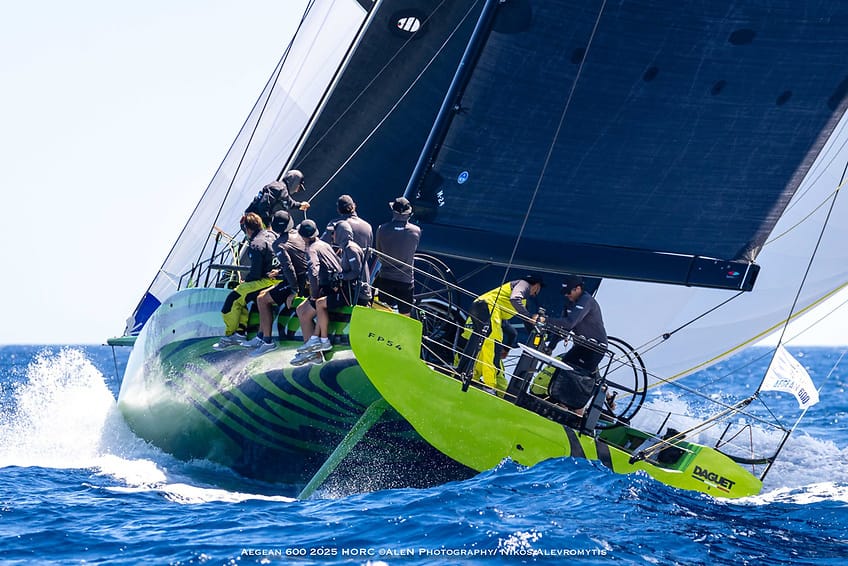
This year’s edition was no exception. These patterns continued throughout the middle portion of the race as the fleet sailed north among the numerous island turns in the course and then west towards the gate at Mykonos before heading onward towards the finish at Cape Sounion. However, after enduring relatively light air for days, the leaders passing Mykonos were blasted with the returning Meltemi where wind speeds reached up to 50 knots. This allowed the slower boats to benefit this time from sailing in more breeze than the leaders for the last third of the race and giving them solid overall corrected time results.
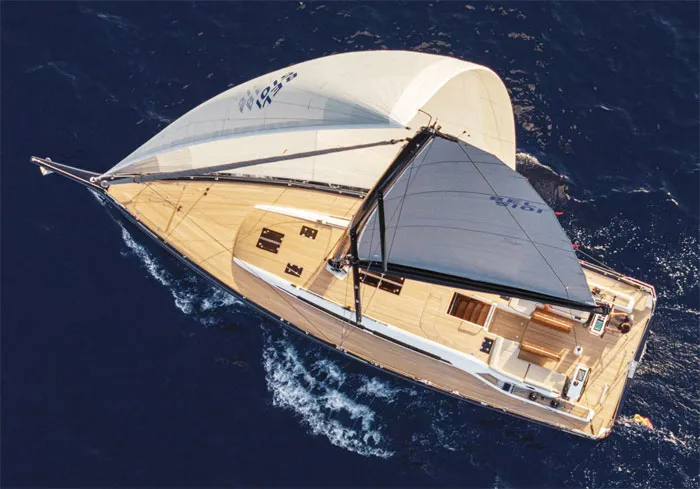
The overall winner in both IRC and ORC scoring was Kay-Johannes Wrede’s Swan 441 Best Buddies IV from Germany, a Ron Holland design that was campaigned in the 1979 Admiral’s Cup for the Swiss team and survived that year’s notorious Fastnet Race unscathed. Yet the enthusiasm among the elapsed time leaders remained high.
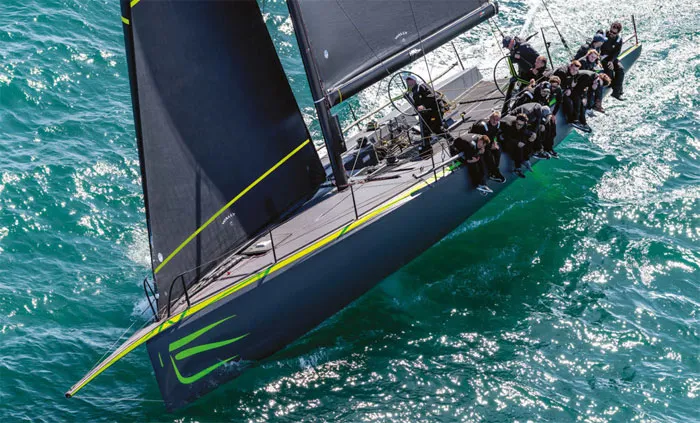
'This was a fantastic race, one of the best,’ says Frédéric Puzin, skipper of the Carkeek 54 Daguet 5, and he should know: his impressive offshore race record includes podium finishes in other 600- mile classics such as the Caribbean 600, Sydney-Hobart and Middle Sea races….
‘I really liked this race not only because of its toughness to have skills tested in all conditions, but also the spirit of this race and its place in history,’ said Puzin. 'The setting here is amazing: the islands, the sunset, and the feeling of all the legendary sailors that have been here doing what we did for thousands of years.’
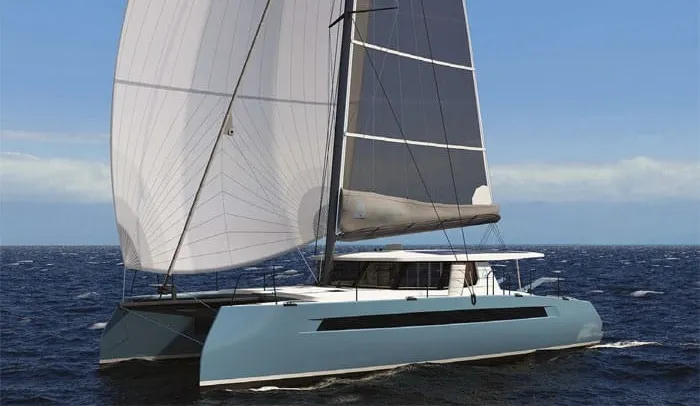
Paul Larson, world speed sailing record-holder and skipper of the largest entry in the fleet, Adrian Keller’s 84-foot luxury performance catamaran Allegra, says ‘We finish this race every time and say “never again” and this is my third time because it is a tough race, a monster of a race, it’s a real challenge. You know it’s going to be a love-hate battle because there’s plenty of love and plenty of hate out there and that’s the thing that brings you back.’
Entries open on 1 December for the sixth edition of the annual Aegean 600, with the race starting on 5 July 2026.
Come join us for an offshore race experience you’ll never forget and to make your own legend in Greek sailing.