
It’s been 45 years since the plans for the original Swan 51 came off Germán Frers’ drawing board and went into production. That was his first design for Nautor and it set the template for a gradually evolving, remarkably long-running and now iconic series of Frers-designed Swans that amounts to 40 different models – more than 700 boats – and still counting.
The nature of sailing has changed quite significantly since then but the brand’s position in the market holds steady and the new Swan 51, again drawn by Frers and launched at the 2025 autumn boat shows, is the model that completes the current generation of Swans.
Some things haven’t changed. Like all of Frers’ previous Swans the new 51 is a handsome, well balanced and weatherly yacht with good motion comfort, helm response and all-round sailing performance, nicely designed cruising accommodation, excellent build quality and a very high standard of finish.
Like all of Frers’ yachts it bears a distinctive sheer line. But unlike earlier generations of Swans, which were dual-purpose boats with equal emphasis placed on both racing and cruising, the core fleet of Swans is now focused primarily on cruising with the separate range of ClubSwan raceboats running in parallel.
Drawing on the experience accumulated from more than 70 yachts built between 48 and 55-feet over the past six years, each tested across tens of thousands of miles in ocean crossings, and regattas by experienced Swan owners, the Swan 51 is designed for ultimate versatility, combining ease of handling for coastal cruising with the reliability and performance needed for extended offshore adventures.
Her mast has been positioned closer to the keel for improved balance and performance, while responsive steering and sail trim deliver a dinghy feeling. As the successor to the original 1981 Swan 51, a milestone model and the first collaboration with Germán Frers, the new yacht re-imagines a Swan icon for a new generation of owners.
Nautor CEO Giovanni Pomati shares his thoughts: ‘The 50ft size has always held a central role in the sailing world. In fact, it's the ideal size for sailing in almost any condition. Sometimes we forget just how much joy a 15m yacht can deliver. The new Swan 51 is easy to sail, offers great comfort with a spacious owner’s cabin and a VIP cabin, and is the perfect way to enter the magical world of Swan. With this model, you truly experience the excellence that only our brand can provide.’
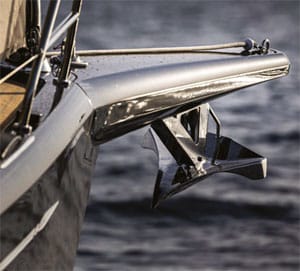
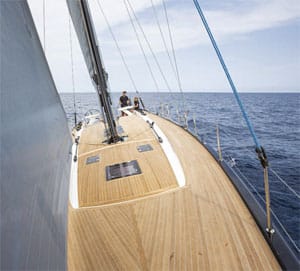
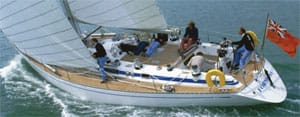
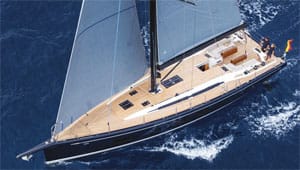
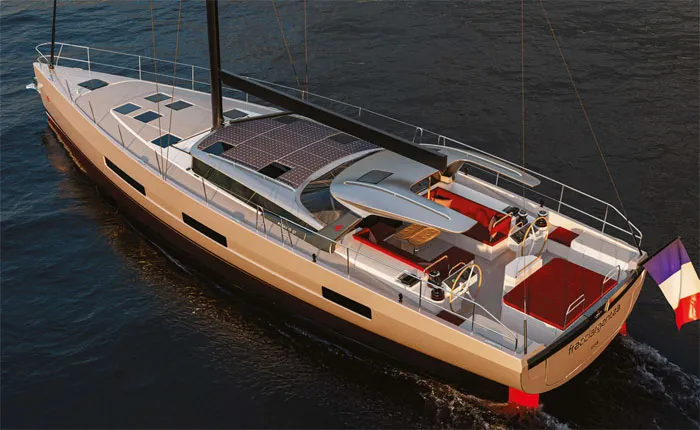
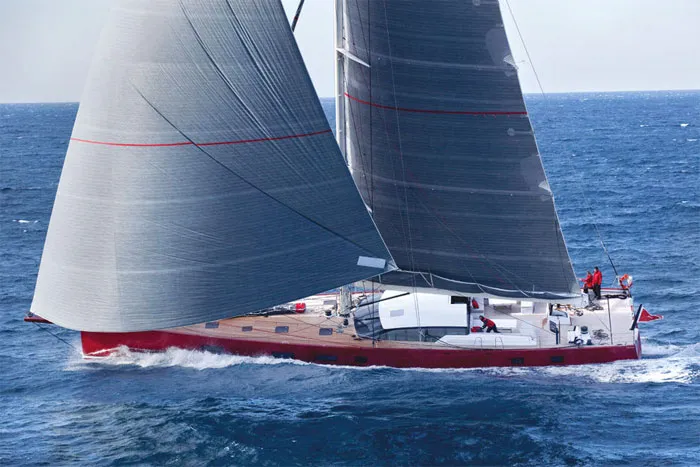
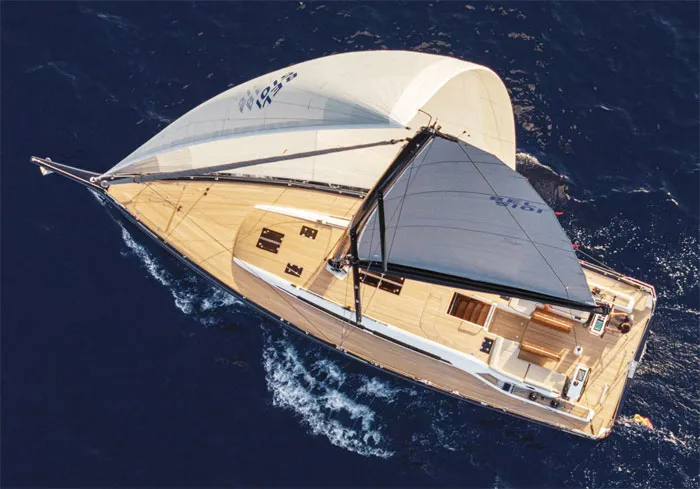
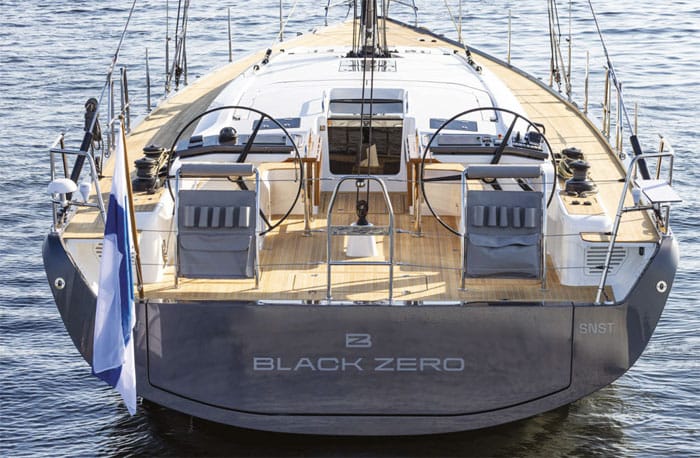
1. The bowsprit doesn’t need a bobstay so nothing interferes with the anchor. 2. A large expanse of flush deck up front does improve the yacht’s aesthetic appeal. The much larger foredeck locker is a great asset for stowing furled code sails. 3. The original Swan 51, designed by Frers in 1980, is the first in a long line of models. 4. The deck plan is clean and sleek with a very large cockpit. The sailplan includes a genoa as well as a self-tacking jib. 5. The master cabin in the forepeak has a big double island bed, together with lee cloths for use when at sea.
‘The concept of a cruiser-racer is no longer realistic,’ Frers says. ‘Racers are now twice as fast, half the weight of a fast cruiser, with much deeper draught.’
High load-carrying ability is increasingly important. ‘Displacement is dictated by the market, it’s what we have to live with,’ he says. ‘Hull design has evolved a lot. We’re now drawing shapes that we didn’t think were possible. This allows us to offer much larger interior volumes and deck spaces.’ It’s a credit to Frers that while meeting these requirements, the fine sailing and handling qualities for which Swans are famous still remain essentially unchanged.
Another thing that defines the Swan 51 is the close working relationship between Frers and the marque’s former owner, now chairman, Leonardo Ferragamo. ‘The new 51 was a project that Ferragamo cared very much about,’ Frers says. It’s perhaps relevant that the first boat the Nautor boss ever owned was an original Swan 51. This latest model also represents a watershed in the evolution of Swans.
Hull design
The starting point for designing the 51 was the existing Swan 48 and Nautor gathered feedback from many owners to feed into the process. In a nutshell they wanted almost exactly the same boat, j ust slightly larger with more headroom, more cockpit space and a lot more stowage, plus the option to accommodate an extra crewmember if need be.
To increase headroom down below – which was already generous on the 48 – Frers raised the freeboard of the 51 to equal that of the next model up, the Swan 55. ‘I used a round deck edge and a carefully drawn sheer line to soften its visual impact,’ he explains. That rounded deck edge is a signature feature that dates all the way back to the very first yacht he designed – in 1958, at age 16. It has appeared on many of his boats since then.
There’s a lot more to this project, however, than simply scaling things up. The hull, keel and rudders were modelled and refined with CFD software to finesse the section shapes and volume distribution, optimising the boat’s performance, balance and helm response, load carrying ability and motion comfort in a wide range of wind and sea conditions.
Upwind sailing performance, that defining characteristic of Swans, is still key. ‘Everyone is a racer when there’s another boat close to windward,’ Frers says, ‘but for a cruising boat the limit to that is draught.’
Germán Frers on yacht design: ‘Keep everything harmonic’
He’s had an incredible career and is still at it, full time, after 67 years. It started with the 10-metre yawl Mirage, launched in 1958 – the first glassfibre boat built in Argentina. His father, the first in a dynasty of naval architects all called Germán Frers that now spans four generations, was reluctant to design a yacht in this new material, so handed the job to his 16-year-old son.
‘My father was progressive, always curious,’ Frers says. ‘He liked what he liked and people followed him. He was designing light displacement boats with broad sterns back in the 1950s. The materials were different of course but in principle it was quite close to what we are doing today.’
‘One thing I got from him, he taught me to care about aesthetics. He always found a way to harmonise things, that mattered to him a lot and also to me. I don’t design anything I don’t like.’
Frers has kept active as a sailor all the way through his career. Before his yacht design breakthrough with Scaramouche in 1973 he was already a top-level ocean racing sailor with several Bermuda Races and Admiral’s Cup series under his belt. He sailed in the infamous 1979 Fastnet Race aboard one of his own designs, Acadia – a sister ship of Blizzard, the design he adapted in 1980 to become the original Swan 51.
‘When we finished the race in Plymouth we knew nothing about what had happened because in those days most electronic equipment was prohibited,’ he recalls. ‘We were celebrating being first to cross the line in Class 1 and someone said ‘Guys, you can’t do this. There’s been a disaster.’
‘When we rounded Fastnet Rock, the storm was already severe. There were a lot of boats, a lot of confusion in very bad conditions. Acadia’s owner Burt Keenan was screaming, ‘We’ve been hit!’ It was just waves hitting us but they felt solid. We had a couple of knockdowns. In one of those, when we were upside down, the fridge exploded. Steering was a real challenge, going down waves at high speed with no control.
‘After that Fastnet my opinions on yacht design were not at all changed. I’d sailed in storms before. The 1960 Bermuda Race was also very rough. Acadia was good, stable and strong. I didn’t see anything that needed to change.’
His IOR designs back then were the genesis of his Swans, which have gradually evolved. ‘It’s a simple formula,’ he says. ‘Keep everything harmonic. The boat must sail well and look good. Don’t be revolutionary, be consistent. Be conservative in the sense of don’t do it unless you’re absolutely sure of it.’
The design process still starts with l ines drawn on paper and intuition does still have a role to play, ‘but we did use a lot of CFD in designing the 51. You get a better balanced yacht than you could with intuition alone. We used to think that the fore-and-aft balance of a hull was important and it turned out not to be.
‘In the times of the IOR we used to meet with Doug Peterson, Ron Holland and others to discuss design. Today it’s a lot more sophisticated. Things have changed.’
When sailing close-hauled or power reaching the Swan 51 is designed to perform best at a heel angle of about 20°. The hull shape confers a fair amount of form stability and the keel bulb provides a moderate amount of ballast.
‘One aspect of performance is that the boat must be sea kindly with a good motion,’ Frers explains. ‘And that goes against having a lot of ballast. With 50 per cent ballast a boat’s motion in waves is jerky. It’s softer with a lower ballast ratio so the Swan 51 is around 33 per cent. But actually, we don’t use ballast ratio as a metric because it can be misleading. This boat has positive stability at 112°, although in reality it is considerably higher, around 120°in light-ship condition, according to available data. In any case, we know it will recover and come back upright in a knockdown,’ he concludes.
Deck plan
Comparing the Swan 51 alongside its predecessor, one thing that’s obvious is the lower, sleeker profile of the cabin top. ‘I wanted to reduce the volume of the coachroof relative to the 48,’ says Frers, who drew the deck plan as well as the boat’s naval architecture. A larger expanse of flush deck up front does improve the yacht’s aesthetic appeal.
Another clear difference is the cockpit. It’s significantly larger, the same size in fact as the Swan 55. The shape of the cockpit is also notable. Its coamings flare outboard in graceful curves as they slope aft and down from the coachroof, providing more lounging space for passengers.
The fixed twin tables have a cleverly engineered feature: the outboard leaf of each one can be lowered to the level of the cockpit seats, providing two broad sunpads while preserving the clear walk-through from the companionway to the helm pedestals. With both leaves of both tables raised, you get one huge table with seating for up to 10 people.
A big increase in stowage space was high on the wish list of feedback from Swan 48 owners. Nautor has taken this seriously. The foredeck locker is almost twice as large, so it’s a lot easier to stow gennakers and code sails furled on their torsion ropes, and easier to deploy them too. The line stowage bins in the cockpit are another excellent feature, highlighting the level of attention to detail that has gone into this boat.
Extra stowage space is also provided in the tender garage, which is just big enough to house a fully inflated 3m dinghy.
Down below
A lot of features and innovations from larger Swan models have trickled down to the 51, along with big-boat engineering knowledge. And as Frers points out, it has a superyacht standard of materials, finish and fittings. This can be seen on deck but it’s most apparent when you go down the companionway steps, into the saloon. Four interior finish options are offered, designed by Nautor’s go-to stylist Misa Poggi.
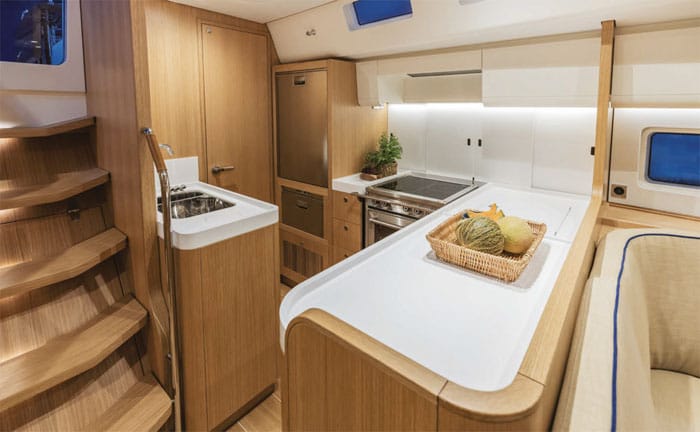
As with the cockpit, the 51’s below-decks arrangement incorporates the best aspects and features from other models in the current range. The galley design has proven itself on the Swan 55 and 48 as an excellent one for cooking at sea. Various configurations of saloon table, seating and chart table are available.
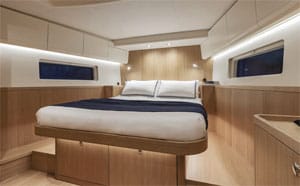
The owner’s suite in the forepeak has a big island bed, together with lee cloths for use when at sea, plus a roomy en suite heads with a separate shower compartment. The two aft cabins are designed as secure sea-berths for offshore passages and there’s a dedicated space for a genset, between them and behind the engine, which has excellent access for maintenance on three sides with the companionway steps hinged up.
It is perhaps significant that the first owner of a Swan 48 was also the first to take delivery of a new Swan 51. ‘There’s something unique about a Swan,’ he says. ‘It’s not just the way it sails, though that alone is remarkable. It’s the feeling it gives you. The way it responds, the way it moves through the water, the confidence it inspires.
‘The 51 is not just a step up, it’s completely new. You recognise the family lines but this boat is a class of its own. What makes it unique is the combination of full volume, refined design and true handling pleasure. It's incredibly wellbalanced, easy to sail with a small crew, and still offers the performance and elegance you expect from Swan. It’s an entirely new boat, not a stretched version of something else. Germán Frers has created something special here.’