

Skip to content

How Tom Dolan won the Figaro du Solitaire by changing his mindset

Tom Dolan made history in 2024 as the first non-French winner of the Solitaire du Figaro. In this interview, the Irish solo skipper shares how a mindset shift, better preparation, and focusing on what he could control helped him finally conquer France’s toughest offshore race.

Image © Tom Dolan Racing

In the summer of 2024, Irish offshore solo skipper Tom Dolan became the first non-French sailor to win the Solitaire du Figaro – widely regarded as the proving ground for aspiring IMOCA around-the-world skippers.

Earlier this year, I caught up with Dolan for an episode of the Yacht Racing Podcast, where he described the arc of his career as a professional sailor – from his introduction to sailing with his father aboard a tiny ramshackle dinghy on a lake near the family farm, to moving to France and becoming a major name on the French offshore sailing scene.

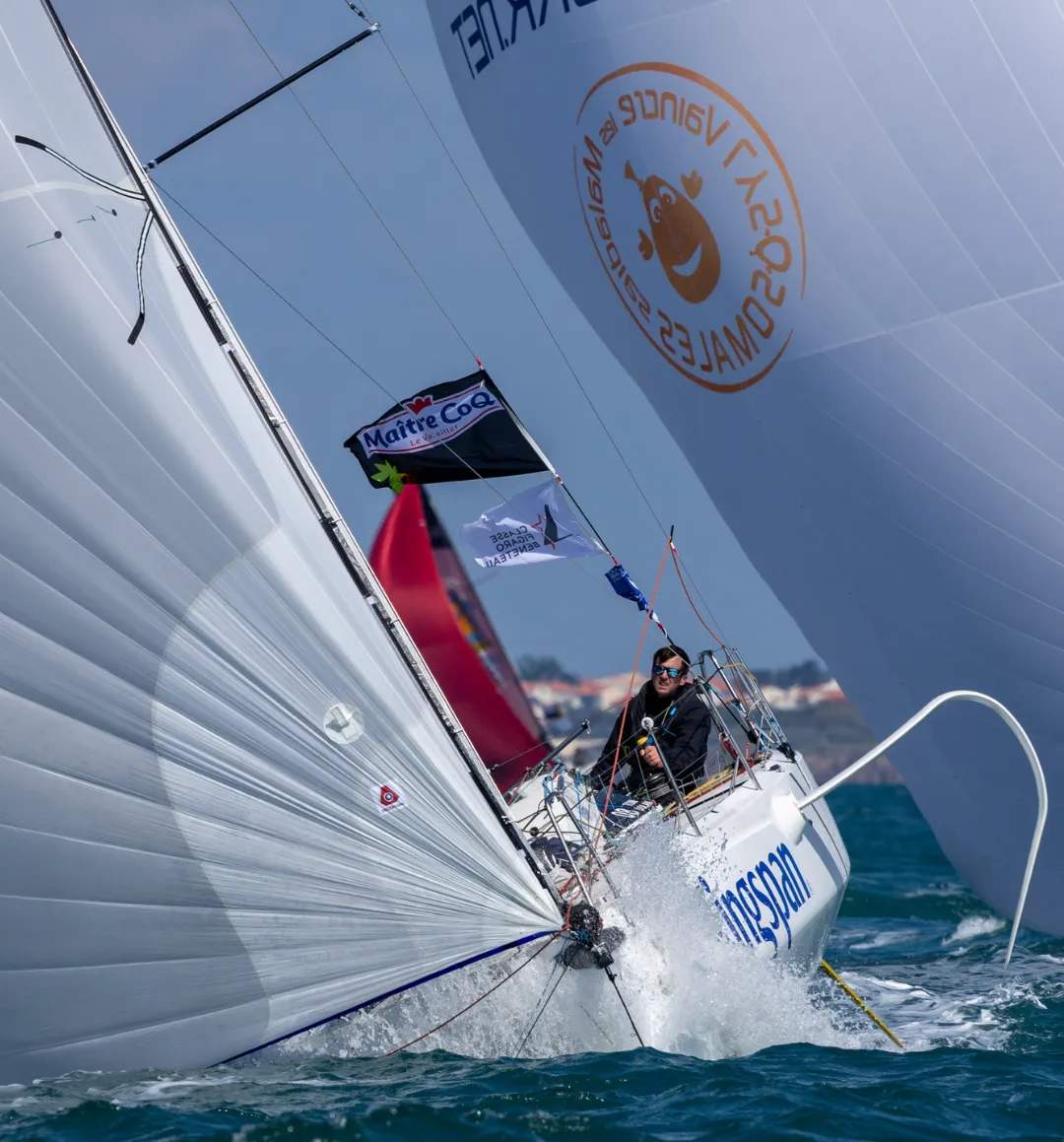
During our interview, Tom talked about his first experience in the Figaro 3 class – a one-design, foil-equipped production monohull whose characteristics, he said, were similar to the Mini 6.50 class in which he had cut his teeth in offshore racing.

“It is just like a big Mini, really,” he explained. “Asymmetric spinnakers with more or less the same overall sail setup. And then there were the foils. Everyone was trying to figure out how the foils would work – would they do anything to help performance, or would we have to take them off?

“But we pretty quickly realised that it was a really fun boat and very interesting from a strategic point of view – because of the bigger sailing angles, especially downwind. It was much more sensitive to wind speed differences than its predecessor, the symmetrical Figaro 2.
“The Figaro 2 would always plod along between eight and nine knots. The angle wouldn’t change that much downwind because we would all just sail really low, so we’d end up all sailing around in a big bunch.

“With the Figaro 3 you can definitely be more aggressive in your angles and in your strategy – and at the helm. Because if you could get the foils to start to lift and the boat to plane – it won’t fully fly – you could very quickly make some big speed differences.”

Garmin quatix® 8 – 47 mm, AMOLED: The Ultimate Smartwatch for Yacht Racers

The Garmin quatix® 8 – 47 mm, AMOLED is more than a smartwatch – it’s a race tool for serious sailors. With GPS-assisted start functions, full Garmin marine integration, and a stunning AMOLED display, it’s built to give yacht racers an edge on and off the water.

FIND OUT MORE

Added to that was the fact that sail designers were all still working out what was best in this new class – and that meant, Tom told me, that there were massive differences between sail designs across the fleet.

“It was really interesting,” he said. “It’s a one-design boat, but not one-design sails. There are maximum measurements for all the sails, but we can play with the shape and where we put the volume.

“In that first year, depending on the wind conditions, some boats would take off and others wouldn’t – and that made it really good fun. Now, though, the designs have all come together in pretty much the same place on the design curve, which means the differences are much less extreme.”

On a mission to get himself up to speed on the new class as quickly as possible, Tom set out to do as much sailing as he possibly could. He partnered up with fellow Irishman and Volvo Ocean Race winner Damian Foxall, as well as French sailor Gildas Mahé, who had finished second in the 2019 edition.

“It was 2019, I had based myself in Lorient, and we had training groups of 10 or 12 boats. It was a fascinating time because in that first year of the Figaro 3, all the old rock stars had come back and bought one. Everyone was in such a rush to get the boats on the water and start training. The Figaro was in June – which was early – and everyone was trying to work out what to do with these boats around the foils and the sails.”

Tom remembers sitting in debriefs surrounded by the likes of Loïck Peyron, Pascal Bidégorry, and Charles Caudrelier.

“It was fairly intimidating – and a bit mad – to see all these legends arguing and debating during the debrief. I think I opened my mouth once during the whole time. But I learned so much.”

Tom gleaned vast amounts of vital inside knowledge from Mahé around strategy, tactics, and how to approach a unique race like the Figaro. But he also contributed to the relationship with his own insights into maximising boatspeed offshore.

By his own admission, Tom’s 2019 race was a poor one. Despite “having a good leg or two”, his overall result was disappointing – something he puts down to his “inability to manage himself”. However, in 2020 he finished fifth – at the time the best result by a non-Frenchman.

“It just started getting better and better in my head,” he said. “Managing the ups and downs of offshore racing at that level. It was a big result because I can remember thinking ‘Geez, I could win this thing’. At least I felt I had the tools within myself to win it.”

Some indication of just how hard it is to perform well in the Solitaire du Figaro comes from the fact that before his 2024 victory, Tom’s scoreline was: fifth in 2020, 16th in 2021, seventh in 2022, and 16th again in 2023.

Aside from the thousands of additional Figaro sailing hours he logged over those seasons, Tom says one of the most significant improvements he made was in how he manages himself during the race.

“What the results don’t show is that in 2022 I came very close to winning – or at least a podium place – but I messed up the last leg with a bad decision that cost me a lot of time. Then in 2023 I finished 16th, but that was after one bad transition in the Bay of Biscay that cost me 15 hours. So in both races I knew I was one bad wind transition or decision away from either a podium or winning. I knew I wasn’t far off.”

After starting to work with a sports psychologist, Tom learned how to stop focusing on the result. For him, it was a major breakthrough. In particular, he learned to concentrate on all the little things that he could control, and not to worry about the stuff that he could not.

“The starting point is the reliability of the boat. I already knew that in this race you cannot have any damage that stops you from racing, otherwise you lose time and you lose the race. So the boat has to be prepared perfectly.”

The same goes for Tom’s physical preparation.

“My team tightly controls all the nutrition during the race. We manage my recuperation between legs very closely. In terms of nutrition I concentrate on fruits and vegetables and avoid fats – even though the temptation is to go and have a few beers, a steak dinner, and a load of chips. I normally sleep for 12 hours as soon as I get in and then sleep as much as I can during the day in between media commitments and weather planning.”

It’s worth noting that in their effort to maximise his sleep time during stopovers, Tom’s team books an apartment out of town, with full blackout curtains or blinds, and provides him with an eye mask and earplugs.

“I even bring a pillow that I have slept with for the previous two weeks or so at home with my fiancée so that it smells familiar when I put my head on it,” Tom recounts.

Rather than thinking about the final destination, Tom now focuses on all the little bits along the way that he can control.

“And what’s great is that once you get all those things lined up you start to enjoy the racing again – because you have taken away all the pressure around ‘I want to win, I want to win!’ When something goes wrong at sea, your instant reaction isn’t ‘Oh no, I’m not going to win.’ You think about what you can control – the boat speed, the sail setting, the navigation, and all those sorts of things.”

Tom says he has always been cynical about athletes who say they just go out and enjoy their sport. However, now he’s a convert.

“It’s one of the biggest things that has ever happened to me,” he said. “I used to go out and put myself under so much pressure. If something would go wrong I would say to myself ‘Oh no, I’m going to be last, the sponsors aren’t going to be happy, the bank is going to come and seize the boat, I’m going to lose my house…’ and so on in a downward spiral. Now I’ve learned how to avoid all that and stay focused on enjoying the race by worrying about the things I can control.”

The 2025 Solitaire du Figaro begins on September 7, but right now Tom is competing in his final warm-up event, the Fig’Armor, sailing with Frenchman Gaston Morvan.

Listen to the full episode of the Yacht Racing Podcast:

Powered by RedCircle

Also available on Apple Podcasts, Spotify, or wherever you get your podcasts.

Comments

Latest

Maxi Edmond de Rothschild launched in Lorient

Maxi Edmond de Rothschild launched in Lorient

After more than two years in build, Gitana 18, the 32-metre Maxi Edmond de Rothschild has been launched, marking the culmination of an ambitious construction programme and the start of a new chapter for the Gitana Team.

Free Members Public