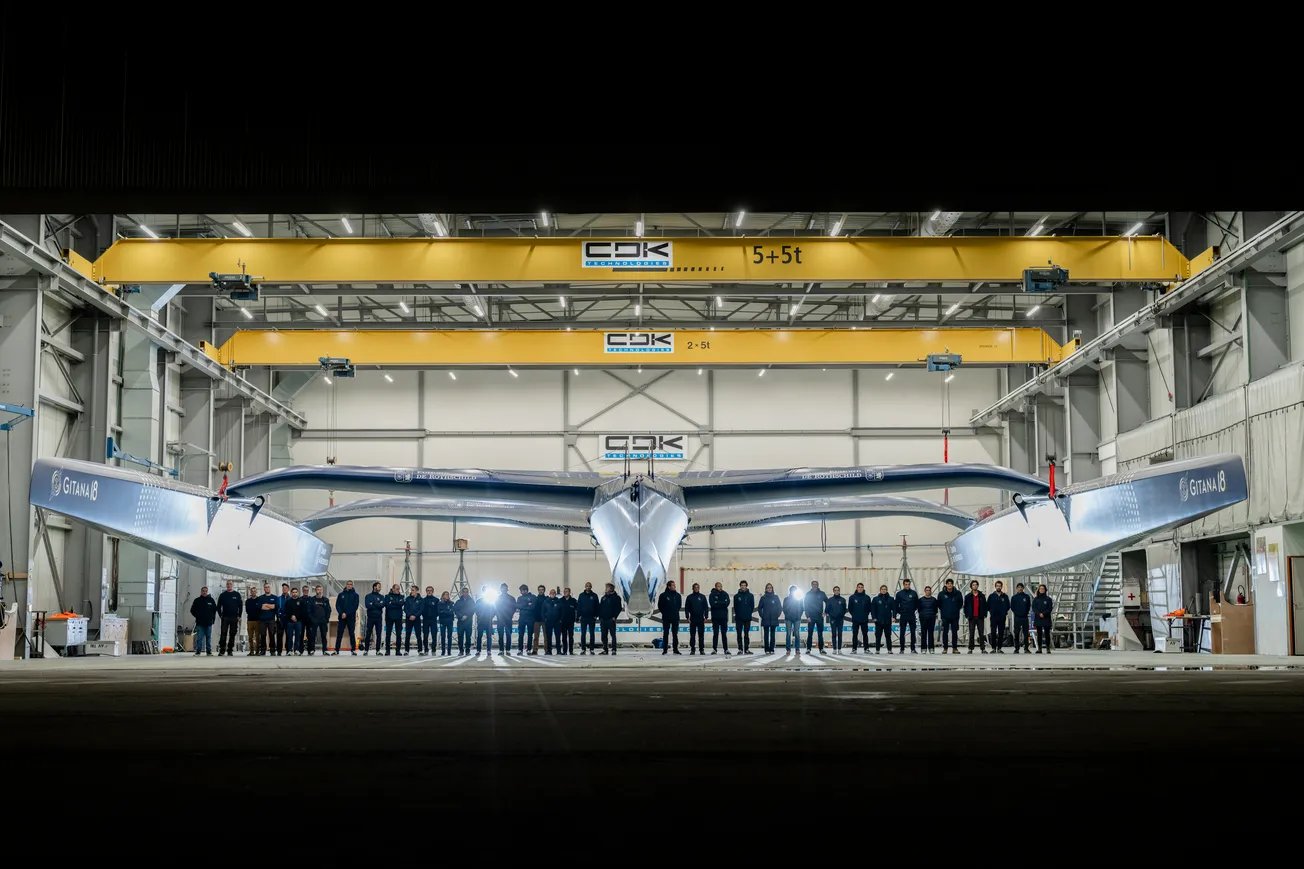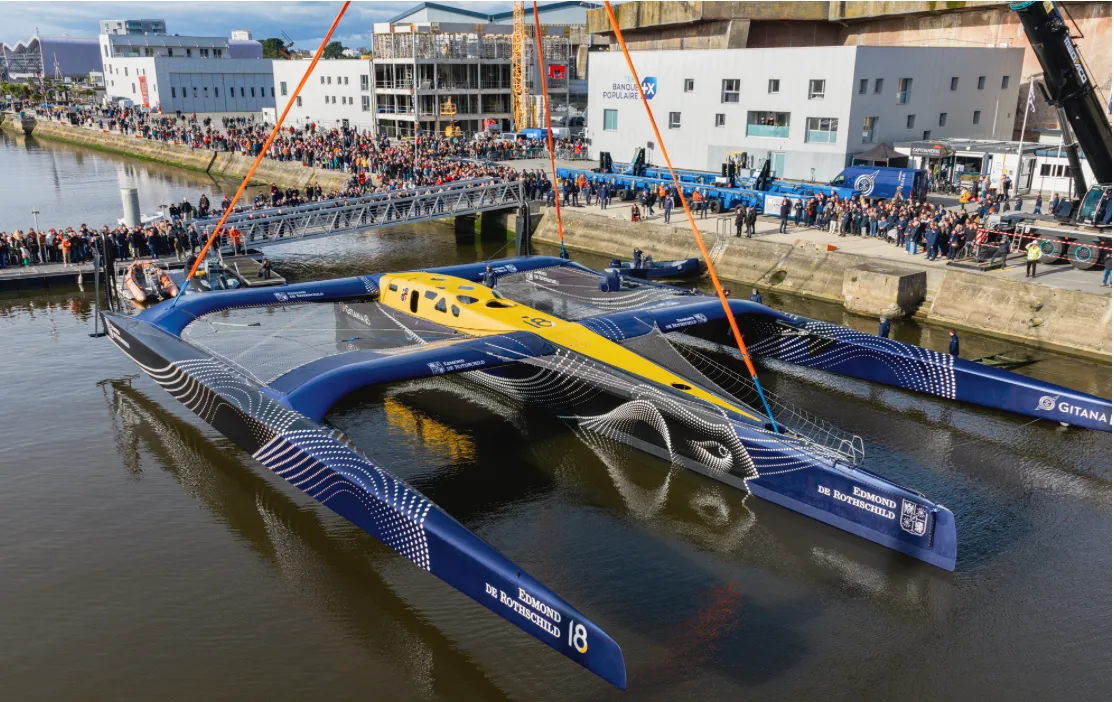
In early December, Ariane de Rothschild unveiled the radical architectural concept of this pioneering flying Ultim trimaran in spectacular fashion. On Saturday 14 February, that vision became reality.
As if on cue, the persistent Breton rain and wind eased for a few precious hours, allowing the five-arrow team to complete the complex launch sequence. Sailing enthusiasts and offshore racing followers turned out in force at Lorient La Base to witness the arrival of the first yacht of the new generation of fully flying Ultim trimarans.
A public and emotional milestone
Back in December, Gitana 18 had been revealed, in the presence of her owners, after 26 months of development conducted in near total confidentiality. Since January 2024, this audacious 32-metre trimaran had taken shape out of sight.
On Saturday, however, Gitana 18 emerged into the open, carefully manoeuvred between the buildings of Lorient La Base before being launched mid-afternoon.
The date had been chosen deliberately. The team was keen for the operation to take place on a Saturday to allow as many supporters as possible to share the moment. But the weather still needed to cooperate. Launching a 32-metre by 23-metre platform — followed by stepping a mast over 36 metres tall — leaves little room for error.
“Everything aligned today,” said skipper Charles Caudrelier at the end of the operation. “The weather window was almost unexpected, but it allowed us to launch the platform and step the mast straight afterwards. It all went perfectly!”
The team benefited from moderate to light winds — rare in recent weeks as successive Atlantic depressions have swept across Brittany.
Simulation of Gitana 18 sailing.
Testing and commissioning
Now moored at her home pontoon in Lorient, Gitana 18, the Maxi Edmond de Rothschild will remain alongside for a few more days before casting off for her first sea trials off the Breton coast.
Given the yacht’s architecture and the scale of the highly innovative appendages, several components must be fitted once the yacht is afloat. When the hangar doors opened on launch morning, only the float rudders were in place. Their distinctive U-shaped geometry immediately caught the eye and prompted questions from onlookers.
They will soon be joined by the central rudder — which is retractable — and the daggerboard.
Positioned in the centre of the main hull and fitted with a three-metre-span metal lifting plane, the daggerboard was deliberately kept as a final surprise for launch day. Like the keel of an IMOCA monohull, it is designed to pivot while remaining fixed in height — an innovative solution that requires it to be installed once the yacht is in the water.
The Y-shaped pendulum foils, each featuring a wing of more than five metres in span, will be installed later, once the initial testing phase has been completed. From next week, the yacht will undergo the standard static tests carried out on all new builds as they leave the yard.
The story is only just beginning. For Charles Caudrelier and the Gitana Team, the months ahead will be dedicated to the delicate process of fine-tuning a demanding and highly sophisticated prototype.
The team has until 1 November – eight months – to be race-ready and in Saint-Malo to defend the team’s title at the Route du Rhum – Destination Guadeloupe.