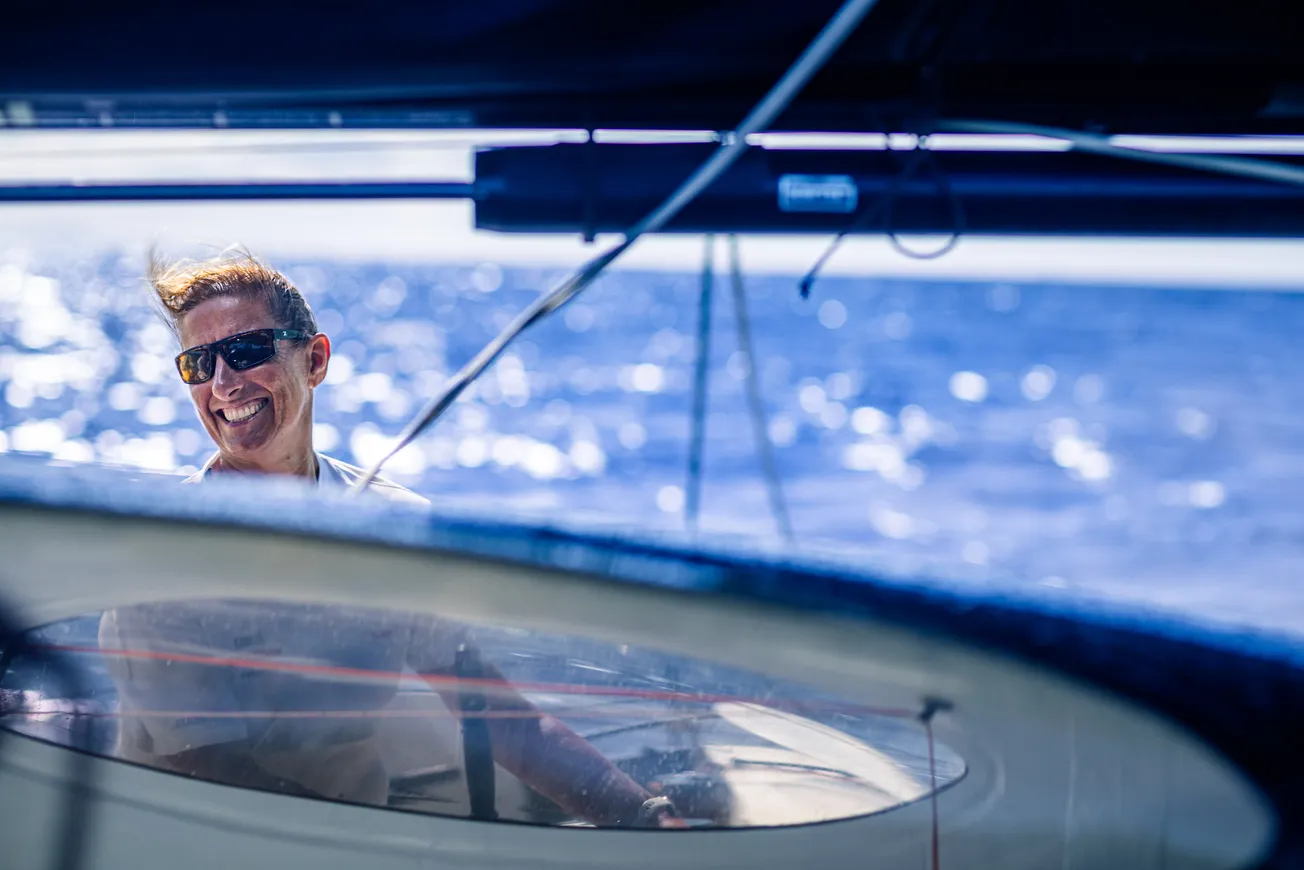


When you’ve sailed around the world six times and become the only woman to have circumnavigated in both directions solo, and then the only woman to have sailed three times round non-stop, it’s going to take something pretty special to get you to go again.
But when the French Vendée Globe sailor Alexia Barrier picked up the phone to Dee Caffari two years ago and asked her to join what has become The Famous Project CIC as co-skipper, Caffari barely waited until she had stopped speaking to say “yes.”
Having already sailed as a skipper in the Global Challenge Race, completed a solo record-setting round-the-world voyage westabout, a Vendée Globe, the Barcelona World Race and two Volvo Ocean Races – one as skipper – an all-female attempt at the Jules Verne Trophy was the one thing missing.
And when you talk to Caffari about it you can still hear the excitement in her voice at being given the opportunity. “For me,” she said, “if I was going to go for lap No. 7, it needed to be very special.
“I didn't just want to go again and it would be repeating stuff. And then Alexia planted this seed – she rang me and was like ‘what d’you think of this? Would you be interested?’ I didn't have to think for a heartbeat. I was like ‘yep!’”
At that time – early days as they were – Caffari wasn’t sure anything would actually happen. It all sounded too ambitious – get hold of an Ultim and put together the first all-female crew since Tracy Edwards’ team on Royal & SunAlliance in 1998 to take on the Jules Verne Trophy for a crack at the non-stop global sailing record.
But that was to underestimate Barrier who – despite one or two setbacks along the way – has done exactly that. And, from November 15, her seven-strong team are going on standby on board none other than IDEC Sport, the 103-foot trimaran that Frenchman Francis Joyon and his crew used to set the current 40-day record back in 2017.
Hard to believe, but initially Caffari was worried that she might be the weak link in a crew that includes one or two young newcomers to this sort of high-profile sailing, plus established names like Marie Tabarly of France and the Dutch sailor Annemieke Bes. But unsurprisingly Barrier had no such concerns and wanted Caffari’s experience and leadership qualities.
“So I was like ‘OK, I can be your wingman on this – I’ve got this,’” said Caffari, who, in recent years, has developed a busy onshore career alongside her racing commitments in media work, public speaking and supporting a number of sailing-related charities. “And it was really nice because it gave me a goal. This is what I’ve been working towards physically in the gym – I want to be strong, injury-free and I want to contribute.”
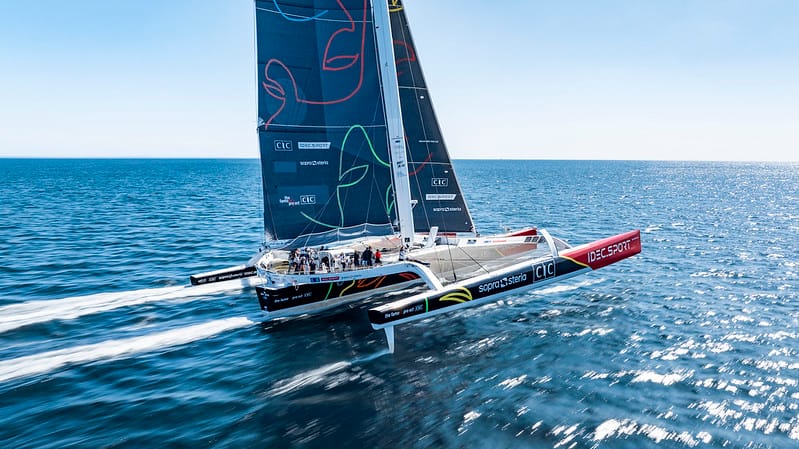
In fact Caffari, 52, is the crew boss on IDEC Sport, backing up Barrier who runs the entire project and who sails as navigator and one of the main drivers. “I take on the responsibility of everyone’s safety on board, so I am probably the nagging voice behind anybody before they do anything,” she said.
Like her crewmates, the months of training the team has undergone in super-fast offshore multihull sailing, first on the MOD70 Limosa, and since April on board IDEC Sport itself, have amazed Caffari with her background in monohulls. “You get totally used to going at 30 knots everywhere really quickly – it’s quite scary how quickly you get used to it and how it becomes normal. Suddenly, when you are doing 20 knots, it’s all a bit pedestrian,” she said. “And the boat is much more comfortable than the IMOCAs are to live on while they are doing this speed and they are designed to do it.”
The team has been training and working with some experienced hands as it has learnt to push Limosa and IDEC Sport to their full potential, among them Tom Dawson, Jack Bouttell, Brian Thompson and Clément Surtel, one of Joyon’s crew from the 2017 record. In between training they have taken part in a number of races, among them the Middle Sea Race, the RORC Transatlantic Race and the Caribbean 600. Caffari has loved it all. “It felt like I was learning to sail again – it’s been exciting, it’s been fast and it’s been full-on,” she said.
She has also learned a lot about Barrier who she describes as “an absolute force” who has been “super-impressive” in the business and sponsorship environment. On the water, Caffari has been surprised by how hard her skipper is prepared to push. “I think at the moment, what’s really interesting when we go sailing is that she is really keen that she does the nav and looks at the weather and speaks to the weather support that we’ve got ashore,” explained Caffari. “But she’s also driven the boats more than anyone. She will hand over the helm and she’ll be like no slower than 25 knots or something like that. Then you know where that performance limit is and what you’re expected to achieve.”
A fascinating part of this campaign is what success looks like for The Famous Project. On the team website, the “mission” is described as being the first all-female team to race around the world, non-stop and unassisted, but also “to conquer the Jules Verne Trophy, at the very least establishing an all-female reference time which has never been done before.”
Sounds pretty straightforward. But the reality is that, by Caffari’s own admission, there is a fairly narrow spectrum of what might be termed “credible performance” for Barrier and her crew, who will be supported on meteorology by Christian Dumard. The outright 40-day record has now stood for eight years and has been beyond repeated attempts by all-male crews on more modern boats. Joyon enjoyed incredible weather in 2017 and, one imagines, it’s going to take a newer boat in equally favourable conditions to break it.
In theory Barrier’s team could go quicker in the same boat as Joyon, but Caffari acknowledges that that is a long shot. Here’s her take on what a realistic goal for this crew could be. “Arguably, we’ve got the fastest boat in the world, but we all know that technology has moved on and the newer boats only need the right weather to go faster, so we were like ‘what does success look like?’ and we’ve looked,” she explained. “Originally it was around the world in 80 days. Well, that’s not really good enough. Ellen (MacArthur) went round in 71 days (B&Q, 2005). So we were like ‘OK, that’s a reference time.’ Then we considered that Charlie Dalin went around the world in 64 days on his own in the last Vendée Globe, so we’ve got to do better than that. The record’s 40 days, so I was like – you know – we should aim for at least 50 days. There has been a discussion between 50 and 60 days and we’re still in that discussion. It’s a big decision, but somewhere in that 50-60 days as a reference time for the first attempt would be amazing.”
Looked at in this way, you can quickly see that The Famous Project has a very tough challenge on its hands indeed in an old boat that still carries the mast used by Joyon all those years ago. But Caffari is determined to try and do something exceptional. “We don’t want to just go around the world,” she said, “the reason we are on the boat is to try and push and do something exciting.”
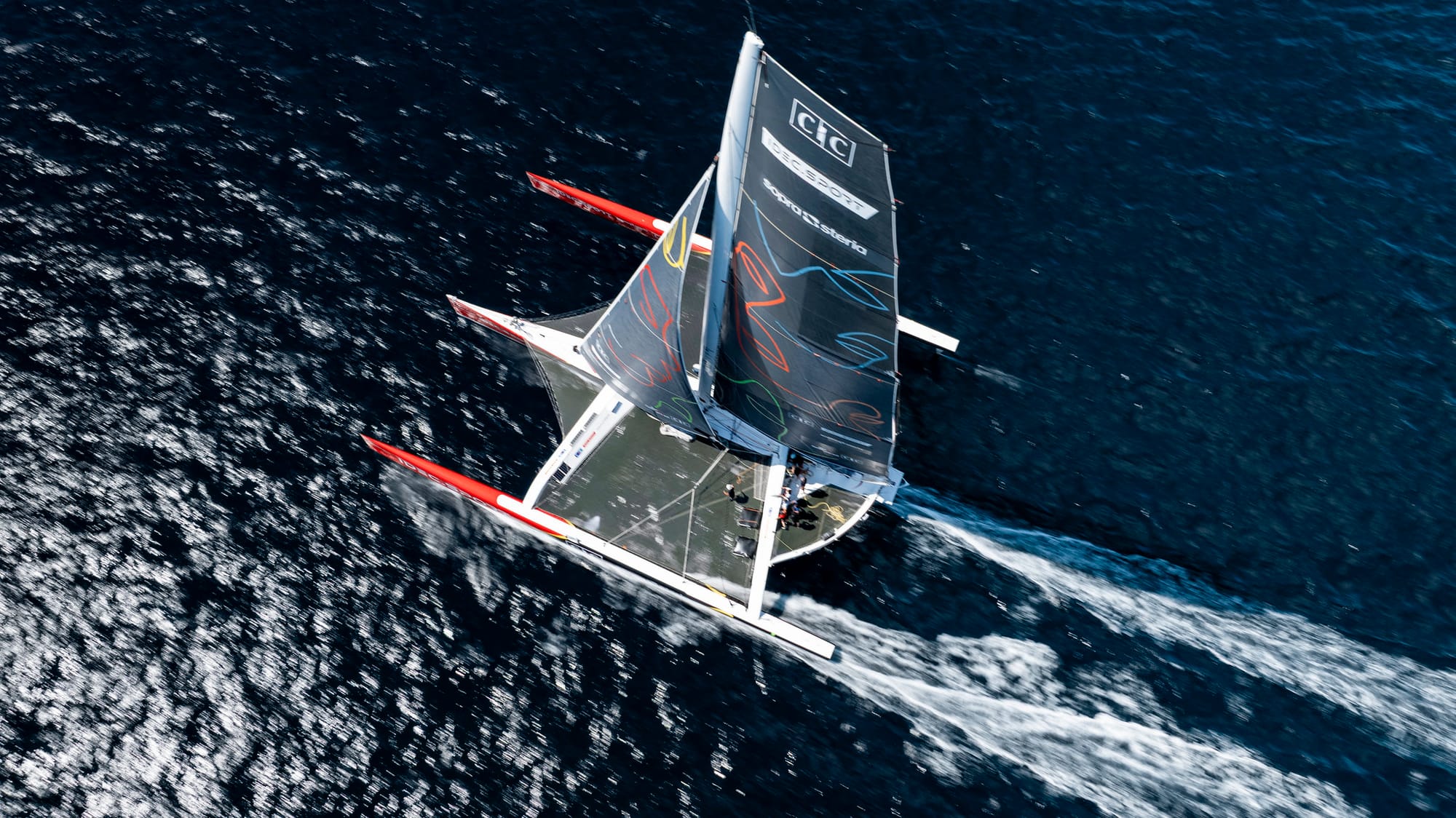
With the outright record not being the only goal, Barrier’s crew will have more flexibility about weather early in the circumnavigation than its rivals. Assuming a fast 10-day trip south in the Atlantic, they will be free to carry on when others might turn back. “For a lot of the teams, when they get to the end of that 10-day window, if they are behind, they are like ‘oh, OK, we are going to stop because we’re not ahead of the record.’ But actually, for us, if we are that far, we are going to go on. We’ve actually got to do it at some point to put the naysayers to bed and show that it can be done and then we can worry about how fast we do it, if we get to go again. We know that the first 10 days should get you down to the bottom of the Atlantic and then, after that, it’s a little bit of luck with the weather that comes,” said Caffari.
The Famous Project is about setting records at sea, but it is also committed to promoting women’s sailing, demonstrating that female sailors can compete at the very highest levels and inspiring new generations by example. Caffari is fully on board with all of that and says the multihull world has been especially hard for women to break into. “There’s more pathways and opportunities being formed, but we’re having to forge them to give people experience so that then we can go into this sailing using that experience,” she said.
With IDEC Sport now in Brest, the countdown to going on standby is ticking and Caffari can’t wait to get started. “It’s cool isn’t it?” she enthused. “It’s us against the clock. It needs quite a lot of discipline to keep going, but it also makes it super-exciting.”
And she returned to relishing the opportunity Barrier has given her after having accomplished so much already on the round the world course. “It is amazing,” she said. “The chances of being able to tick all those boxes are so slim, so I’ve been super-lucky which is probably why I jumped at this. And the other thing is it has just been so much fun and rewarding. Sailing a multihull just feels so different. You’re thinking in more dimensions, it all happens faster and obviously, if it all goes wrong, it does so seriously and really fast. I have enjoyed that learning challenge and just pushing myself in a different environment and getting used to doing everything at 30 knots.”