A rare combination of speed and easy handling
The 53ft Finn is a remarkable yacht that achieves the holy grail of true high-performance cruising with race-winning ability and very few compromises.

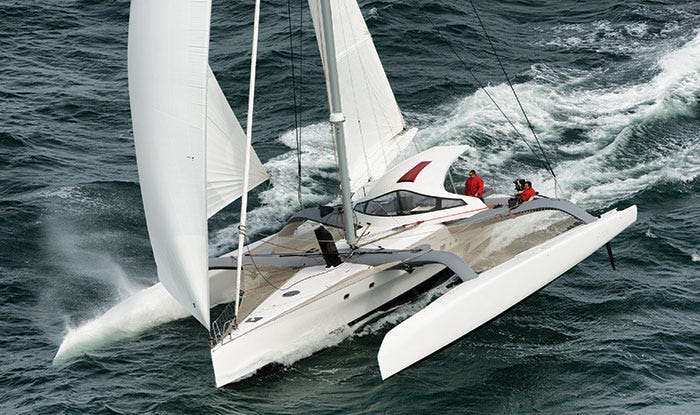
The design and build of a custom performance yacht is always a process of bringing together the visions of owner and design team to create a unique platform for racing, cruising or both. Every so often, a project emerges with the ambition - and the execution - to deliver remarkably few compromises. Finn is one such yacht, combining high performance with the capability for safe, comfortable short-handed offshore cruising. Now offered for sale through Fraser Yachts, she presents an unusually well-developed opportunity for a sailor looking for both speed and versatility.
The original commission for Finn came in 2012 from the world-renowned photographer Clint Clemens, a descendent of Samuel Clemens (Mark Twain - the name Finn comes from the Huckleberry Finn character in the novel Tom Sawyer), whose interest in fast, comfortable multihulls had already led him to the Chris White-designed Atlantic 42 Lightspeed, followed by the Morelli & Melvin-designed Gunboat 62 Safari. Gunboats were helping establish an exciting new genre, combining high performance with luxury, but Clemens wanted to take the concept further: a modern multihull with the speed and performance to satisfy a serious sailor, coupled with the confidence and ease of handling needed for short-handed offshore sailing.
Designing the ideal platform
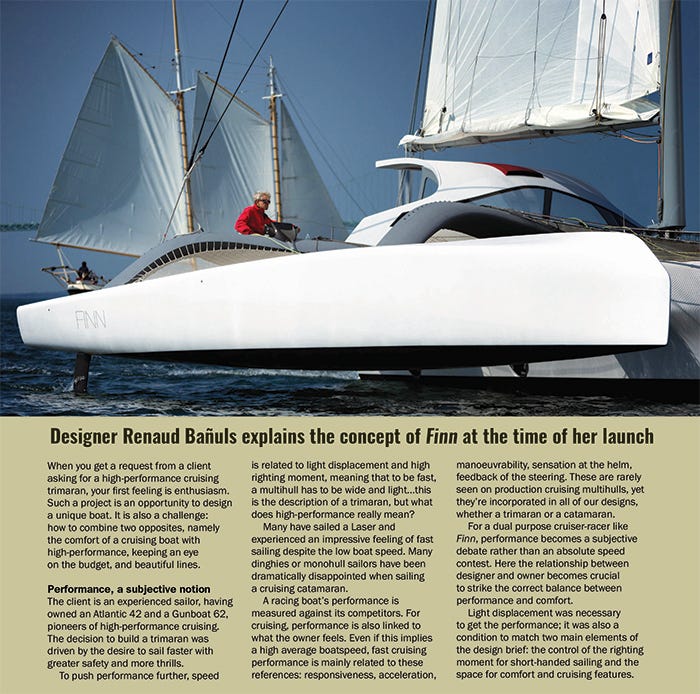
After careful consideration, a trimaran was selected as the optimal platform. Compared with a monohull or catamaran, a trimaran’s stability, efficiency and reduced heel offer significant advantages when sailing offshore with a small crew, without compromising the speed required for fast passage-making. Its greater righting moment allows a generous sail plan and, for a short-handed crew, more than sufficient living space.
For the hull and ama design, Clemens turned to French trimaran designer Renaud Bañuls, part of the design team behind the Jules Verne Trophy-winning Sodebo Ultim 3 and the America’s Cup-winning Oracle trimaran. The brief was to turn this philosophy into a new 53ft design.
Construction demanded a world class boatbuilder capable of producing strong, lightweight composite structures. This requirement led to McConaghy Boats, whose reputation had been built over decades of producing some of the world’s most competitive offshore sailing yachts.
Clint, an experienced boatbuilder in his own right who built his first boat at the age of 16, became so involved in the build that he made 12 one-month trips to the McConaghy yard in China over the course of the two-year process.
The spars called for similar expertise: lightweight, strong and versatile enough for the demands of offshore sailing. Lorima, the Imoca class exclusive supplier, was selected to build the rig.
The brief was not simply to create a safe, fast cruising yacht. Finn also needed to be competitive in fully crewed offshore racing. That requirement shaped many of the decisions made during construction, particularly around weight. The objective was to save weight where it delivered a meaningful performance benefit, while retaining the structure and equipment needed to provide the comfort expected of a proper cruising yacht.
The result was a carefully considered approach to composite construction. The hulls and amas were built in vacuum-infused E-glass and foam laminates, contributing to a quieter cruising experience, while carbon was used for hull reinforcements, appendages, crossbeams and chainplates.
Weight aloft was reduced with a high-modulus carbon rig, which both rotates and cants to maximise aerodynamic efficiency and control power simultaneously.
For ease of tuning, the mast is spreader-less and supported by Kevlar standing rigging from Future Fibres. The result is a considered combination of performance, structural strength and cruising comfort and efficiency.
Speed with an easy touch
Since her launch in 2014, Finn has demonstrated the effectiveness of that approach. Under sail she can reach speeds of up to 30 knots, delivering passages of around 350-500 miles a day. For a cruising owner, that speed brings more than bragging rights: it opens up routing options, reduces passage times and can make narrow weather windows considerably more manageable.
Her racing record is equally persuasive. In 2020 Finn won the Caribbean Multihull Challenge in the CSA Multihull 1 Class and received the event’s Most Worthy Performer award. More recently, she placed second in the RORC Transatlantic Race from Lanzarote in the Canary Islands to the Caribbean.
Finn was sold in 2019 sailed to the Mediterranean, where her current owner, Jacopo Bracco, found her in 2023. Bracco has continued to maintain and develop the boat, building on Clemens’ and Bañuls’ original design philosophy.
‘The rudder system was entirely reconditioned,’ he explains. ‘It’s a very effective system that is pretty much a carbon copy of the MOD 70 three-rudder system with a kick-up centre rudder. After 10 years all the bearings needed replacement, the attachment hardware was checked and replaced where needed, and the rudders aligned and calibrated.’
For Bracco, who raced F18 catamarans for several years, the most compelling aspect of Finn is the combination of speed and ease of handling.
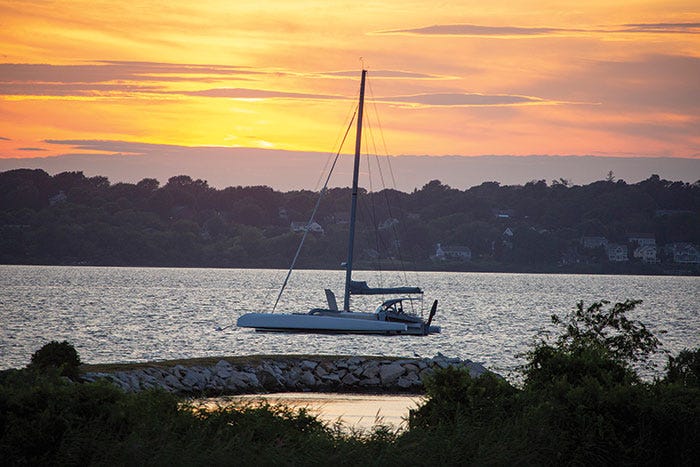
‘Finn is fun,’ he says. ‘In fact she is exhilarating. As soon as the wind picks up a little, you find yourself sailing at 15-18 knots and you don’t even feel it. She is a sailor’s dream boat: put the autopilot on a comfortable setting, adjust the sails and enjoy the run ahead; then take back control of the rudder on the windward helm position, grab the mainsheet traveller in one hand as a safety and the tiller in the other and just let it rip, playing with the waves, gusts and apparent wind just like you do on an F18.’
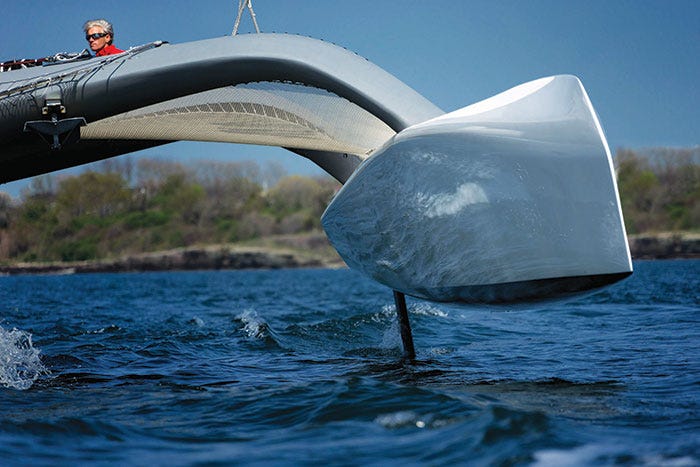
The large amas and piercing bows are central to that experience. ‘They allow you to stuff them into the oncoming waves, which they slice just like butter,’ says Bracco. ‘And when you get tired of holding the tiller, just engage the autopilot, make some adjustments to the sail trim if you want a more relaxing ride, get something to drink and sit on the cockpit sofa.’
Built to outrun bad weather
Bracco has also been impressed by the way Finn retains her composure as conditions build.‘Besides fun, Finn is also about pure speed,’ he says. ‘I can still remember some of the speed records we made: 25 knots downwind off Sardinia; 28 knots off Milos towards Folegandros with my inexperienced son on the helm; 33 knots in the middle of the Atlantic during the RORC Transatlantic Race while going down a giant trade wind swell. As I said: exhilarating.’
A versatile sailplan is central to that capability. With three reefing points in the mainsail and an easy reefing system, Bracco says the boat is straightforward to depower when required.
‘You should never get caught overpowered,’ he says. ‘In over 10,000 miles sailed, I have never used more than the second reef.’
The boat’s high-speed Starlink internet connection also provides ready access to weather information, supporting the owner’s approach to routing. ‘The most important safety principle in Finn is that you can outrun trouble,’ Bracco says.
He recalls sailing from Sardinia towards Naples in Mistral conditions, using the boat’s speed to stay on the edge of the weather system: ‘We would sail east until the wind went down to 15 knots and then gybe south until the winds picked up to the mid-20s. We were basically sailing the edge of the system.’
The sail inventory also provides considerable flexibility. ‘We have five sails to choose from,’ he says, ‘and multiple configurations possible, including three concurrent sails for when we have good breeze downwind.’
An outdoor boat
For all the emphasis on speed, Finn was never intended to be a stripped-out race boat. Her cruising credentials are evident in the way her owners have used her.
‘Finn is an outdoor boat,’ says Bracco. ‘It is not a catamaran with a giant livingroom cabin. It is a boat to stay outside, in comfort. On sunny, light- to medium-wind days, there is nothing more pleasant than putting a bean bag on the massive trampoline and enjoying moving through the water; seeing the dolphins come and visit and play with the bows; choosing a sunny or shady spot and not getting wet.’
He compares the experience with larger performance catamarans: ‘It’s the difference between staying in the house or in the patio, garden and pool.’
Bracco and his wife spent nine weeks cruising from Valencia to the Balearic Islands before continuing to Bonifacio in Corsica, where Finn attracted plenty of attention among the superyachts. ‘We were welcomed like heroes into this mythical cove,’ he recalls, ‘flanked by superyachts yet commanding all the attention because, of course, the French love trimarans!’
Bracco has a detailed understanding of what makes Finn distinctive. The boat has been maintained, upgraded and actively sailed, rather than simply preserved as a design exercise. For a new owner, that represents a significant advantage: the opportunity to acquire a proven, fast offshore trimaran with an established development history and the accumulated knowledge of two experienced owners.
Finn is now offered for sale through Fraser Yachts. For anyone looking for a genuine high-performance multihull that can be sailed short-handed offshore, yet still has the pace and pedigree to perform on the racecourse, she is a particularly compelling proposition.
Note: Not for sale or charter to US residents while in US waters.
Discussion about this post