



From performance cruisers to superyachts, many of the high-end vessels built in Italy, and increasingly beyond its borders, rely on components designed, engineered and produced by a remarkable supplier based in Ancona: Advanced Mechanical Solutions, or AMS.
The trajectory of this thriving firm is impossible to separate from the story of its founder and CEO, Francesco Pelizza. His approach to marine structural engineering began long before Finite Element Method (FEM) calculations, carbon laminates and composite load paths entered the picture. At the beginning there was simply the family boat: a Show 29 designed by Alain Jézéquel, one of the glassfibre yachts that introduced a generation to offshore sailing during the 1970s and ‘80s.
For Pelizza, that early exposure became a genuine apprenticeship. By the 1990s he had built extensive offshore racing experience, including a PHS division victory in the Sydney Hobart Race and line honours with a course record at both the Middle Sea Race and the Giraglia, as well as second place in the Fastnet Race. All of that he achieved before graduating from university and launching his own engineering company.
‘I started in the Optimist like everyone else, although only briefly,’ he recalls. ‘The real sea school was the family boat, cruising and long passages.’
At the same time came his first offshore races out of Ancona, which during the 1980s and ’90s was one of the most active offshore sailing hubs in Italy. Pelizza joined local crews and sailed alongside some of the best-known names in Italian sailing including Andrea Giorgetti, who was the bowman aboard the Italian America’s Cup 12 Metre Azzurra.
‘I was mainsail trimmer for these round-the-can races,’ Pelizza says. ‘I also did countless deliveries between regattas, thousands of miles between the Adriatic and Tyrrhenian Seas.’
In those years the sea was more than a sporting passion. Pelizza also worked as a commercial diver for an Ancona-based offshore contractor servicing oil platforms in the Adriatic, while simultaneously studying engineering and continuing to race. There were periods, he says, when he spent more hours at sea than ashore. His first big offshore campaigns were in the early 1990s with the 500 x 2, the historic double-handed Adriatic race. Despite its enclosed geography, the Adriatic is far from benign. Violent summer squalls descending from the Balkans and steep, short seas generated by southerly weather systems make it an unforgiving training ground.
Pelizza belongs to a generation of Italian offshore sailors raised in an era when campaigns were run on modest budgets. Technical preparation was largely self-taught and success depended heavily on practical ingenuity. It was common to arrive at the start line of a race after days of offshore delivery sailing with a reduced crew, little sleep and continuous boat preparation under way. The same mindset would later prove to be invaluable in his engineering career.
One of the first significant results came in 1994 with victory in the Rimini-Corfù– Rimini aboard Pegaso, an Open-class yacht considered exceptionally quick for its time. But it was double-handed racing that truly defined that period. Pelizza competed in multiple editions of the 500 x 2 and Roma x 2 races, experiencing challenges that were central to both his technical and personal development.
One campaign in the 500 x 2 ended dramatically when, during a night return leg toward Italy, the 10m yacht he was racing double-handed – while lying second overall – was struck by a commercial ship. Nobody was injured but the race ended with a badly damaged bow and the boat dismasted. The following year he returned with Massimo Giacomozzi and won.
A long string of successes followed. Giacomozzi and Pelizza formed one of the most successful offshore partnerships of late 1990s Italian sailing and the two sailors also shared a Mini Transat project. Giacomozzi bought a Mini 6.50 that the pair prepared together for the 1997 race, while Pelizza competed in the 1999 edition, all while continuing their intensive offshore programmes in both the Adriatic and Tyrrhenian circuits.
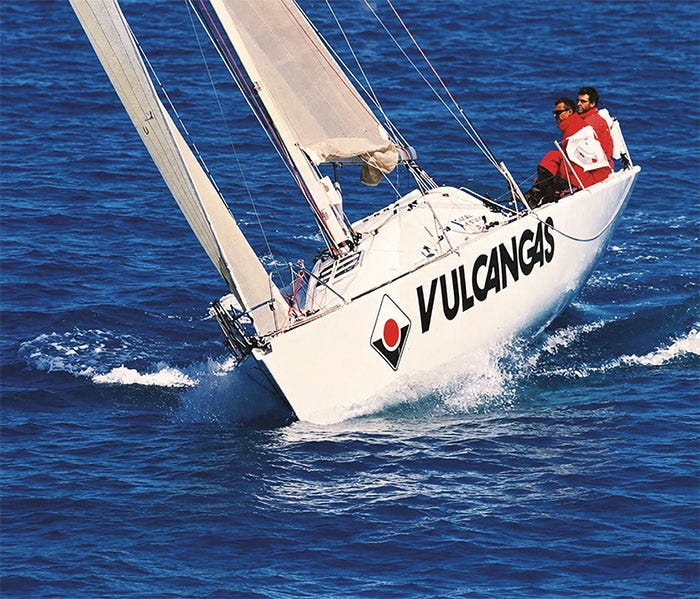
One of the emblematic boats of that era was Vulcangas, a tiny but exceptionally quick Ami 30 designed by Alberto Fiorenzi. Spartan, light and aggressively optimised, the boat repeatedly defeated much larger rivals. With Vulcangas, Pelizza and Giacomozzi won the Roma per Due, the 500 x 2 and the Rimini–Corfù–Rimini, frequently beating yachts 10ft or even 20ft longer on real and corrected time.
Those involved in the Italian offshore scene at the time still remember that boat as a David-versus-Goliath project. Fifty and 60-footers regularly found themselves behind a stripped-out 30-footer prepared with obsessive care and sailed exceptionally well.
At the same time Pelizza joined the crew of Riviera di Rimini, the famous Andrea Vallicelli-designed 60ft design which was among the Mediterranean’s most competitive offshore platforms of the period. He raced in multiple editions of the Middle Sea Race aboard that yacht, including the particularly brutal 1998 race in which Riviera di Rimini established a record of 72 hours, 50 minutes and 42 seconds – a mark that stood for 12 years. In 1998, he also came second in the Fastnet Race aboard the same yacht. On board, Pelizza alternated between bow work, helmsman and watch captain duties. His résumé also includes the 1997 Sydney-Hobart aboard the Italian entry Orchidea, racing on the Farr 50 Seac Banche which the team had chartered in Australia. They won the PHS division.
Then came the 1999 Mini Transat and in many ways that was the moment when Pelizza chose his long-term direction.
He graduated in mechanical engineering from the Marche Polytechnic University in 1999 with a thesis dedicated to the structural analysis of a sailing yacht at sea. His experimental platform was none other than Vulcangas. Sensors, data acquisition systems and instrumentation were installed aboard to study real deformation and load cases during offshore sailing.
‘It was already an attempt to connect practical experience with structural analysis,’ he explains. ‘I wasn’t interested only in theoretical numbers. I wanted to understand what actually happens to a yacht at sea.’
The 1999 Mini Transat was meant to represent the natural culmination of that journey. His Mini, designed by the late Andrea Romanelli, had been heavily modified with a canting keel and revised systems to remain competitive in a class that was evolving at remarkable speed.
The campaign ended prematurely when the keel detached, causing the yacht to capsize. Pelizza escaped unharmed but the incident also marked the end of his top-level offshore racing career.
‘In reality I had already decided that after the Mini Transat I would dedicate myself entirely to engineering,’ he says. ‘Whether I finished first or last, that was going to be the moment I changed direction.’
The next step took him first to Rome, working in the office of marine structural engineer Giulio Ricci, before moving into the aerospace sector between Trieste and Rome with Aerostudi. Those years proved decisive. Advanced FEM analysis, carbon composite structures and aerospacederived calculation methodologies became his daily working environment. It was there that what later became the AMS method truly took shape: applying aerospace engineering principles to yacht design while retaining the perspective of someone who has deep and long experience of high-level offshore sailing.
In 2005 Pelizza returned to Ancona and founded AMS. One of the company’s first major commissions was the structural design work for the RC44 conceived by Russell Coutts and designed by Andrej Justin. That project became the company’s real turning point.
‘The RC44 was the project that made me realise I could build something of my own,’ says Pelizza. ‘Everything started from there.’
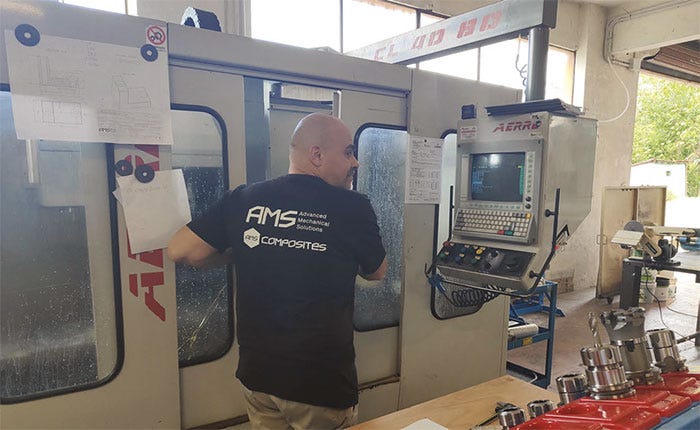
Today AMS operates as a multidisciplinary organisation comprising an in-house engineering office with more than 15 engineers and 30 people in the company, a composites division, a dedicated metalworking facility and a broad network of specialist external partners. In 2021 the company also launched AMS-Composites, a division dedicated to the direct production of in-house developed carbon components.
The company has worked and continues to work with many international shipyards and design offices across projects ranging from performance cruisers to full custom superyachts. Clients include Wally, Solaris Yachts, Cantiere del Pardo, Maxi Dolphin, YYachts and CRN. AMS is currently working on a 100ft superyacht project, the details of which cannot be disclosed.
Yet despite the company’s growth and the increasing sophistication of modern yacht engineering, Pelizza still sees a direct continuity between his offshore sailing background and the way AMS approaches structural design today.
‘When we size a component, we don’t think only about the numbers imposed by classification rules,’ he explains. ‘We think about the yacht slamming into waves, about real dynamic loads and what can happen during offshore sailing. Having lived through those situations helps enormously.’
According to Pelizza, the biggest change from the past lies not so much in structural principles themselves but in the design constraints that are imposed by the styling of contemporary yachts.
‘Today, structures have to coexist with far more extreme interior layouts,’ he says. ‘Yachts have greater internal volumes, fewer bulkheads and much more open interiors. Our job is to maintain stiffness and minimise weight within increasingly complex constraints.’
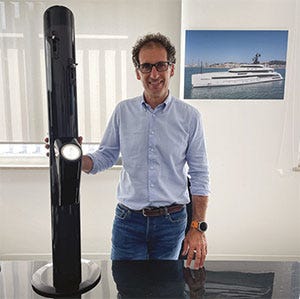
The AMS approach remains strongly focused on FEM optimisation and weight reduction, with a philosophy heavily influenced by the racing world even when applied to high-performance cruising yachts. It is no coincidence that many systems developed by AMS for large motor yachts are equally applicable to sailing superyachts: tender handling systems, retractable passerelles, automatic awnings, stern-door opening systems, anchor arms and numerous custom carbon-and-metal kinematic assemblies.
‘In the end the principle is always the same,’ says Pelizza. ‘It is to build structures that are light, reliable and as integrated as possible.’
In truth, the connection with yacht racing never entirely disappeared. In 2017 Pelizza won the ORC Corinthian World Championship aboard a Grand Soleil 43 whose structures had been engineered, a few years before, by AMS itself – a fitting full circle in which the designer returned to winning aboard a yacht shaped partly by his own engineering work.
In recent years he has returned to dinghy sailing, choosing the Contender.
‘When I was younger I sailed very few dinghies and always felt something was missing,’ he says with a smile. ‘The Contender is an extraordinary boat. It’s a 1967 design but it still feels completely modern in terms of acceleration, balance, sensitivity. Ben Lexcen really was a genius.’
And if he had to choose a yacht for a return to offshore racing today?
The answer comes immediately.
‘A modern Class40. I think it’s one of the most interesting offshore platforms in existence today. I would love to do a major ocean race aboard one of those boats – particularly the Musa 40, which is a completely Italian project.’