No compromises
After 12 years producing ultra-fast cruisers (which have won a fair number of races), Neo Yachts is finally building an actual raceboat.

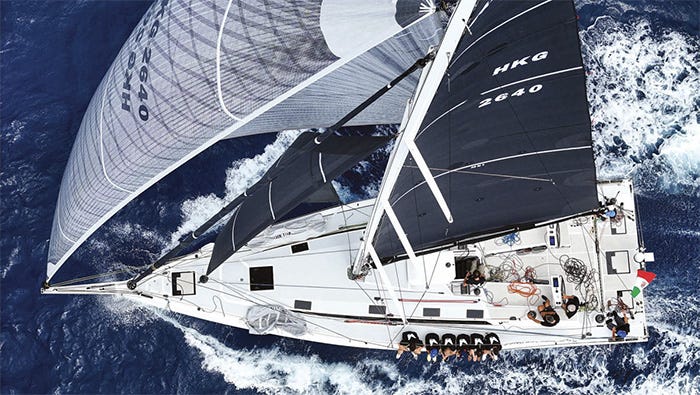

Neo Yachts’ 460 Roma and 520 Roma will make their debut at two boat shows later in 2026. For CEO and founder Paolo Semeraro, they are the clearest statement yet of what his boats have always been – and what people keep mistaking them for.
‘We want people to understand the difference between our fast cruiser and what the market is offering,’ he says. ‘Ours are the only production boats in the world built in full carbon with structural interiors also in carbon. They are built like an ocean racer, but they’re cruising boats. We have the safety, the lightness and nearly the speed of an offshore racing boat, but it’s a cruiser.’
And it’s some cruiser. Neo Yachts’ 570 Roma has long been compared with a TP52, a comparison Semeraro rejects. ‘That can never be true because our 570 is sailing with air conditioning, genset, electric winches, two electric toilets and so on. Now we can help people understand where to position Roma as a fast cruiser.’
It is a comparison he has been trying to correct for years. Race results from cruising boats – such as Mia Gioia, a NEO 430 Roma fitted with water ballast, winning the 2025 ORC Doublehanded World Championship, and Margot taking Class 2 in the 2026 Chicago to Mackinac Race – are impressive, but they can create the wrong perception.
‘The confusion created around our brand has affected a potential owner’s perception of what they can buy.’


Before the Ceccarelli-designed NEO 460 and 520 Roma arrived, the range already included five monohulls between 35ft and 62ft, all carrying the Roma name. (‘Roma means Gran Turismo,’ Semeraro explains, ‘a fast cruiser.’) Two catamarans of 41ft and 56ft complete the range.
The new 46-footer and 52-footer, also built in epoxy-infused carbon, continue the same philosophy: lightweight construction combined with a deep lead keel bulb that places nearly half the boat’s weight low down, creating substantial righting moment against a powerful sailplan.
‘It adds value however you are using your boat,’ says Semeraro. ‘Cruising, fast cruising, racing – it is always an added value because the boat is better. You heel less, you pitch less and you are faster.
‘That doesn’t only mean sporty. If you have bad weather and want to run away in front of a storm with your family, this boat can plane under jib alone. With a displacement boat, you simply wait for the storm to catch you.’
The effects are felt across the wind range. In light airs, a NEO will be sailing while many displacement cruisers are motoring; in stronger conditions, planing speeds of 20-25kts are unremarkable. Inevitably, that performance has shaped how the brand is perceived.
Yet every Roma built so far has been a genuine well-appointed fast cruiser rather than a stripped-out raceboat with a coachroof. The speed comes not from removing comfort, but from the material everything is built from. Hull, deck and loadbearing furniture form one stiff, continuous carbon structure, hand-faired, spray-painted and fitted out once the boat is closed up. There are no headliners or inner mouldings.
Building a comfortable cruising interior inside a structural carbon shell is, Semeraro points out, a more demanding engineering challenge than building a pure racer. Every technical system – from air conditioning and electrics to plumbing and tanks – must be integrated precisely, ideally low and on the centreline to improve stability.


NEO owners generally fall into two groups. The first buys a Roma purely to cruise quickly and efficiently: experienced sailors who want the ability to plane at 20kts and beyond, but have little interest in racing.
‘They want to sail in six knots of wind with the code zero, making seven or eight knots, faster than the wind,’ says Semeraro. ‘And they want the planing sensation.’ The first two 460 Romas have gone to exactly these owners.
The second group combines cruising and racing, and Semeraro configures the boats accordingly. Push too far towards grand-prix systems and a boat intended for long-term ownership can lose value.
‘A Roma is very easy to resell as a cruising boat,’ he says. ‘If you race a boat, after two, three or five years it will lose value like all racing machines – you can buy a TP52 for €300,000.’
Before specifying a boat, he asks owners how they intend to use it over the next five to 10 years. Most, he says, find the right balance. Around 85 per cent choose carbon composite rigging, removing 60kg from the rig, lowering the centre of gravity and allowing additional equipment such as air conditioning and larger battery banks without compromising performance.
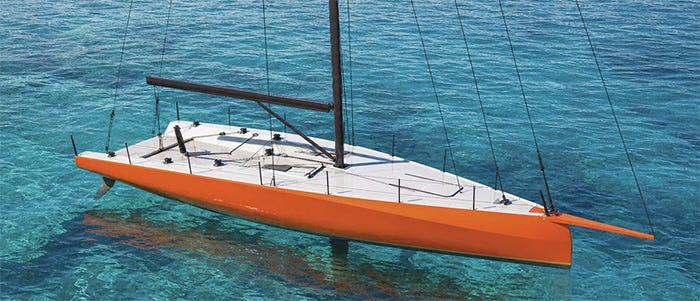
That distinction is central to the 460 Competizione, which follows the two Romas into the water in late 2026 or early 2027. Sharing its hull with the 460 Roma, it is Neo Yachts’ first genuine racing boat, developed specifically for serious inshore and offshore competition.
How we developed CYD 236: the NEO 460 Competizione
Giovanni Ceccarelli Ravenna
My collaboration with Neo Yachts began 15 years ago, when Paolo Semeraro founded the yard and asked Ceccarelli Yacht Design to develop the NEO 400. Paolo defined the vision and character of each yacht, while my studio translated those concepts into naval architecture, exterior design and interior layout. The NEO 400 was followed by the NEO 400 Plus, NEO 350, NEO 430 Roma, NEO 460 Roma, the recently launched NEO 520 and now the NEO 460 Competizione.
Across this family the objective has always been to combine identity, functionality and performance. The NEO yachts designed by our studio have achieved significant results in major offshore races around the world, validating a design approach developed through competition and practical experience.
Yachts designed by Ceccarelli Yacht Design have won 10 World Championship titles in offshore racing. These results have allowed us to compare design predictions with racecourse performance and have contributed to the evolution of our methods.
The NEO 460 Competizione moves decisively towards racing. It is a pure offshore racer, conceived without compromise for events and developed for both IRC and ORC. Two configurations were considered from the outset: fully crewed and double-handed.
The choice of a 14-metre length overall followed an analysis of offshore racing. We identified this size as effective for Mediterranean conditions, where a yacht must combine light-air efficiency, acceleration, reaching power and the ability to maintain speed through short, steep seas. Its principal parameters also place it within Class 1 for both the Admiral’s Cup and Sardinia Cup.
CYD 236 reflects a design methodology that I developed over more than 10 years as principal designer in two America’s Cup challenges. In that environment, hull geometry, appendages, numerical analysis and performance prediction were developed together through a continuous design loop, an approach that remains central to Ceccarelli Yacht Design today.
For the NEO 460 Competizione, the hull geometry and performance targets were defined by Ceccarelli Yacht Design, while CFD calculations and numerical support were carried out with Fluid for Engineering. The aim was not to optimise the yacht for one narrow condition, but to create a broad performance envelope for offshore racing.
At low heel angles, the hull was developed to minimise wetted surface. It has a relatively low prismatic coefficient, with rounded and deep sections. Upright, the geometry is efficient in lighter conditions; as the yacht heels, the immersed shape changes progressively, increasing effective waterline length and producing strong dynamic elongation.
The reverse bow reduces unnecessary volume forward. A pronounced chine helps control the immersed geometry as heel increases, while the volume distribution encourages early planing and maintains dynamic balance under asymmetric sails.
A 450-litre water ballast system provides additional righting moment, particularly valuable in double-handed racing, where movable crew weight is limited. It increases power without unnecessary complexity.
The appendage package follows the same adaptable philosophy. The yacht can be configured with a single rudder for fully crewed racing or twin rudders for double-handed use. The single rudder offers low drag and direct response, while twin rudders provide greater control at high heel angles and during fast reaching with reduced crew.
The keel is a deep fin with a ballast bulb, characterised by a high aspect ratio and optimised through CFD with Fluid for Engineering. Its fin is manufactured in high-strength steel and forms an integral part of the load-bearing structure, while remaining removable for transport, maintenance or future configuration changes.
The sailplan allows several configurations and a broad range of headsails. Offshore performance is not simply a matter of maximum sail area; it depends on preserving the correct aerodynamic balance as wind strength, sea state and crew numbers change. The deck layout and sail-handling systems are therefore being developed around efficiency, rapid manoeuvres and ease of use, especially when racing double-handed.
The structural concept was developed by Ceccarelli Yacht Design with ISD Italia, which carried out the detailed finiteelement analysis. This allowed the structure to be refined around the yacht’s load paths, balancing stiffness, strength and weight for offshore competition.
The NEO 460 Competizione is the most focused racing yacht we’ve designed for Paolo Semeraro and Neo Yachts. It brings together Paolo’s vision, 15 years of shared development, the international offshore results achieved by Neo Yachts, and the broader racing experience of Ceccarelli Yacht Design, whose projects have won 10 offshore World Championship titles. More than a single model, CYD 236 expresses our approach to performance yacht design: integrating naval architecture, CFD, appendage development, structural engineering and practical racing experience into one coherent project.
If you’re a sailing team looking to test the Competizione: the first boat in this series belongs to captn orange gmbh and, from summer 2027, you’ll be able to charter this “neo gioia” for selected races in the Mediterranean.
‘The Competizione is a pure racer, stripped out, a boat ready for the Sardinia and Admiral’s Cups,’ says Semeraro. ‘If 95 per cent of your sailing will be racing, buy the Competizione and rent a cruising boat for the rest. A fully appointed Roma will only get damaged racing hard.’
Semeraro describes the Competizione as a platform. The hull was deliberately targeted at a displacement weight of 5,800-6,000kg, resisting the temptation to chase an ultra-light 5,000kg package that he believes leaves similar-sized raceboats compromised upwind.
Owners can specify a single rudder and standard sailplan for fully crewed racing, or twin rudders and water ballast for shorthanded and offshore sailing. The rudder configuration can be changed within a few hours on the hard. The fixed keel, rather than a canting system, is designed for simplicity and efficiency.
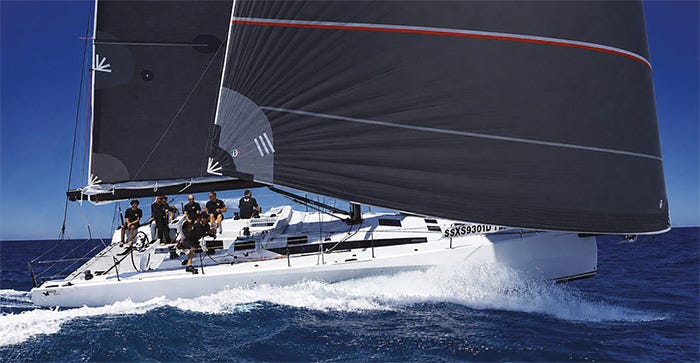
‘For this size of boat, a canting keel doesn’t pay,’ Semeraro says. The keel is secured with just two bolts, allowing keel and rudders to be removed and the boat transported by road to major events such as the Admiral’s Cup.
The Competizione’s development follows the same philosophy that runs through the entire Neo range: allow the water to determine the final design.
‘My last post on Facebook was “WIP” – work in progress,’ says Semeraro. ‘We prefer to wait for on-water tests of the previous boat before taking a decision on the next one.’
That approach influenced the development of the rig with mast-builder Pauger Composites. Rather than finalising specifications too early, Neo waited until sailing data was available.
‘Innovation cannot start from design, it starts with on-water tests.’


Semeraro’s confidence in defining the difference between racer and cruiser comes from a lifetime in competition. He represented Italy in two Olympic Finn campaigns, in 1984 and 1988, sailed the Admiral’s Cup in 1985 and 1987, and raced the America’s Cup in 1987. An engineering degree then led him into sailmaking and eventually ownership of Banks Sails Europe, where he built a business that achieved three ORC World Championship victories and multiple X-35 World and European titles.
‘My career was always about helping boatbuilders fine-tune deck plans and sailplans,’ he says. ‘In the end, rather than focus only on sails, I decided to build a boat.’
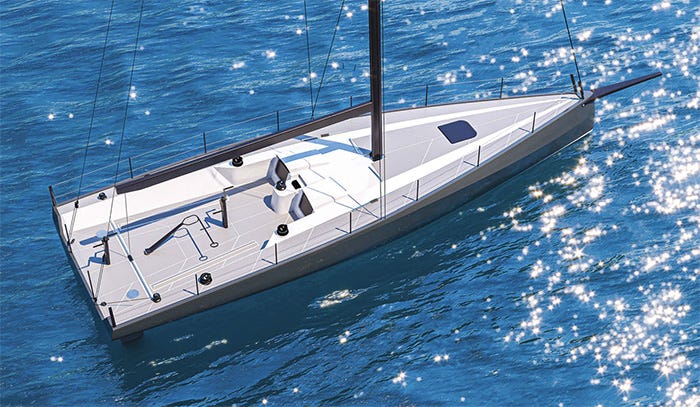
The first NEO, a Ceccarelli-designed 40-footer in pre-preg carbon, launched in 2014. Six months later it won its class in a stormy Middle Sea Race where much of the fleet retired, without breaking anything.
Since then, Neo Yachts has sold 31 boats built by a 15-strong team in Puglia. Owners are spread across 17 countries, including the US, Australia, Hong Kong, Japan, Finland, Norway, Lithuania, Spain, Germany and Greece.
The yard operates from a 2,500m² facility with two climate-controlled ovens for curing and painting. Each boat is built to order, with construction taking 12-15 months from mould to launch. Completed hulls move to a service yard in Bari for keel, rudder and rig installation before sailing within days. When owners arrive, Semeraro says, everything has already been tested and prepared.


That same focus applies to suppliers. Neo Yachts now prioritises service as much as product quality, having learned from early experiences with suppliers who delivered excellent components but poor support.
‘Whatever goes wrong gets solved in 24 to 48 hours,’ he says. ‘Send a spare part, fly someone to the yard, make a video call – but we have to deliver the boat.’
For Semeraro, the appeal of a Roma is not simply speed. It is the way the boat improves the owner’s sailing skills. ‘They buy the boat to go fast but also to improve their sailing ability,’ he says. ‘They know that by using this boat day after day they will become a better sailor.’
Every adjustment brings a response: easing a jib sheet barber hauler, changing traveller position or choosing a code zero over a jib all produce measurable gains.
‘The boat reacts to the tuning. It is a fast boat. It is like changing to a more powerful motorbike – more stable, more modern, higher speed with more safety. They keep a young soul.’
With two Romas heading to boat shows in 2026 and the Competizione following soon after, Neo’s message should become clearer than ever: the Roma is a fast cruiser, not a compromised racer, while the Competizione is the raceboat the company has deliberately waited to build.
Discussion about this post