


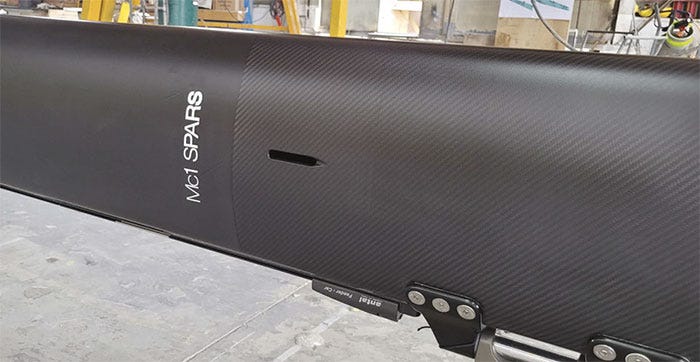

Getting hi-tech designs like TP52s to achieve their peak performance requires more than top crew work, perfect sail trim and outstanding steering and tactics. Having the right spars is also absolutely essential. A case study of a successful Class 0 entry at the ORC World Championship in Sorrento, Italy shows how MC1 Spars rose to the challenge of designing, fabricating and delivering a replacement mast on time and on budget, for a high-profile team entered in this very competitive event, and then providing full commissioning support.
This story starts at the 2025 Admiral’s Cup where Carl-Peter Forster’s TP52 Red Bandit, part of the Bayerischer Yacht Club team, showed tremendous promise. They came into the Admiral’s Cup after an overall win in the 2024 Middle Sea Race and scored some solid results in the opening stages of the AC.
The team was earning attention for these results because Red Bandit Racing is not just another all-pro programme loaded with decades of elite talent and the very latest technologies, like a typical Admiral’s Cup campaign. In fact, the Forster Offshore Racing Foundation that supports Red Bandit Racing is a decidedly pro-am effort that provides ambitious young sailors with the chance to get the training from a few seasoned pros and to compete at a professional level in a variety of inshore and offshore racing events. The foundation’s mission is to train and develop young sailors from one-design and dinghy classes (such as, 420, 470, 49er) the opportunity to transition into the world of big-boat racing.
‘So far we have invited more than 70 young people to sail with us in this programme,’ says Forster, ‘and interest continues to grow’.
Yet this positive start to last year’s Admiral’s Cup took an unfortunate turn. On the first of the inshore races in the Solent, Red Bandit’s mast crumpled and broke, fortunately without injury to any of the crew, but taking them out of the event and cancelling all other planned racing for months to come.
Enter MC1 Spars
In the search for a replacement mast, Forster contacted MC1 Spars’ manager Trent Justice to find out what options were available to get them back on the water.
‘We first looked carefully at the team’s goals,’ says Justice. ‘Their programme has a primary focus on serious offshore racing, with occasional inshore races as well, so we agreed that a mast of exceptional strength was a priority, especially after their experience in the Solent.
‘Cost was also a consideration, so we suggested high-modulus carbon rather than ultra-high modulus because the small difference in weight and centre of gravity did not outweigh the extra expense for the type of racing they were anticipating.’
Justice then contacted Steve Wilson, who he calls “the godfather of rig design”. Wilson’s development of the SailPack software system has led to extensive experience in designing many dozens of successful high-performance spars.
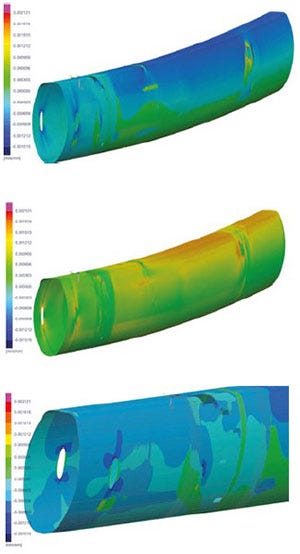
Wilson routinely works with the team at MC1 Spars to determine the dimensions and composites layup needed to optimise a spar to meet the customer’s needs. In this capacity he works alongside other experts, such as project manager Wade Morgan, who was available for this job after finishing his role with the new Mills 56 Denali built in Valencia, another highperformance boat with an offshore focus.
‘Working with this team at MC1 Spars was a great pleasure,’ says Forster, whose background in the 505 and Star classes, as well as in offshore racing, gave him a strong personal insight on the importance of having exactly the right mast to match the boat.
‘Our TP 52 is an older judel/vrolijk design from 2008, which is a little heavier with a shorter keel than the current generation boats, but has less wetted surface in the hull form,’ Forster says. ‘So we can do quite well in winds less than 10 knots.’ The sailplan is slightly different as well, with a smaller mainsail but larger headsails and spinnakers. Other important features that needed consideration in the spar design were:
the ability to increase headstay loads from 6.5 tons to 8 tons
no less than six halyard locks to handle staysails and flying sails as well as the headsails and spinnakers
while a new mainsail would be built for the new mast, the team wanted a workable deflector system to fine-tune the mast shape as needed throughout the range of conditions typical of most offshore races. This avoids the need to make too many luff curve adjustments in the new mainsail
all other sails – headsails, spinnakers, staysails and code sails – would be from the existing inventory and used without immediate plans for replacement
Time to deliver... but also innovate
Another important target was to deliver the new mast to the boat in St-Tropez by early May 2026 in time for the ORC Worlds in Italy. Hopefully sooner, to have some time to check its fit and do some tuning before the event. This included ensuring the new set of composite rigging from Future Fibres was also arriving on time and on dimension to fit properly.
‘What also really impressed me about working with MC1 Spars,’ Forster says, ‘was the on-site commissioning service and how Trent and his team worked really hard to solve a few issues that came up in the commissioning. Their work was diligent and efficient so that we had time to not only make the event, but to have a few days of sailing before racing.’
The on-time delivery from the team at MC1 Spars started with completing the mast fabrication at its base in Zhuhai, China, ahead of schedule, allowing Forster to help find a shorter shipping route from the export location in Shanghai. He found a one-stop solution that landed the mast in Belgium and it was then transported by truck to St Tropez a few days earlier than the plan. In all, it was delivered four and a half weeks earlier than the contracted arrival date.
‘One thing we do for our customers is to maintain a constant flow of weekly reports that give not only the progress of what’s happened to date, but also a projection of completion targets in the next week,’ Justice says. This approach builds confidence and trust, effectively bring the client into the team to collaboratively arrive at outcomes that don’t just fulfil contract goals but provide an opportunity to exceed them, as happened with Red Bandit’s new mast.
‘We are deliberately careful in establishing timelines that may seem ambitious but are actually realistic,’ Justice says. ‘That avoids us having to rush at the end to meet deadlines, which is when mistakes can easily be made and we then fall behind in correcting them.’
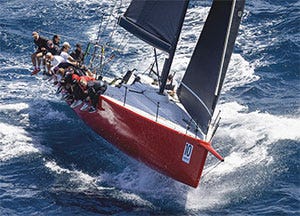
Another interesting aspect of the Red Bandit mast project is the detailed innovations in spar assembly that make a difference in a variety of important ways, such as reducing weight and windage, increasing strength and adding useful functionality. Justice gives an example in the fabrication and installation of the diagonal shroud tangs.
‘When we were designing these we realised we could improve not only on reducing the weight from 510g to 397g by using titanium, but also reduce the fabrication time by building the tangs in one part and not three. We spoke about this with Carl-Peter and he said: ‘This is great, but how much more will it cost?’ When I said there was no charge for it, this is what we do, he could not believe it.’
Similar improvements in design were made to the six halyard locks by having the bullet travel over the sheave and positioning the flipper behind it. This makes the release under load more reliable when applied off-axis, which is typical when dousing even a furled sail while under way. For any foredeck team in modern offshore racing, a consistently reliable halyard lock system can be a game-changer.
Besides the full-service commissioning work performed by Justice and the MC1 Spars team, Forster was also impressed with the guidance they gave for an initial set of tuning numbers to get them started towards the ORC World Championships in Sorrento, which were fast approaching.
‘In our pro-am team we are without a specialist in rig tuning,’ Forster says. ‘Trent’s guidance was a tremendous help in getting us started. We would have been lost without that.’
At the ORC Worlds the Red Bandit team performed well considering that they were starting afresh. In Class 0, the toughest class at the event with 15 entries including eight seasoned, mostly all-pro TP52s and three Wallyrockets, Red Bandit finished fifth among the TPs and eighth overall. Included in their remaining season of four events are the always competitive Copa del Rey and a return to the Rolex Middle Sea Race.
Watch for this team as they grow in competitiveness while still completing their mission to also grow the sport.