



The inaugural edition of The Ocean Race Atlantic this September will see two examples of the very latest in IMOCA design-thinking face off against each other for the very first time.
Boris Herrmann’s Malizia 4 (GER) and Kojiro Shiraishi’s DMG MORI Global One (JPN) – both launched in Lorient, France in recent weeks and currently in the early stages of commissioning by their respective teams – represent two very different design philosophies.
First to hit the water in early June, DMG MORI Global One was conceived by the legendary Guillaume Verdier – famous not only for his success in the IMOCA world, but also for his contribution to the creation of the America’s Cup class AC75 foiling monohull.
Indeed, the French designer looks to have incorporated some of the AC75 underwater profile into the new Japanese boat – most notably, a pronounced bustle running the length of its centreline.
It’s a feature that has never been seen on an IMOCA before and – as Verdier explained – speaks volumes about just how different this boat is to the established IMOCA norm.
“Most IMOCA designs are U-shaped,” he said. “This is so that when they heel over the hull’s wetted surface is reduced. We decided to go to the other side of the line and create a boat that is designed to mostly stay upright.”
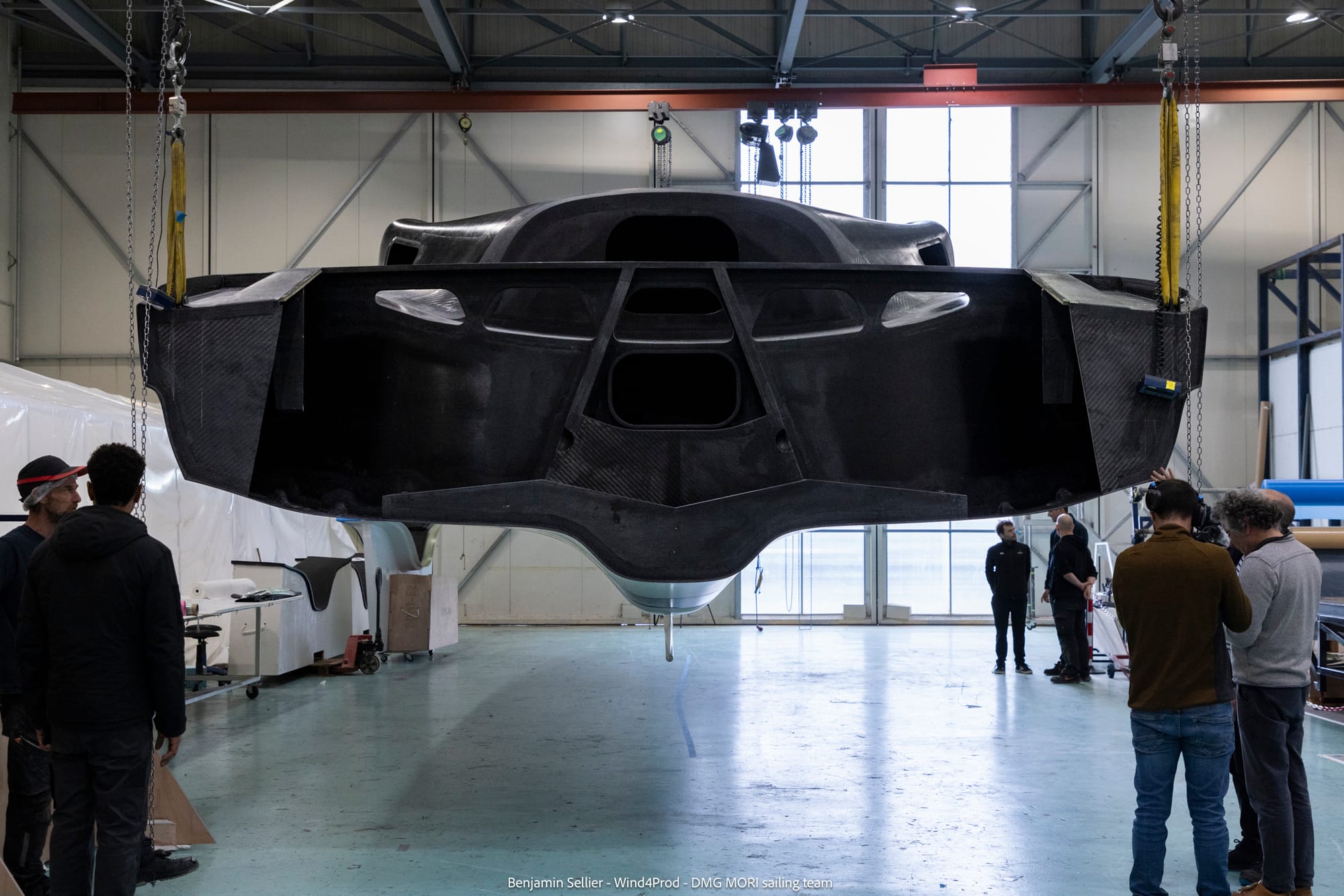
Verdier described the new underwater hull shape as being akin to the central hull on a foiling multihull and said he expects the normal angle of heel for the boat to be around eight or nine degrees.
“We will displace the full volume of the boat on this bustle,” he said. “That’s a wetted area equivalent to 70 to 75 per cent – a saving of around 20 square metres.”
According to Verdier, the knock-on effect of the low angle of heel and the fact that the boat will ride on the central bustle is a more comfortable ride for the crew as the boat skims over the waves.
DMG MORI Sailing Team manager Jacques Caraës described the new boat as “a new page in IMOCA design-thinking”.
“Everybody has been waiting to see this boat,” he said. “We think it will be very stable and we are hoping that will mean it flies a little earlier too. We will have to wait a little while to find out.”
Also in Lorient, last week, Team Malizia celebrated the launch of the Antoine Koch/Finot-Conq-designed Malizia 4. If the new DMG MORI boat can be described as a revolution, then its German rival is very much about evolution.
Herrmann’s new IMOCA is the second of three boats built as part of a unique three-way collaboration between the German skipper and France’s Thomas Ruyant (TR Racing) and Loïs Berrehar (Banque Populaire). Ruyant’s boat was launched in Lorient on June 19, with Berrehar’s yacht scheduled to be ready in early 2027. All three boats share identical hull shapes but will differ internally to suit the ergonomic requirements of the three individual skippers.
Herrmann described himself as being as happy as a child given a new toy, but was quick to point out that the launch of the new boat came at the end of a two-year period of intense work by everyone in the team.
Asked about the differences between his new Koch boat and Shiraishi’s Verdier design, Herrmann said the differences were vast.
“The design philosophies are very different,” he said. “Their boat is large, wide, powerful, while our one is pointy and narrow. They are completely different: the Verdier boat has a bustle. If you put them next to each other, you would think they were two different classes.”
Herrmann said he chose to work with Koch for his third IMOCA after seeing the impressive open-ocean performances of Ruyant and fellow French skipper Yoann Richomme in the 2024-25 Vendée Globe. Particularly of interest was the way the Koch designs coped so well with the big waves of the Southern Ocean because of their chined bow sections.
It’s no surprise, then, to see Malizia 4 sport a pronounced double chine bow to help it in fast running downwind conditions. However, according to Team Malizia co-skipper Will Harris (GBR), the new German boat has been designed to be more of an all-rounder than the previous iteration.
“What we have got is the next generation of IMOCA design. We are trying to keep that downwind speed and power with those big chines on the bow to help us get through the waves, but then also we've got more power in the boat, which is going to help us upwind in the medium and the light conditions.”
At the time of writing this story, Malizia 4 had sailed twice last week. The first outing was a seven-knot shakedown sail – which the team used to take a look at the new sail inventory – but the second sail a couple of days later saw the boat up and fully foiling on a flat sea in 12 knots of wind.
The Malizia skipper said he could not be happier with how the first week had gone with the new boat.
“Everything is working, so congratulations to the team and to the architect,” he said. “We managed stable flight and the boat feels really nice on the helm. The steering feels super nice and we can control the boat longitudinally more than the last one. It’s nicely balanced and everything feels good. We knew after five minutes of flight that this is something spectacular – the boat is amazing.”
Both teams are now tightly focused on getting their individual boats ready for their first transatlantic crossings from Lorient to New York ahead of the start of the first-ever edition of The Ocean Race Atlantic on September 1.
“You totally shouldn't underestimate what we've got to do to achieve that,” Malizia’s Harris said. “Launching one of these new boats is really hard. To make sure every system is working reliably enough to go and send it across the Atlantic – where you've got no technical assistance less than a week away – that's a big thing we've got to be ready for.”
Yacht Racing Life is a reader-supported subscription website about high-performance competitive sailing. Sign up for free to receive our email newsletter or take out a paid subscription to access exclusive member-only content.
With less than a month before the Royal Ocean Racing Club’s Round Britain and Ireland Race (start Sunday 9 August), the fleet is taking shape. So far, 30 teams from 11 nations and over 140 sailors will take on the 1800nm non-stop race. The 2026 edition is particularly significant, marking the 50th anniversary of the race.
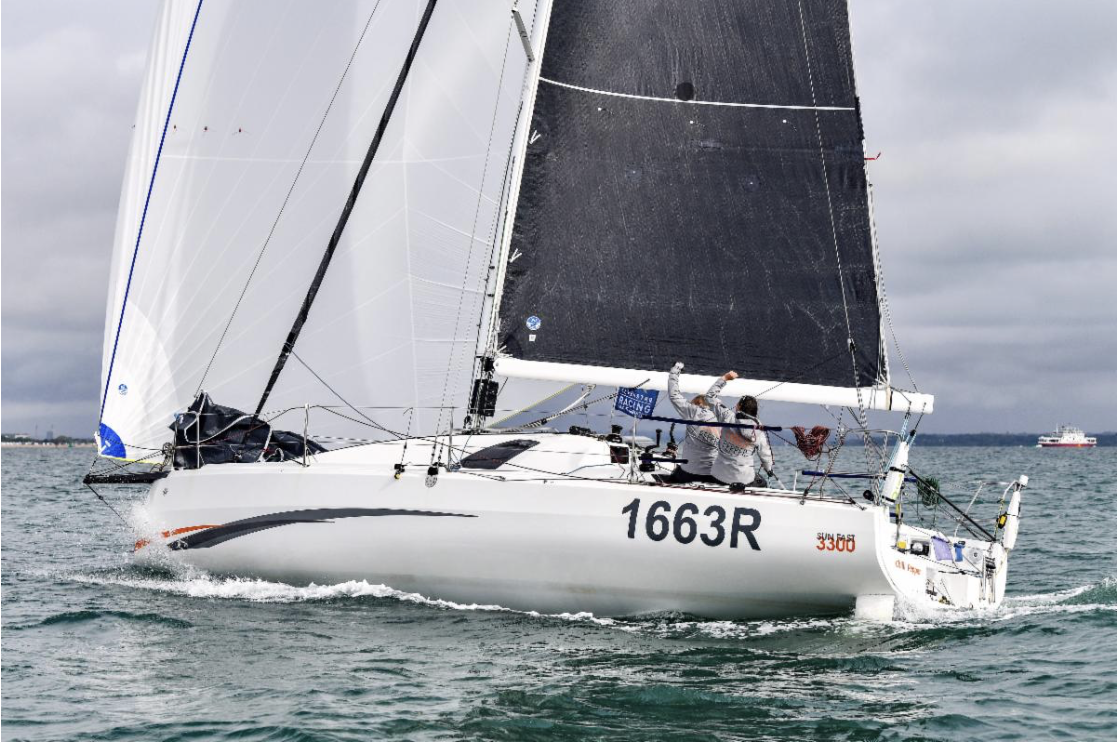
The teams will be embarking on one of offshore sailing’s greatest challenges. Yet behind every boat lies a story of ambition and adventure. Widely regarded as one of the toughest pro-am offshore races in the world, the RORC Round Britain and Ireland Race is far more than a contest of speed. Competitors face up to the complexity and endurance created by strong tides, multifaceted navigation, unpredictable weather and in some cases over two weeks at sea. Racing in some of the most remote and notorious waters in Europe is an enormous challenge just to finish.
The 2026 fleet highlights the growing strength of offshore sailing’s next generation racing with RORC. Alongside seasoned veterans, almost a third of the sailors entered are in their teens, twenties and early thirties, reflecting the continued appeal of long-distance offshore racing to younger competitors seeking adventure, challenge and opportunity.
Father and Daughter Take on Their Biggest Offshore Challenge
One of the most compelling human-interest stories in this year’s fleet belongs to Mojo, the J/105 being raced double-handed by Richard Breese and his 19-year-old daughter Emma Breese, a past British National Junior Optimist Champion.
Richard and Emma Breese have already completed the 2025 Rolex Fastnet Race aboard Mojo double-handed and this year Emma is part of the RORC Griffin Pathway, racing with the ‘Cherbourg Team’ in her first year at university. For both Richard and Emma Breese, the major progression to the 1800NM Round Britain and Ireland Race is a significant one. Emma only started offshore racing last year and the Round Britain and Ireland Race is the longest race that either Richard or Emma have ever done.
“The Round Britain and Ireland Race feels like a huge step up and that’s exactly what makes it so exciting,” commented Emma Breese. “Taking on a challenge of this scale with my dad is something I never imagined doing so soon. He taught me to sail when I was seven years old and we still learn from each other every time we go offshore. His experience comes from years of ocean racing, while I’ve come through dinghy sailing and more recently the RORC Griffin Pathway, so I think our different backgrounds work well together.
“Away from sailing, I’m in my first year studying medicine at Cardiff University and I’m constantly surprised by how many similarities there are between the two. Teamwork, communication, problem-solving and always looking for ways to improve are just as important offshore as they are in medicine. Offshore racing has taught me a lot about resilience and self-belief. When I first started, I found the sleep deprivation and physical demands incredibly challenging, but I’ve learned that I’m capable of much more than I thought, while also understanding when to rest and recover.
“I know a lot of my friends think sailing around Britain and Ireland non-stop sounds completely crazy, especially the sailing through the night and living on freeze-dried food, but they’ll be following the race and tracking our progress. For me, the opportunity to take on such an iconic race at this stage of my sailing career is hugely motivating. Whatever happens, I know I’ll learn an enormous amount from the experience and hopefully take another big step forward as an offshore sailor.”
From One Generation of Offshore Sailors to the Next
The father-and-daughter partnership of Richard and Emma follows in the wake of Jim and Ellie Driver, who raced double-handed in the 2022 Round Britain and Ireland Race, finishing sixth in under 15 days. Ellie Driver was about the same age as Emma Breese is today and Ellie has now gone on to compete in the last two editions of La Solitaire du Figaro. Ellie and Emma Breese are well acquainted as Emma has sailed with Ellie delivering her Figaro 3 to race start locations.
“Racing around Britain and Ireland with my dad was incredibly special. We went into it very green,” smiled Ellie Driver. “We had completed a Fastnet, but four days at sea is very different from 15 days. It taught me that this race is a marathon, not a sprint. You have to finish as strongly as you start. The Round Britain and Ireland is the Fastnet Race 10 times over.
“The biggest lesson is managing sleep, food and energy. Double-handed, you have to look after each other and take every opportunity to recover. There will be difficult moments, but there are also so many chances to come back. The weather changes, the tide changes and the race can turn again, so you have to stay positive.
“For me, the race confirmed how much I love being at sea and there is something very pure about that. It also made me realise that this was something I wanted to pursue professionally rather than a hobby.
“My advice to Emma would be enjoy the experience and remember that one bad day does not define the race. It may also help her decide whether offshore sailing is a passion she wants to take much further.”
Griffin’s Next Generation Takes On the Ultimate Test
The youthful profile of the fleet is further illustrated by the RORC Griffin Youth Pathway Team racing the Sun Fast 3600 RORC Griffin. The campaign represents one of the most exciting development programmes in offshore racing.
The Griffin Fund, established in 1947 by the Royal Ocean Racing Clubwas created to support young sailors and encourage participation in offshore racing. Nearly 80 years later, the programme continues to provide talented young sailors with opportunities to progress within the sport.
Over 100 young sailors are part of the 2026 Griffin Pathwayand the crew of eight racing on RORC Griffin for the Round Britain and Ireland Race are all 18-30 years of age, including Eimer McMorrow-Moriarty, who brings a special connection to the race. The 22-year-old from Fenit, County Kerry, will race past the West Coast of Ireland that inspired her lifelong passion for the sea.
"I feel super proud to be not only Irish, but an Irish girl as well,” enthused Eimer McMorrow-Moriarty. “It will be really special to race on RORC Griffin past the coastline of Kerry and the West Coast of Ireland that I call home. The Round Britain and Ireland Race is the biggest challenge I've ever taken on and I'm incredibly grateful to be doing it with the RORC Griffin team."
A Race Like No Other
Organised every four years by the Royal Ocean Racing Club, the RORC Round Britain and Ireland Race is one of the most demanding in offshore sailing. Starting from Cowes, the fleet races 1800 nautical miles around Britain and Ireland, passing famous landmarks before returning to the Solent. As the fleet departs Cowes on 9 August, it will showcase not only the very best of offshore racing, but also the future of the sport.


