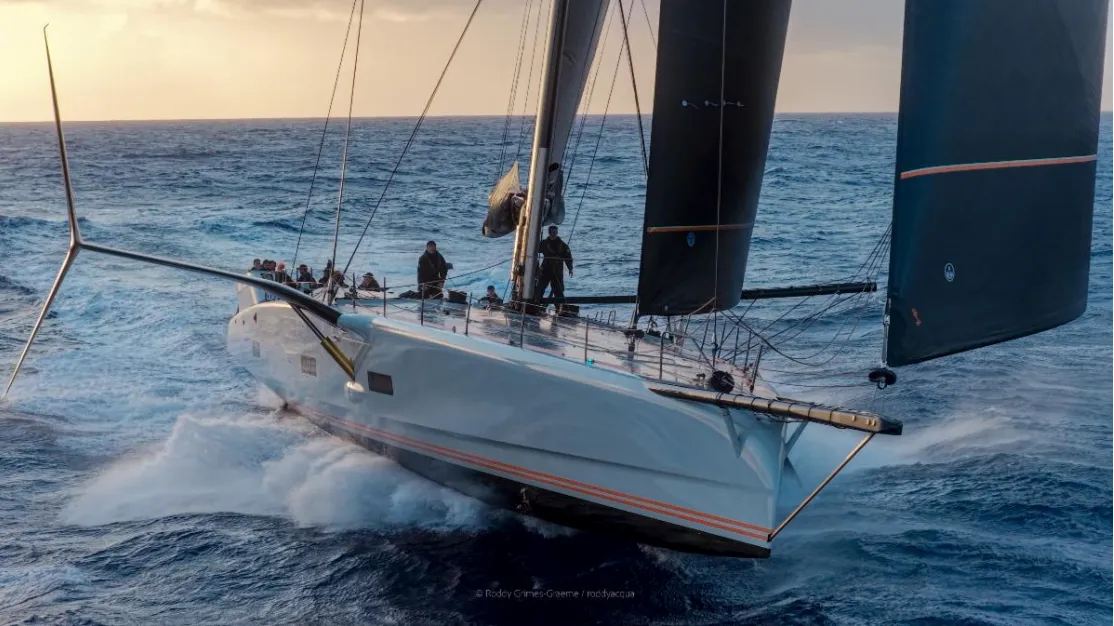
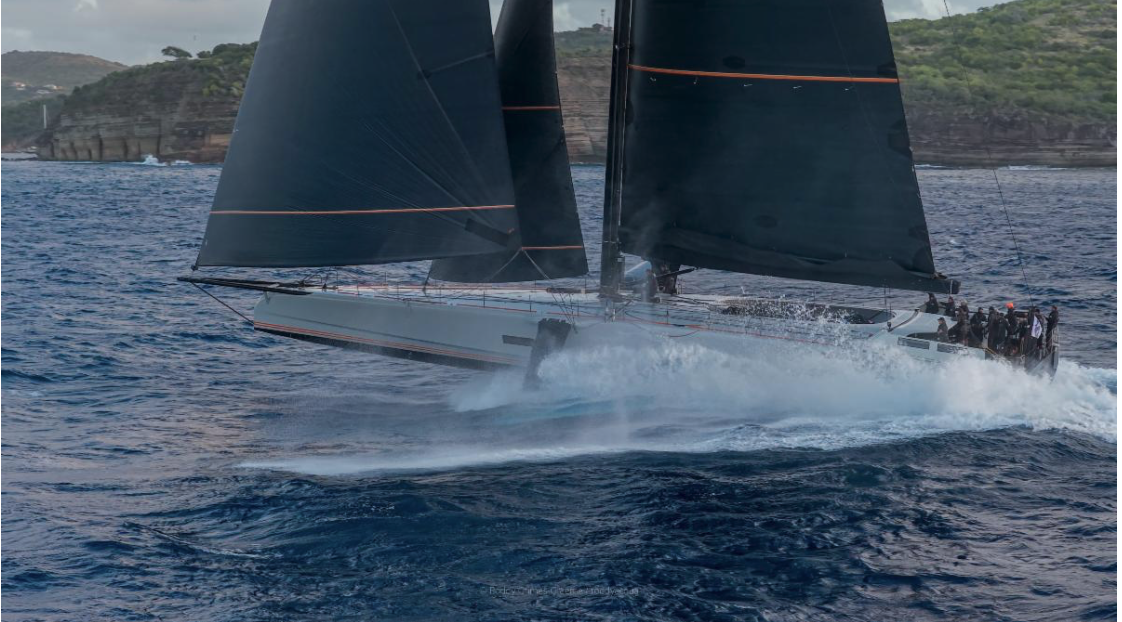
Skippered by Damien Durchon, Raven crossed the finish line at 30 knots of boat speed off English Harbour, Antigua, on Sunday 18 January, completing the 3,000-nautical-mile Atlantic crossing in just under seven days, an extraordinary achievement. Light for her length, foil assisted and engineered to sustain very high average speeds for days at a time, Raven represents a new chapter in offshore maxi yacht design.
Raven was welcomed into Falmouth Harbour by The Hon. Charles ‘Max’ Fernandez, Minister of Tourism & Economic Development, who congratulated the crew and presented the IMA Transatlantic Trophy, as the first maxi yacht to finish the race. Fernandez highlighted Antigua’s role as the new finish destination for the RORC Transatlantic Race, underlining the island’s appeal to elite offshore racing yachts and international crews.
A new benchmark for monohulls
For navigator Will Oxley, who also navigated Comanche to the monohull race record in the 2022 RORC Transatlantic Race to Grenada, the comparison between the two boats highlights just how radical Raven is.
“It’s fascinating to compare Raven and Comanche,” explained Oxley. “Comanche is still the global benchmark in VMG downwind sailing, but Raven has clear performance advantages at certain angles. In this race, which is largely a classic downwind Atlantic crossing, when we’re sailing our angles we’re faster. Where Comanche still has the edge is pure VMG, and that’s something we continue to work on. But Raven is an incredible platform, and what we’ve achieved here sets a very serious benchmark.”
That benchmark was achieved without drama, a key measure of success for the team. “Before the start I said I would judge this race on three things,” Oxley added. “Boat condition, crew condition and whether the time we set stood up against Atlantic crossing benchmarks. We achieved all three. We arrived with the boat and crew in great shape, and we set a time that speaks for itself.”
Speed with stability
Unlike fully flying foilers, Raven generates enormous righting moment through her side foils while remaining largely in the water, combining performance with control. For skipper Damien Durchon, that balance is fundamental.
“This boat is incredibly stable,” said Durchon. “The better it performs, the safer it becomes. We have huge righting moment from the foils, backed up by 10 tonnes of water ballast and strong hull form stability. If a foil stalls, the boat simply behaves like a conventional yacht. In many respects, I would say Raven is safer than most offshore boats.”
At speed, the sensation is thrilling
“At 25 knots it already feels fast,” Durchon explained. “At 30 knots and above, you’re moving quicker than the waves themselves. You’re working your way through the sea rather than reacting to it. It’s demanding, but the boat remains remarkably manageable.”
A platform built to go fast for days
Sailing Master Brad Jackson emphasised that sustained performance, not peak speed, was the defining feature of the campaign.
“If you complete a race like this in under seven days, a lot has gone right,” Jackson said. “The weather was excellent, but the boat is genuinely fast through the water. That’s the impressive part. This wasn’t a sprint with everything on the edge, it was about keeping the boat in one piece and letting it do what it’s designed to do.”
Jackson also highlighted the significance of crew cohesion on such an advanced platform. “This is a complicated boat, but the crew dynamic is very positive,” he said. “Everyone knows their role, everyone is professional, and we’ve spent a lot of time learning this boat together. This was the first time we really stepped up the intensity and treated it like a full race. The way the team came together was a big part of the result.”
Oxley echoed that sentiment: “Brad has done a great job building a team where the dynamics really work,” he said. “There’s no friction, the humour stays no matter what’s happening, and that makes a huge difference offshore. People want to sail this boat because of the platform, but also because of the team.”
Engineering the future
Project Manager Claes Nyloef believes Raven points clearly toward the future of offshore monohulls.
“This is a way forward,” said Nyloef. “You get foiling performance without fully flying, which is critical for ocean racing. It’s a very good combination of a fast monohull and foiling technology. I think you will see more boats like this. It’s efficient, it’s reliable, and you can sail it like a normal boat while accessing a completely new level of performance."
Nyloef described the acceleration as the boat’s defining trait. “When she starts accelerating, it doesn’t stop,” he said. “It’s breathtaking. Previously you only experienced that sensation on multihulls. Now you can feel it on a monohull of this size, and it’s extraordinary.”
Finishing in style
The race ended as it began, with precision and pace. Oxley called the final approach into Antigua in challenging, shifting conditions.
“It was a very dark night, no moon, shifting breeze and changing pressure,” he recalled. “We wanted to call a good layline for the finish. With a bit of practice and a bit of luck, we nailed it and crossed the finish doing over 30 knots. That was a pretty special way to end the race.
“We said before the race that we would do this in seven days,” he said. “We did it in six days and 22 hours. That tells us we understand this boat now. There’s still room to improve, especially at certain angles, but this race proved the concept.”
A statement victory
Raven’s performance not only secures Monohull Line Honours and the IMA Trophy but also establishes her as a leading contender for the overall IRC corrected-time result, with few boats capable of matching her blend of speed, stability and consistency. Raven has set the benchmark IRC corrected time to beat, but the next boat likely to finish is the Mach 50 Palanad 4. The scow bow canting keeler is in a very good position to take the overall lead under IRC.
“This was the first transatlantic race for the boat and the owner,” said Durchon. “To set a record in your first attempt is something very special.”
As Raven came to rest in Antigua, one thing is clear. This was not just a race win. It was a statement of intent from a new generation of offshore monohull.