

Goodchild recently completed his first Vendée Globe finishing ninth overall in the grueling, non-stop, solo round-the-world race. But while he has raced aroun d the bottom of the world before as part of a crew, racing alone through this vast, inhospitable wilderness was an entirely different experience.
"It was the first time by myself, that's for sure," Goodchild told Justin Chisholm on the latest episode of The Yacht Racing Podcast Extra. "I did The Ocean Race with Team Holcim two years ago, so I went from Cape Town and around Cape Horn—that's 90% of the Southern Ocean, if you like. But this was the first time to go all the way around the world and be in the Southern Ocean on my own."
There is nowhere else on the planet like the Southern Ocean. It is the most remote, least forgiving body of water on Earth. Sailors who venture there do so with the full knowledge that help is not coming if something goes wrong.
"Mentally, is the biggest difference," Goodchild explained. "You're just so far from anything. You are constantly aware that if I have an issue now, there's not going to be a ship coming past tomorrow."
"There’s not going to be a helicopter here in four hours. I’m here until either one of my competitors comes and picks me up—and he or she will be on their own on a 60-foot boat, struggling to manage it themselves, never mind mounting a rescue mission. That’s what has an impact on you."
Even the weather is unique. The absence of significant land masses means that low-pressure systems sweep around the bottom of the planet unchecked, creating conditions that are both extreme and unpredictable – very unlike the North Atlantic where most IMOCA racing takes place.
"The weather systems are much bigger and much faster moving," Goodchild noted. "In the North Atlantic, there's a lot more input, a lot more experience of what is likely to happen. In the Southern Ocean, it’s different. You see over 40 knots of wind six or seven times, with waves up to eight or nine meters. In the North Atlantic, we never see conditions like that—you’d never even go sailing in it. You’d look at the forecast and say, ‘OK, we’ll stay on the dock, shall we?’"
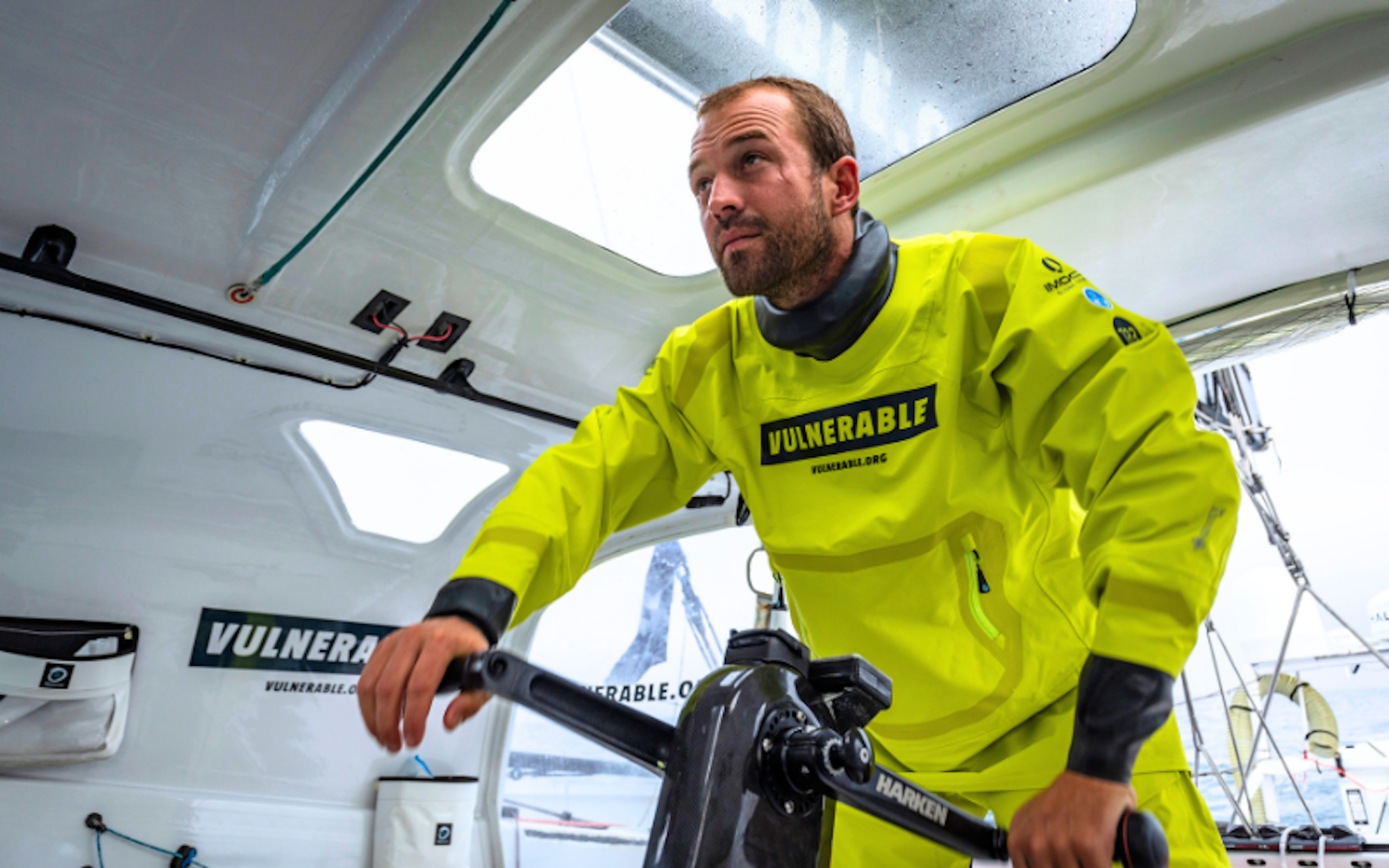
And yet, in the Vendée Globe, stopping is not an option. "You can ask yourself ten times whether you should go around weather like that," Goodchild admitted. "But in the end, you just go through it. And it turns out it’s not actually that bad. The risk is high, but when things go to plan, the boats are designed for it—they can make it through no problem."
For all the preparation and experience that goes into a Vendée Globe campaign, the reality of solo ocean racing is that things will go wrong. And when they do, there is no one to rely on but yourself.
One of the most dramatic moments of Goodchild’s race came when his massive 180-square-metre headsail detached and fell into the ocean, threatening to be shredded by the boat’s port foil. It was the middle of the night when he was jolted awake by the unmistakable sound of a halyard running free.
"I heard the halyard go 'bzzz' out of the cockpit," he recalled. "I thought, 'Oh no, that's not good.' I came up on deck and saw this huge sail in the water next to the boat. My immediate reaction was to think, ‘OK, I’m going to cut it off, because I’m never going to get that back on board.’ I was just trying to work out where to cut it to lose as little as possible."
But then, something changed. "I suddenly thought, ‘Hang on a minute. It would be stupid not to at least try to get it on board.’ You can’t just cut a massive sail away and leave it in the water like that."
Retrieving a submerged sail from a racing yacht while alone in the Southern Ocean is an almost impossible task. Waterlogged sailcloth becomes impossibly heavy, and any attempt to simply haul it back aboard risks tearing the sail apart—or worse, injuring the sailor in the process. Goodchild needed a plan.
"I tried pulling on the halyard, but it was like trying to lift a huge fishing net filled with tons of water. It was just going to break the halyard. So I started working through what I could do."
The first step was to prevent the sail from being destroyed by the boat’s foil. "I lifted the foil up so the tip wasn’t going to poke through the sail," he said. "Then I tacked the boat to stop the sail from being washed underneath. It had fallen to leeward and was being pulled under the hull, so I pinned in the mainsail to tack the boat around. That way, the sail was being washed out to windward, and I was drifting away from it instead of on top of it."
With the boat repositioned, Goodchild focused on reducing the sail’s drag in the water. "I put a mouse line on the halyard so I could ease it out, letting the sail sit on the surface instead of making a big pocket full of water. Then I sheeted the sail on as hard as I could to lift the foot out of the water—the tack and clew are built for high loads, so I knew they could take it."
Then came the painstaking process of bundling the sail, section by section, to make it manageable. "I went to the bow and started working aft, bunching the sail together with sail ties—just like ‘wooling’ a spinnaker. I’d do a meter, tie it off, another meter, tie it off. By the time I got to the clew, I thought, ‘Hang on a minute, this is actually coming towards me easily.’ I just pulled in the head of the sail and that was it. It took 45 minutes. I was amazed."
Recovering the headsail intact was not just a victory in the moment—it was a testament to Goodchild’s resourcefulness and determination. "It’s one of those situations that you encounter a lot in the Vendée Globe," he said. "You can look at it and say, ‘How hard and difficult this looks,’ but nothing's going to change. No one's going to solve it for you. No one's going to come to help you. So you might as well try something and get on with it. It’s amazing how you can come up with solutions to situations that seemed impossible to begin with."
Would the same method work again? "I don’t know," Goodchild admitted. "But I hoisted the sail a few days later, furled it up, and it’s still in the sail bag today."
Asked if he might now patent his innovative technique for retrieving a lost sail. "Maybe I should," he laughed. "Yeah, maybe I should."
Goodchild’s Vendée Globe was a journey of resilience, ingenuity, and sheer willpower. His battle through the Southern Ocean—including his remarkable headsail recovery—exemplifies the essence of solo ocean racing: when there’s no one to call for help, you find a way. And that’s exactly what he did.


