
The timing was perfect. Just as Sicomin completed a long-running R&D process to replace one of its keystone product lines with a brand new eco-friendly epoxy resin, an ambitious plan to design and build a next-generation range of low-carbon offshore racing yachts was gathering pace.
There couldn't be a better proving ground for the new Greenpoxy 550 – a bio-based resin system designed specifically for hand lamination of timber-and-fibre composites – than the Greenscow initiative, which aims to demonstrate that plywood is a viable hull construction material for Mini 6.50s, Class40s and Imoca 60s.
You might be inclined to dismiss the whole idea of plywood grand prix raceboats as a foolish, futile endeavour but it’s a credible proposition. Plywood has great potential as a core material – it’s stronger than foam and in sandwich construction, with two skins of fibre, it can be just as light and stiff.
It also has a much lower carbon footprint than other core materials if the timber is sourced from renewable forestry, and it’s very efficient for one-offs and small-series production because you don’t need to make a mould to build the boat.
The Greenscow concept comes from Gildas Plessis, a naval architect whose 350 designs range from dinghies and workboats via offshore racing monohulls and big cruising multihulls to mega yachts up to 120 metres in length. When the French Sailing Federation set a requirement in 2023 for all yacht racing classes to get ready for a major reduction in the carbon footprint of new boats, in line with the 2015 Paris Agreement, Plessis designed a low-carbon Class40.
Epoxy-ply composite construction is one key element of the Greenscow concept; another is replacing as much carbon as possible with natural fibre such as flax or basalt. Sicomin’s bio-sourced Greenpoxy resins also lower the carbon footprint of building the hull and are much less toxic than most comparable epoxies. Compared to a full carbon composite hull, the overall footprint of construction can be reduced by up to 80 per cent.
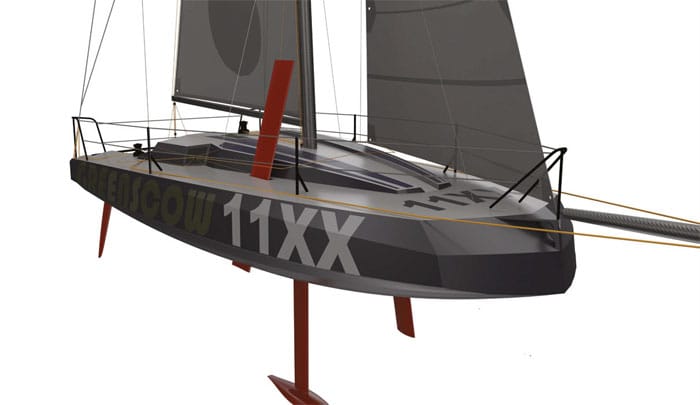
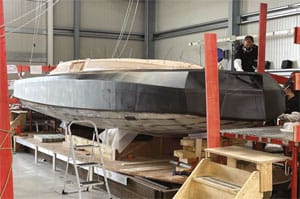
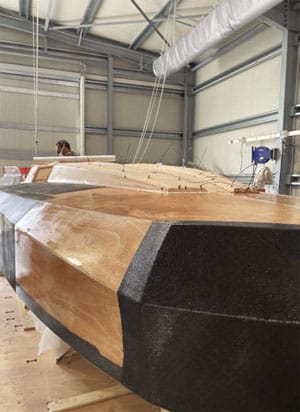
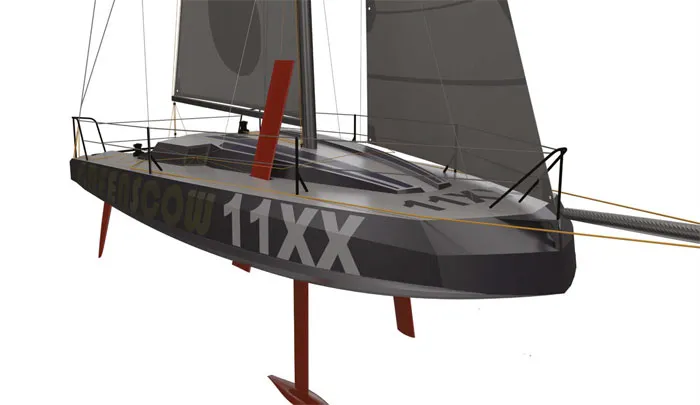
1. Yannick Eudeline’s Mini 6.50 is designed and engineered to be built in epoxy-plywood composite with extensive use of natural fibre materials. Note the chamfered arrow bow profile. 2. Yannick Eudelline’s Mini 6.50 in build at Duqueine Atlantique. Sicomin’s Erwan Spiral provided on-site technical support. 3. The Greenscow Mini 6.50 has some interesting design features. Narrow bottom strakes create a well-rounded bottom with prodigious rocker, while minimising the drag of hard chines. The arrow bow is a very efficient shape to build in plywood.
No natural fibre material can match the strength-to-weight ratio of carbon fibre, but a natural fibre composite (NFC) hull can be competitive in Class40 and Class Mini, where the use of carbon is limited. While carbon fibre is essential for some components such as foils, an NFC hull is feasible even for an Imoca if allowances can be made for the difference in weight – and with a carbon cap for Imocas now looming, NFCs offer an alternative.
Several Class40 skippers are raising funds to build a Greenscow 40 and a cruiser-racer version is already in build. A veteran Imoca skipper, Marc Thiercelin, has also bought into the concept and a 60ft foiling Greenscow has been designed and fully engineered, to be built for the 2032 Vendée Globe. In the meantime Yannick Eudeline, a young naval architect and former aerospace engineer who works in Plessis’s design office, developed his own Mini 6.50 Greenscow design in his spare time and hatched a plan to build and race it himself.
‘We noticed that the smaller the boat, the smaller the proportional difference in weight between a carbon composite and NFC hull,’ Eudeline explains. ‘For the Greenscow 650 we are aiming for a variation of around 50 kilogrammes. Being prepared to lose a little performance on paper is part of our approach to implementing a different build process for racing boats.
‘I say on paper because, as I see it, the disparity in strategy or skills from one skipper to another is more impactful than a few extra kilos. In terms of stiffness there is no real difference because we design the boat to withstand the same loads. As the material is not the same, the overall layout of the boat's structure has to be adapted to use the right fibre in the right place.’
A fully equipped Greenscow 6.50 will weigh less than 800 kg and Eudeline’s design has some interesting features. ‘The idea was to design a scow with a wide, spatula-shaped bow and a lot of rocker but the round-nosed boats that exist today are difficult to imitate with plywood panels,’ he says. ‘So I designed an arrow bow to maximise the width up front without creating a bow transom that would be a real wall facing the sea.
‘The second concept concerns the bottom strakes. I wanted to minimise the chines to reduce the drag they induce. To do this, I designed narrow strakes and multiplied them across the width of the boat. This brings us closer to a classic hull shape, well rounded and with a lot of volume where it’s needed.’
The Greenscow initiative took off when Eudeline and Plessis teamed up with Kaori Concept, a shipyard in south Brittany that specialises in epoxy-plywood composite construction. Led by Flavien Gaulard, a respected boatbuilder with a strong focus on sustainable innovation, Kaori has a reputation for exceptional build quality. The yard has one previous grand prix offshore project under its belt: Armel Tripon’s Imoca Les P’tits Doudous, built in partnership with the aerospace composite fabricator Duqueine Group.
Gaulard and Plessis were already working together on various projects and a deal was made. Eudeline built his prototype Mini 6.50 at Kaori Concept with support from Gaulard’s team, and Kaori is now putting the design into small-series production, offering both raceboats and cruisers. The full-on racing versions of the Greenscow boats are designed and engineered to be easily converted into cruisers at the end of their racing career, giving them a second lease of life.
Eudeline’s Mini 6.50 hull was exhibited last month at the Grand Pavois boat show in La Rochelle. Parts of that boat were laminated under vacuum by Duqueine, though not infused. The Greenscow Imoca 60 will be vacuum-infused by Duqueine from plywood parts produced by Kaori Concept, with Gaulard overseeing the build. However, all other Greenscows will be built entirely by hand lamination.
The issue with using vacuum infusion, Gaulard explains, is excessive waste. ‘Before I started Kaori Concept I was building big multihulls in the Philippines and I was disgusted by the amount of trash we generated,’ he says.
Boats built at Kaori Concept are proof that a highly skilled hand laminator working with optimised resins can produce a hull just as strong and stiff as an infused one – and only slightly heavier. ‘When you see how much product you’re throwing away after infusion it’s obvious that hand lamination is the best way to reduce trash and pollution,’ he explains. ‘Combining this traditional process with new materials and technology is very efficient.’
To hand-laminate a modern raceboat with tight weight tolerances, the properties of the resin are extremely important. ‘The key benefits of GP550 are its viscosity and reactivity,’ Sicomin’s Marc Denjean says. ‘They make the product easy to use and ideal for hand laminating. Mechanical performance at room temperature and excellent surface quality in the finished product are other advantages. Finally, adhesion to different types of wood – we've worked on this a lot.’
The product that GP550 replaces, SR5550, had all those excellent properties too. Like most resin systems it contained carcinogenic, mutagenic and reprotoxic (CMR) chemicals which the industry is now obliged to reduce. Sicomin went one better and phased them out completely.
‘We believe GP550 is the only biobased non-CMR epoxy system for wood that's available today,’ Denjean says. ‘Product development and innovative chemistry is a huge part of what makes Sicomin special. Our work on bio-based systems and replacing historic raw materials with non-CMR alternatives is a careful balance between guaranteeing exceptional performance and meeting the environmental and HSE targets.
'The challenge is that the old materials often perform really well. For the new GP550 we've done more than 10 iterations, working with the formulation team, testing laminating parameters and checking the mechanical performance, before feeding back to the chemists in our lab. It took a long time but the complex new formulation offers our customers a clean material safety data sheet with uncompromising resin performance.’
Gaulard was understandably keen to start using GP550 and his contact at Sicomin, Erwan Spiral, played a key role as the interface between the Greenscow project and Sicomin’s R&
D lab, providing onsite technical support. ‘I was asking Erwan to give me the new generation product to test, even before it was ready,’ Gaulard says. ‘I had a supply of leftover recycled carbon fibre and we used that to test the new resin in a direct comparison with both GP33 and the old SR5550.
‘With these three resins we made composite parts – about 500 test samples in total – using all the different types of fibre, in all of the structural applications, in all the different ways of lamination. We weighed everything and sent it to be tested on a machine for bending and tensile strength. Then we sent samples to a university in St-Nazaire, Yannick asked another university to run some tests, so we’ll have three sets of data to compare. I may one day share all that data but we’ll keep it to ourselves until we build the first Greenscow Imoca.
‘In my experience, plywood with basalt fibre and bioresin is the best compromise between performance, longevity, easy repairability and carbon footprint,’ Gaulard says. ‘A wooden boat with a bit of composite on it is a really good boat. You keep a bit of carbon fibre on it, you save a bit of carbon footprint with a good resin, the wood is well protected like a standard composite boat, and the weight is almost as light as full carbon sandwich. It’s a very good balance.’