



And yet you could argue that looking in from the outside, their entire history and continued success has been built around rethinking items that had already reached peak evolution.
From rope clutches to tiller extensions, lifejackets and beyond, the Cowes-based firm have made it their mission to take a genuinely fresh look at items we take for granted by going back to first principles each time and working up their solutions from there. The results frequently leave the rest of us wondering why we hadn’t seen the potential for improvement all along.
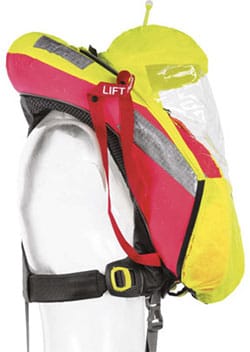
Their Deckvests are excellent examples. This range of lightweight, easy-to-use and highly practical lifejackets set new standards from the off, packed with innovations including Pylon Light, LumeOn Lights and Harness Release System. The strange thing is that when it came to upgrading their top of-the-range vest, the VITO, even they were a little hesitant about whether or not they could improve it.
With the VITO AFS now on sale, it is clear that they haven’t just refined a lifejacket that was already considered to be the best in class and the result of a seriously in-depth study for the Volvo Ocean Race back in 2017. Once again Spinlock has raised the bar significantly. Even more interesting is that the starting point for the new project wasn’t even the VITO.
‘A number of years ago we were awarded a grant to investigate the issue of flotation,’ explains product manager Myles Uren, who specialises in technical product development. ‘One of the issues when you’re assessing lifejackets is that it’s very hard to build meaningful data when you are using humans to test the flotation characteristics. Not only do you have to consider a wide range of weights and sizes, but even if you were using the same person throughout the tests, a human’s response in the water could be different every time making it hard to pin down the data.
‘So we started by setting up our own pool facility and creating a standard mannequin that we called “Randy”. This allowed us to vary all kinds of details relating to the buoyancy and conditions and then record the effect.’
Monitoring a wide range of factors from how quickly the lifejacket righted Randy to the angle of rotation, the freeboard achieved and more, the research team established a large amount of meaningful data that allowed them to focus on what would make the optimum lifejacket.
The results have led to the new AFS development. Keeping the bulk of the buoyancy low down and close to the body had a big effect on efficiency and made it clear what shape the inflated lifejacket should take.
However, making these inflated shapes by using conventional manufacturing techniques wasn’t possible. Spinlock turned to some sophisticated 3D software that is used elsewhere in the apparel industry, along with a new method of construction, to create what the research had led them to.
‘The normal process of making a chamber in two parts that are welded together means that you are very limited on the shapes that you can create,’ says Uren. ‘Inserting a highly flexible airtight inner chamber into a perfectly shaped outer retainer that has been stitched together allows us to create the perfect inflated shape. Put simply, it’s like an inner tube on a bicycle tyre filling the cavity and shape of the outer tube.’
The vastly improved buoyancy distribution gives further benefits. One of these, a big win for most sailors, is reducing the overall bulk of the lifejacket while also reducing its stiffness and weight, and improving its fit.
‘The fit around the neck in particular has made this a much more comfortable lifejacket to wear,’ he says. ‘Re-packing is also much simpler as there is no specific folding method required. We’ve even been able to improve visibility thanks to the new construction by using two highly contrasting colours for the retainer, something we couldn’t do with the previous chamber material.’
But perhaps the most telling single fact in a long list of new benefits is that when compared with its previous lifejackets Spinlock has been able to significantly increase the measured performance that can be achieved from a 170N N rated chamber whilst making it lighter, more flexible and making the lifejacket more comfortable to wear. This is progress that goes way beyond incremental evolution. Something that Spinlock is famous for.


