



Technology generally progresses not in a smooth upward gradient, but in sudden bursts of inspiration, followed by periods of more linear refinement and development.
One such burst took place when Doyle Sails introduced its new Structured Luff Asymmetric sail at the Sorrento IMA Maxi European Championship in May of 2024.
Hap Fauth’s former Maxi 72 Bella Mente won the event with a race to spare sporting one of the new sails, which drew plenty of attention on the race track and caused much dockside discussion.
Structured Luff Asymmetric is the brainchild of Doyle Sails president, Mike Sanderson, who identified that the recent turbo-charging of the former Maxi 72 class had opened a gap in their sail inventory. Some of the boats have been lengthened and several, including Bella Mente, have added twin rudders and water ballast.
‘As the 72s have got lighter and more powerful, they have become significantly faster than they were 10 years ago,’ Sanderson notes. ‘We are now often sailing downwind at apparent wind angles of 50-55°. To expect nylon or polyester spinnaker material to cope with a jib-like angle of attack is a big ask.
‘I had been scratching my head trying to figure out how to transition into a narrower apparent wind type of sail without losing the conventional abilities to do string drops, peels, standard gybes, regular packing and so on.’
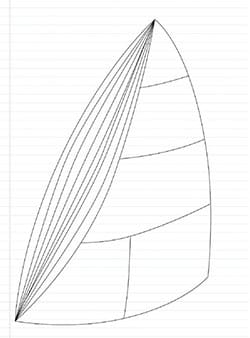
Eventually, Sanderson produced a sketch showing a Structured Luff-type lens on the leading edge morphing into a more conventional soft sail towards the trailing edge. ‘I put the concept to our designers, but initially I got no traction at all. It was like I had fallen out of a tree on Mars,’ he laughs.
Then, Justin Ferris and Andrew Lechte started to play around with the concept and produced a prototype for Sanderson’s 35ft Rob Shaw-designed canting keeler. ‘We tried it out with my son, Merrick, filming it on his drone. I circulated the footage to the designers. “This idea has got legs, guys; we need to start paying attention”, I told them.’
‘Richard Bouzaid, who is a genius with this kind of challenge, managed to get the concept to run on our software and from there we were able to engineer the structural transition from Stratis material down the forward section to off-the-shelf polyester. To be honest, the result continues to exceed expectations.’
Sanderson confesses that the first time they hoisted the sail on Bella Mente, it was one of those moments when you close your eyes and then slowly take a peep to see if it is surviving. ‘It is one thing to try the concept with the family out on a 35-footer,’ he says. ‘It is another thing altogether on a maxi where the loads are totally different. But it worked straight out of the bag.’
Before the Sorrento regatta, the Bella Mente crew assembled in Palma for a week’s training, where the sail had a good workout. ‘We tested it thoroughly for performance and reliability. We had it up in sloppy seas and smooth water. We explored how it performed in reaching conditions and running quite deep angles. We practised gybes, string drops, peels.
‘By the time we got to the regatta, the sail had already accumulated quite a mileage, but it went straight into our frontline racing inventory. We used it every day of the regatta except for one day of windy windward-leewards where it was out of range.’
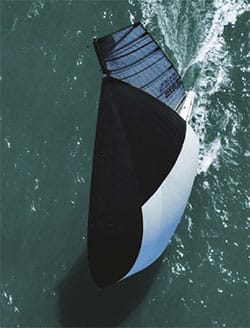
In race mode, the sail proved extremely flexible, with a wide performance sweet spot. Typical maxi racing situations involve passages between and around islands, often demanding apparent wind angle changes from 50° to 80°. ‘Those are big shifts from a load standpoint,’ Sanderson says.
‘In highly competitive fleets, we also need to allow for frequent tactical moves, defending or attacking high or low. With conventional laminate sails of this type, the performance window is very narrow. When you have to put the bow down for tactical reasons, the performance just falls off a cliff.
‘With this new Structured Luff Asymmetric sail, the potential is huge; we found it was possibly faster in every respect. We improved on the performance of a conventional sail in its target range, but were able to put the bow up or down and still feel like we had a speed edge. That is a very big deal for us in the type of racing we are doing.’
Although the Bella Mente sail was built to a lightwind A1-type configuration, its stronger construction and the ability to project forward in a typical Structured Luff lens shape allows it to handle reaching angles further up the conventional wind range. It stood out, both literally and figuratively.
‘It definitely drew a lot of attention,’ says Sanderson. ‘People were talking about it. We had many teams putting in orders in time for the 2025 September Rolex Maxi Worlds in Sardinia. One team ordered three of the new sails.’
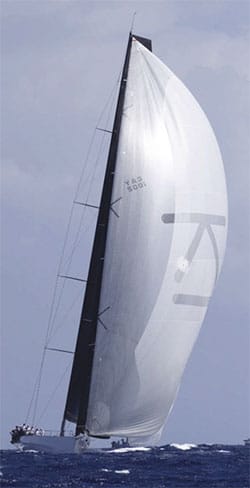
Now two years on, the concept has been refined and is utilised across all yachts, maxi and grand prix. It is now the norm and this year's St Barth’s Bucket regatta, where many superyachts also made great use of this technology, showed how Doyle Sails continues to lead the industry in innovation.
‘Our designers did an amazing job of turning the concept into reality,’ says Sanderson, who also paid tribute to Hap Fauth’s willingness to try new things. ‘We sometimes call the boat “Experimente,” Sanderson laughs.
‘We have had a fair share of wins and the odd loss, but we have an owner who just loves pushing the boundaries and thinking outside of the box. He doesn’t want us just sitting still.
‘Apart from the experimental sail on my 35-footer, the Bella Mente version of the Structured Luff Asymmetric sail was really Mark One. I was impressed and proud that it worked so well on its first competitive outing.


