




The popularity of the revised edition of the Admiral’s Cup last year has ignited new enthusiasm for true dual-purpose race boats. Not dual-purpose in the sense of being racer/cruisers but being capable and competitive at both inshore and offshore racing.
The last few decades have seen a bifurcation in this regard, with the advent and popularity of big boat one-design classes and box-ruled designs racing around buoys for a few hours in daylight. By contrast, for those who wish to race offshore there have not been many available options to choose from among proper raceboats without having to customise their build for this purpose.
The Admiral’s Cup has changed this by attracting interest in developing no-compromise raceboats that are adaptable for both buoy and ocean racing in size ranges that also make them competitive in other race and event formats. And now a trusted name in raceboat building is right there with this latest trend: McConaghy Boats and its partner MC1 Spars.
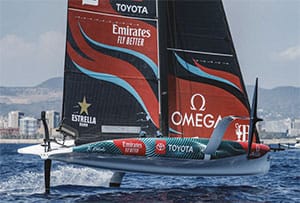
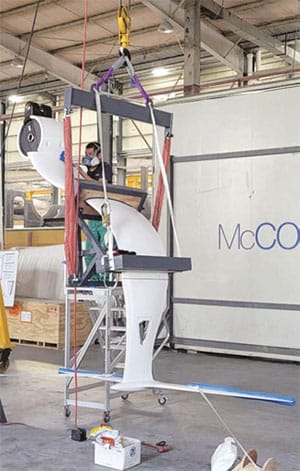


For 50 years, McConaghy has been refining and improving techniques and processes to build exceptional composite structures. This has been matched with major investment in machinery and production facilities.
A new weapon for the Admiral’s Cup
The tremendous capability and heritage of excellence at McConaghy will be put to the test in their next exciting project: a brand-new 41ft Botin design for Class 2 in the next Admiral’s Cup. For the past decade Botin Partners’ designs have dominated the 52 Super Series and many other grand prix races and regattas around the world.
Raceboat projects in the 40ft size range are not new to McConaghy either. About 10 years ago they built Ker 40s, Ker 40+s, and Carkeek 40s that dominated both IRC and ORC fleet racing in the USA, Australia, Europe and the UK – and those boats continue to be competitive.
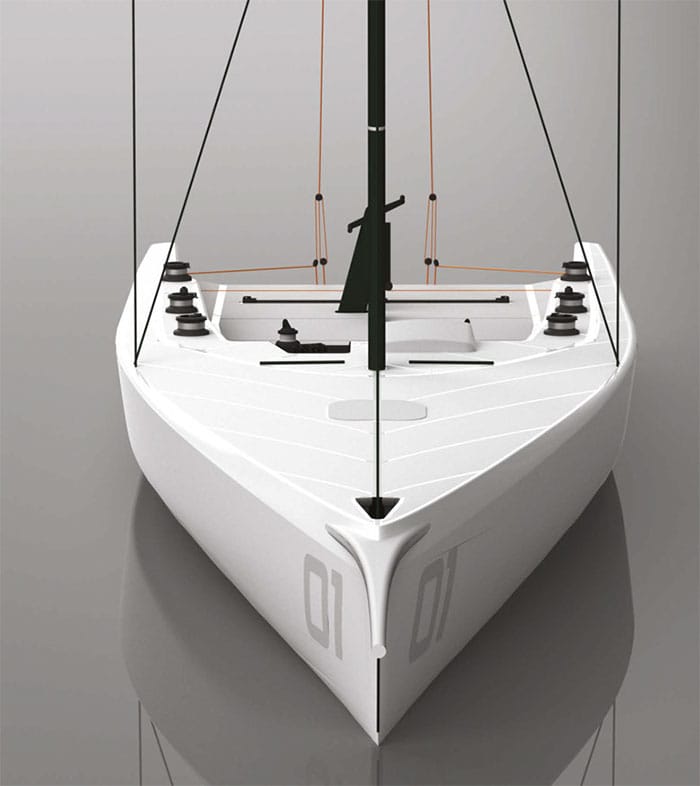
Adolfo Carrau from Botin has some observations on the thinking that has gone into this latest project.
‘We conceived the Botin 41 as a direct response to the revival of the Admiral’s Cup and the growing demand for optimised platforms within the AC2 Class, capped at a maximum TCC of 1.282,’ he says. ‘The design brief is clear: deliver a yacht capable of winning under IRC across both coastal and offshore formats, while maintaining cost discipline to ensure accessibility for serious owner-driver campaigns.’
The boat needs to be suitably strong for serious offshore sailing. ‘It needs to cope with a typical Fastnet Race in heavy conditions,’ Carrau says. ‘Pure Engineering is considering these extreme load cases and adding strength over the minimum ISO requirements.’
‘On the ergonomics and crew operation side, we have benefited from the recent experience in the 2025 Admiral’s Cup to fine-tune the freeboard height, cockpit volume, overall watertightness and interior volume. The deck layout and running rigging systems are being designed to maximise performance and trimming tune ability, while minimising through-deck holes to avoid water ingress.
‘A new hull concept is currently being developed, more oriented towards fast offshore racing but keeping in mind that these boats will also compete in plenty of inshore windward-leeward events.
‘These sometimes conflicting requirements are being evaluated, and we are using our experience and race modeling / performance prediction software to place the boat in the right spot in the design space.’
Carrau says while hull length is planned at 12.60m, the exact weight and draught details are still being determined based on some available options. When optimising the hull shape they will be considering use of a stern interceptor trim tab, benefiting from experience with many Botin grand prix designs that have been using these since 2023.
The appendage package decision is wide open and under evaluation, with options being:
• Single vs twin rudder – upwind efficiency versus fast reaching and downwind performance
• High lift upwind fins versus low drag reaching fins
Carrau says water ballast is a hot topic for this design because the IRC rating increase is substantial. A water balast system is also relatively heavy for this size of boat and the added cost and complexity need to be considered. On the other hand, water ballast allows for a much lighter boat which translates to speed in the right conditions.
‘We will make the final decision with each owner and team because their input is fundamental,’ he says.
‘This will be our fourth 41ft design since 2012 for McConaghy Yachts together with Pure Engineering, and the previous three have been extremely successful. We will build on that experience to come up with a design which is a step forward compared with the current fleet, and it’s an exciting challenge ahead.’
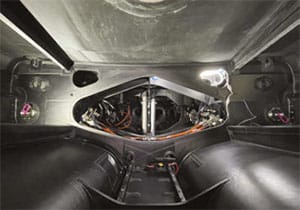
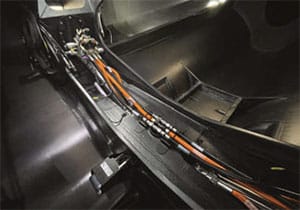
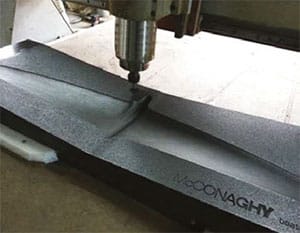
1. A true inshore-offfshore racer needs to be as watertight as possible. 2.McConaghy also has ample experience in raceboat systems engineering. 3. The one-design fleet of foiling AC40 monohull day racers is a good example of McConaghy’s ability to build truly cutting-edge raceboats with reliable precision.
Half a century of innovation and excellence
McConaghy’s strong heritage of producing the highest-quality raceboats in the world started in 1967 when John McConaghy began building skiffs, Tornados and A Class catamarans in Australia with new materials that were not common in raceboat building of that era. His builds were light, stiff and started winning races in these competitive fleets.
By the mid-1970s McConaghy’s reputation for innovation continued to grow by being one of the first raceboat builders to use pre-preg carbon composite construction. Using materials previously only seen in aerospace applications, in 1987 McConaghy took another leap forward by constructing the first Nomexcored pre-preg carbon maxi yacht, engineered by Giovanni Belgrano and SP Systems.
This yacht was the largest composite structure in the world at that time. McConaghy has been researching, testing and perfecting the techniques and processes required to build high-strength, durable and lightweight composite structures ever since.
Another milestone came in 2010 with the addition of production facilities in Zhuhai, China, followed by yet another boost in 2014 with an infusion of capital from Hong Kongbased Tiger Group Investments, a prominent commercial marine company led by keen yachtsman Graham Porter. This partnership provided the capital needed to further invest in state-of-the-art machinery and equipment at McConaghy’s sites in China and Sydney to remain at the cutting edge of both design and fabrication.
The resulting success shows in McConaghy’s impressive track record of results: among the 150 racing yachts built are innumerable overall and class division offshore race winners, multiple world champions, and more maxi yacht line honour wins than any other builder. Just in the Sydney-Hobart alone, there have been 64 McConaghy-built podium finishers in this race since 1983.
Continuing the heritage through innovation
With its inherent culture of pushing boundaries, McConaghy is constantly innovating, testing and improving its techniques, applying composite technology to new fields as well as refining the production, mechanical properties and minimising the weight of composites in existing applications.
Many of McConaghy’s manufacturing techniques are proprietary and remain in-house, and have been developed through extensive testing programmes on numerous projects. This comes from decades of experience with every moulding method and mould material, which can be adapted and optimised to suit each customer’s unique requirements.
Relationships and trust are also important, and McConaghy appreciates the need for a close collaboration between the builder, yacht designer, composite engineer, material suppliers, project manager and client. They have worked successfully with many design teams over the years, including Banuls, Botin, Dubois, Dunning, Elliott, Farr, Frers, Juan Design, Judel Vrolijk, Ker, Lutra, McDougall, Mills, Owen Clarke, Reichel/ Pugh and Shuttleworth.
McConaghy also has a close working relationship with a range of composite engineers such as, Gurit, SDK, HDS and Pure Design. They source the best quality materials from a variety of outlets depending on design requirements, including Gurit, Cytek, Newport Prepregs, Euro-Composites and Schutz.
With each new project, McConaghy produces a number of panels for testing, collaborating with engineers and material suppliers to ensure that the desired weight and structural properties will be achieved even before construction starts.
Maintaining a keen focus on research and development, McConaghy has assembled a team of in-house experts covering all facets of composite building.
An example of this lies in the development of techniques to ensure that the bonding between honeycomb cores (both Kevlar and Nomex) and carbon skins is robust and reliable. McConaghy has developed in-house techniques for thermo-forming Kevlar and Nomex honeycomb cores as well as Corecell foams, ensuring that engineers can specify the best properties in even the most challenging geometries.
McConaghy also uses the latest techniques and machinery for the moulding of complex pre-preg composite structures, for example:
• Autoclaved female-moulded cored and monolithic structures (such as Mach 2 Moth hulls and components) built from CNC-milled steel, aluminum and composite tools
• Autoclaved mandrel-moulded cored and monolithic structures for yacht masts and booms
• High-temperature cured yacht hulls, decks and structures
• Female-moulded carbon tools (infused over a male plug)
• Direct CNC-milled female hull and deck tools
While excellence in composites is a hallmark at McConaghy, this is a company that produces racing yachts where excellence is also shown in carpentry and finish quality to meet the expectations of a demanding clientele.
Having MC1 able to provide complete spar system solutions to all their projects makes McConaghy now capable of delivering every component part of the raceboat package, including commissioning.


