



The human performance of a sailor can be looked at from many perspectives through the centuries. This has led me to develop freeze-dried meals for sailing, with high culinary value.
Garments and tools we use on board are always changing but a splash of cold salty water hitting your face will always feel the same, just as lying in a wet bunk, cold, exhausted and with a thousand calories of food in your belly ready to fuel you again and again just a couple of hours later.
I still remember watching an onboard video of Puma Mostro during the Volvo Ocean Race 2011-12. Kelvin Harrap, on deck resting against the sail stack was asked by the onboard reporter: ‘What are you eating? A Milky Way?’ Drenched at that moment by the most classic example of a freeing cold Southern Ocean wave, he corrected himself: ‘A salty Milky Way!’.
In 2013, while sailing as bowman with Giovanni Soldini who at the time was the skipper of Maserati (formerly Ericsson 3) I started for the first time to seriously think about different approaches to offshore food consumption, its storage and the history behind it.
I’ve been sailing on many different offshore programmes through the years. I witnessed Soldini famously refusing (to this day) to eat any freeze-dried food, developing his own pressure-cooker based recipes. I sailed with Chris Nicholson who banned chocolate in the summer to avoid the hassle of cleaning melted spots off the yacht. On some French shorthanded racing programmes, the food thermos became a treasured piece of equipment.
We all had to tackle the issue of what to eat on board for multiple days or even weeks with only a kettle or a jetboil to heat water, no refrigeration and the need to intake around 5,000 calories per day. These are the same questions that many other sailors for thousands of years had to ask themselves when voyaging around the world.
Thankfully, even thousands of years ago they rigorously kept track of the content of their galleys, allowing us to look at the evolution of the sailor's diet through millennia of Western and Mediterranean tradition. This is how we discovered that the 4,000 to 5,000 calories per day of a modern offshore racing sailor are the same amount consumed by Lord Nelson’s sailors in the 18th century and by those enrolled in the 10th century Maritime Republics such as Venice.
For four months at sea, during La Serenissima (Republic of Venice), they would calculate 500kg of fresh water per person, biscuits, salted pork, broad beans, cheese, and wine for a total daily intake of 3,915 calories, of which 14.4 per cent came from protein, 14.3 per cent from fat, and 71.3 per cent from carbohydrates.
Among the earliest archaeological groceries discovered on ships in the Mediterranean are wine, beer, ground grains to be rehydrated with boiling water and cheese (one of the oldest techniques of food conservation, as it preserves the minerals, proteins and fats in the milk by stabilising it with the use of rennet).
As improved boatbuilding allowed longer voyages, we also needed to create better methods of food preservation. In the case of cheese, for instance, waxing the outside protected it from mould and contaminants, making it waterproof and perfect for storage on ships. Naval and food technology fed off each other.
James Cook famously began to embark sauerkraut – fermented vegetables preserved in brine to maintain a high vitamin C content – during his increasingly long voyages, thus avoiding the need for frequent stops to replenish supplies of fresh produce.
Until then, some of the little vitamin C on board had been unknowingly obtained by eating the insects that often infested ships. Not surprisingly, the attention paid to human performance on board was a cornerstone of Cook’s expeditions.
A well-fed and strong crew is as essential today as it was then. The quality of food, including its gastronomic value, is fundamental to morale, which is now considered essential to maintain overall performance.
Some foods that are part of our daily lives have origins strongly linked to ocean navigation, designed to fulfil the need to transport stable carbohydrates which are so dry that they do not spoil. Dry pasta, as we know it in Italy, comes from the Arab world.
As sailors, it is easy to believe the hypothesis of many academics who think it originates from completely dried bread or pasta scraps left over from processing and then boiled in water.
It was among the commodities that the Arabs brought first to Sicily, then entered Genoa and Naples. The Genoese loaded lasagne onto their galleys and in 1363 there is already mention of the calza lasagnaria, a slotted spoon for pasta.
But surely the most representative sailing food, which allowed first the Maritime Republics and then the Age of Sail to exist, is the biscuit. Also known as hardtack, cracker and many other names found in different parts of the world, these are very hard, dry breads about which literature and archaeology have given us endless stories.
During the Republic of Venice, the preparation of biscuits reached an unimaginable scale with factories, protocols, certificates, and rules. The same was true of the English Navy in the following centuries. The Venetian Arsenal occupied 26 hectares, employed 3,000 workers, and produced 100 galleys in a month and a half. The needs of those who sailed were important.
Biscuits were mainly accompanied with salted meat, dehydrated by osmosis after being left in brine. Together with biscuits, it was rehydrated in a cloth bag inside a cauldron of boiling water, in much the same way as today, with cereals and proteins rehydrated in a doypack stand-up pouch of freeze-dried food. Today, as then, whatever is available is added to this bag in which we eat when we are particularly hungry: spices, fats and so on.
The 19th century considerably altered the sailor's diet. In a short time, millennia-old traditions changed forever thanks to a number of inventions developed in part due to the specific needs of maritime trade. The soup tablet, a stable and portable dehydrated gelatinous broth, evolved into meat extract, the stock cube we all know today.
In 1809, the French confectioner Nicolas Appert discovered hermetic food preservation a hundred years before Pasteur demonstrated that heat could kill bacteria, creating a historical watershed between before and after canning. If technological developments in food preservation have simplified and enabled long voyages, the quality of food on board had also declined over the centuries, especially considering that crews once embarked livestock.
In the second half of the 19th century, refrigeration was invented and soon adopted on ships. This coincided with the introduction of steamers, changing the physical propulsion of a boat around the time of the first modern regattas. The ocean, once the exclusive domain of just three human activities: trade, fishing, and warfare, became a shared venue for sport when the Newport-Bermuda Race – the oldest regularly scheduled ocean race in the world – was first held in 1906.
On high-performance offshore sailing yachts, food is mostly served as three freeze-dried meals per day, rehydrated with water from a desalinator, boiled with a propane-gas camping stove. This saves the weight of equipment and provisions that would need to be prepared with greater care. Many sailors have, at least once, run out of cooking gas long before arrival and faced the unpalatable prospect of living on dried rations that need to be soaked for many hours in cold water.
Once we avoided disaster when a crewmate came out from below deck shouting ‘fire!’ In a heartbeat the stove, which was on fire, was thrown overboard. No-one injured but no warm food for the remaining days. No spare stove on board.
Richard Altman developed the modern freeze-drying process in 1890 but the technology was not actually used until the 1930s, and then only for medical and research purposes. Freeze-dried food finally arrived in the 1950s.
In our collective imagination freezedrying is still associated with space food, yet a similar natural process called chuno has long been used in Peru to preserve potatoes. In Japan, tofu has been freezedried as koya-dofu since the 16th century. Traditionally, products were left to freeze during the night and exposed to strong sun during the day, slowly sublimating all of the liquid inside the food.
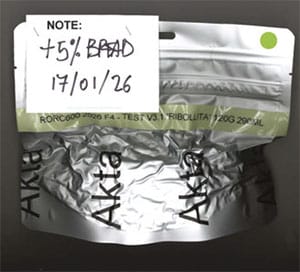
Although the process was known in the West since the 19th century, it was not adopted by the sailing community for a long time. Now, with freeze-drying, sailors can enjoy meals from any cuisine. Dry food on board provides an easily accessible organic archive of flavours and aromas directly connected to pleasant memories. I founded Akta with this focus, starting with a range of classic regional Italian dishes, which will be expanded to include other cuisines in the future.
A freeze-dried pouch, unlike cooked food, does not cause a build-up of odours in the boat’s interior. It’s only when you open your pouch that you get the smell, bringing back instant memories of a specific dish.
On board, you are either on watch or asleep. One of the few moments to build camaraderie is when you eat. Good food can get almost anyone into personal conversation. After few days offshore, most conversations tend to polarise on one topic only: food. Crew members start to barter their rations and talk about what they would eat back ashore.
Even within the span of 15 years sailing career, a lot has changed and continues to evolve. Now we try to avoid glycemic spikes induced by chocolates and sweets, but they can be needed to quickly recover energy after a long set of manoeuvres. The days of snack-bag living on deck 24/7 and fuelling the crew with Mars, Snickers and Sour-Patch might not be over but it is being questioned more and more.
Drinking practices today and through the centuries deserve a whole article. It’s important to remember we only recently have been able to use desalination. This allows us to avoid loading tons of water but has led to the issue of needing to supplement the water with electrolyte.
Beer, wine and grog have always been at the core of a sailor’s diet but these have recently disappeared from ocean racing due to social norms of safety. Yet, we should remember that the English Navy was still giving a ration of rum to the whole crew until 1970 and sailing teams in the Whitbread Round the World Race were still stacking crates of wine in the 1980s.
Now, in the era of personalisation, each food programme is modelled to meet the needs and preferences of an athlete. Everyone’s digestion is different and constipation can become a big problem when sailing offshore in a diet traditionally poor in fibre, an issue that freeze-drying often doesn’t, but can easily solve. Once, sailing a rough Transatlantic on the Imoca Biotherm, a member of the crew decided to eat nothing but Japanese freeze-dried rice, a choice they would soon regret.
At Akta, we study the psychology of food and how this influences the performance of the athlete. We work to match what you want to eat with what you need to eat, also taking into consideration how the taste profile of each food changes when you’re tired and sleep deprived. The closer we get to achieving that, the better the athlete will perform.


