



The French follow Cup-holders Emirates Team New Zealand and the Italian Luna Rossa syndicate, who have both been clocking up the training and testing hours over recent months at their bases in Auckland and Cagliari, respectively.
Being third to re-launch is in significant contrast to the French team’s campaign in the previous cycle, when they were a super late entry after experiencing severe funding setbacks. There appear to be no such concerns this time around with the squad becoming the first ever French challenger to compete in two consecutive campaigns.
Under the rules of the 38th America’s Cup teams which competed in AC37 are required to use the same boat, rather than build a new one. AC38 also sees cyclors replaced with batteries and the overall crew numbers reduced from eight to five sailors.
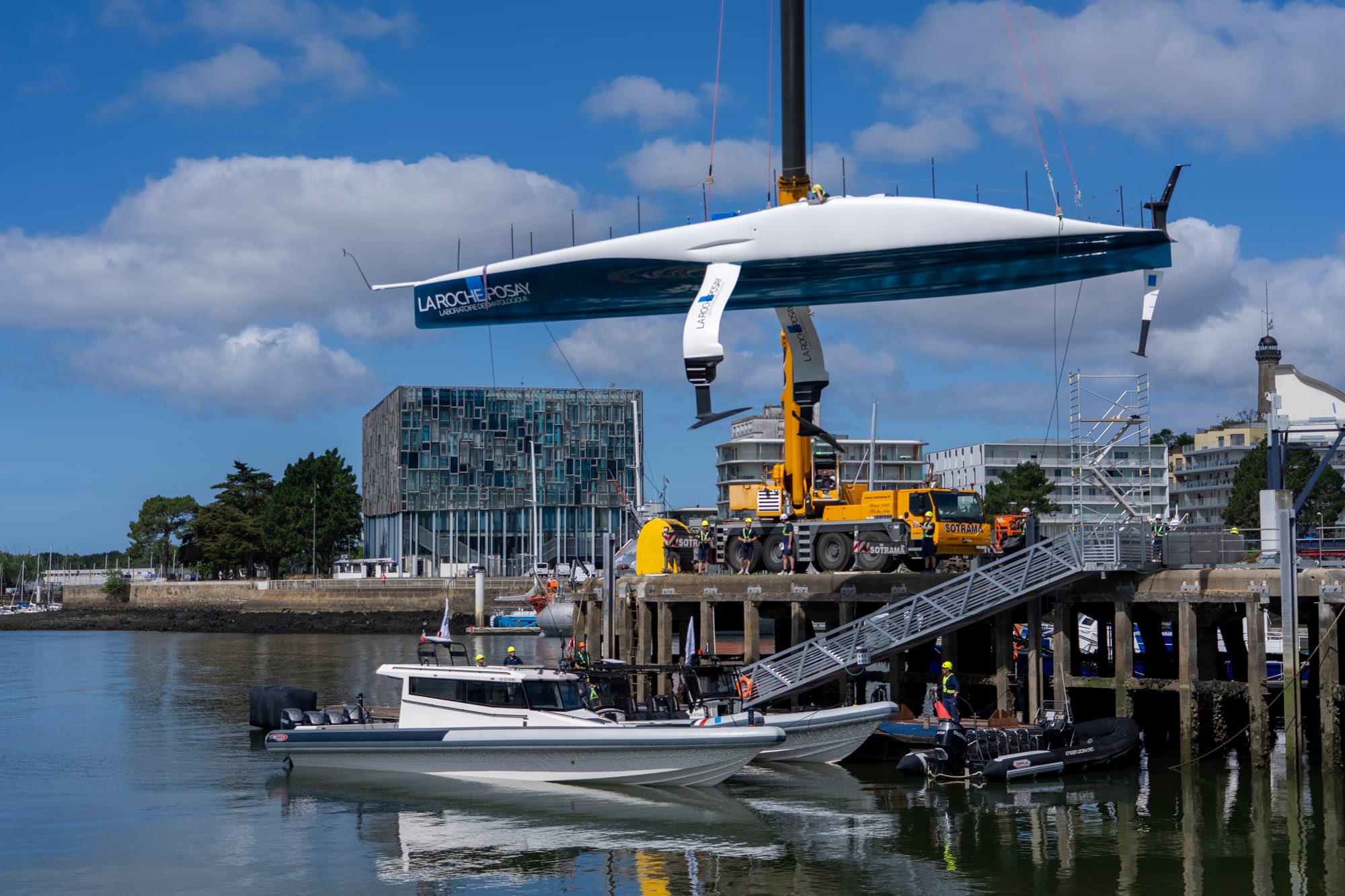
All of that means the French boat – which was built to a design purchased from Emirates Team New Zealand for AC37 – has had to undergo a major re-design of its deck layout to include six pods (for the five crew and one guest spot). Meanwhile, below decks, the complex mexatronics controlling the onboard systems that enable the boat to fly above the water at speeds over 50 knots have all needed to be re-thought.
“Going from eight to five crew members changes everything: ergonomics, communications, the division of tasks and the control systems,” commented technical director Antoine Carraz. “With fewer people on board, every action must be simpler, more direct and perfectly coordinated. We have worked to ensure the boat remains extremely high-performance without becoming more complicated for the crew to operate.
“Externally, the public will recognise the 2024 boat. But technically, this is not simply a refurbishment. We’ve had to rethink its internal architecture and the way the crew interacts with the vessel. The challenge was to radically transform the boat whilst retaining its original platform.”
Yacht Racing Life is a reader-supported subscription website about high-performance competitive sailing. Sign up for free to receive our email newsletter or take out a paid subscription to access exclusive member-only content.
Replacing human cyclor power-generation with a fixed amount of energy stored in batteries has forced all the teams competing in AC38 to completely rethink the efficiency of their boats’ electrical and hydraulic systems. With every expenditure of energy needing to be carefully managed, the French engineers are fully focussed on battery consumption, cooling, and the overall reliability of the system.
“The disappearance of the cyclors is a major development,” Carraz said. “Previously, part of the performance depended directly on the sailors’ ability to generate power. Now, we have to manage a certain amount of on-board energy. We need to store it, distribute it and use it at the right moment, with the best possible efficiency.
“We’re not just looking to have a lot of power available. Above all, we’re looking to avoid wasting it. A few seconds of operation, a manoeuvre or an adjustment repeated dozens of times can have a significant impact on a race’s energy balance.”
But the focus is not solely inside the boat. Significant performance gains can be found in the design of the rudder, foils, and sails – as well as through optimisation of the yacht’s overall aerodynamic profile.
For yesterday’s re-launch the French boat was fitted with legacy foils from the last America’s Cup, but the final versions that are used in Naples next year are likely to be very different.
“The first launch does not represent a final configuration,” Carraz confirmed. “It gives us a working basis. We will measure, compare, understand and gradually refine the boat. In the America’s Cup, performance rarely stems from a single great idea. It arises from hundreds of details that ultimately work together.”
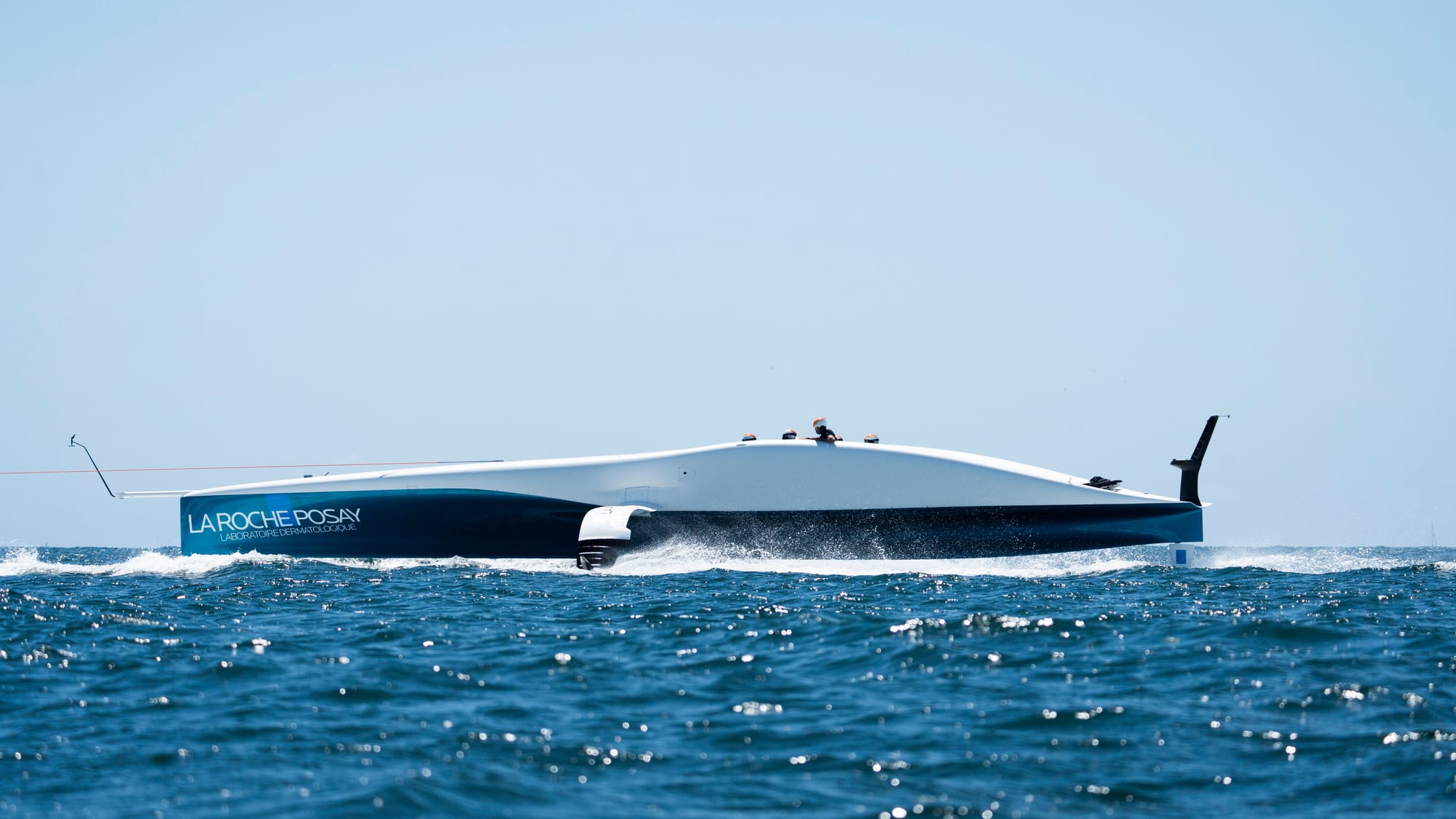
The return of the French boat to the water comes after thousands of hours of work carried out using digital tools: 3D modelling, structural calculations, air and water flow simulations, systems analysis and bench testing.
But no model can perfectly replicate the complexity of an AC75 under sail. Yesterday’s tow test runs provided an opportunity to validate the engineers’ assumptions against reality. A continuous cycle of sailing, analysis and refinement will form the core of the French team’s technical programme in the coming months.
“During the first few sorties, we won’t be aiming for top speed straight away,” said Carraz. “We’re taking it step by step. We need to check that all systems are performing as expected, then gradually increase the load and intensity. Performance can only be achieved once the boat is reliable and fully understood by those who sail it.”
The team have two training periods scheduled in Lorient (June 29 to July 17 and August 1 to 14) before they decamp to Naples sometime between the middle of August to the end of September.
The team will race their AC40 at the second Preliminary Regatta of the AC38 cycle over the weekend of September 24–27, before starting to sail their AC75 at the Cup venue during October.


