



The schedules for next year’s Louis Vuitton Cup Challenger Selection Series and the Louis Vuitton 38th America’s Cup Match in Naples have been revealed – and AC fans can look forward to AC75s fleet racing for the first time ever, as well as more round-robin racing than in AC37.
Racing will get underway with a six-race fleet racing series in AC75s, followed by three sessions of round-robin racing, a semi-final elimination round, and culminate in the Louis Vuitton Cup series to determine which of the six challengers will face Emirates Team New Zealand in the 38th America’s Cup Match.
The third AC38 Preliminary Regatta (fleet racing in AC75s) will take place over the weekend of May 22-23 and will mark the first time AC75s have raced together in a fleet race.
The first two three-day stages of the Louis Vuitton Cup Challenger Selection Series will run for three days from May 26-28 and May 29-31, with 21 round-robin races scheduled for each stage. After a week’s downtime, the third round-robin stage will take place from June 9-11, with a further 21 races scheduled.
The Defender Emirates Team New Zealand will take part in the three round-robin stages of the Challenger Selection Series, but their matches will not impact the challenger series scores.
The top three teams from the round-robin stages will qualify automatically for the Louis Vuitton Cup semi-finals, with the fourth semi-final team being determined by a two-day match racing repêchage series between the remaining challengers taking place from June 12-13.
The Louis Vuitton Cup Challenger Selection Series will run from June 16-20 (with June 21 as a reserve day). 13 races are scheduled, with the winner being the first team to reach seven points.
The Challenger Selection Series Final for the Louis Vuitton Cup and a place in the 38th America’s Cup Final will take place over June 26-27 and could finish over the following weekend of July 3-4. Once again, 13 races are scheduled, with the winner being the first team to reach seven points.
The 38th Louis Vuitton America’s Cup Match begins over the weekend of July 10-11 and is scheduled to run through to July 19 – however that timeline could be extended if weather conditions cause missed days of racing.
Yacht Racing Life is a reader-supported subscription website about high-performance competitive sailing. Sign up for free to receive our email newsletter or take out a paid subscription to access exclusive member-only content.
Daring to make major changes to one of French sailing’s most iconic annual solo offshore regattas is a brave move. But that’s exactly what OC Sport Pen Duick – the organisers of the 50-year-old La Solitaire du Figaro – have chosen to do.
The French company announced late last week that the 2027 Solitaire will be the last event raced in 36’ Bénéteau Figaro 3 yachts, with the 2028 event switching to the much larger Ocean Fifty trimaran class.
It’s a bombshell move that has been met with incredulity around the French offshore scene.
Not least of the objections is the variance in the size of the campaign budgets between the Figaro 3s and the Ocean 50s. Depending on who you talk to, a competitive Figaro 3 season would set the skipper back something between 150,000 and 210,000 Euro. Meanwhile, an Ocean Fifty campaign costs in the range 500,000 to one million Euro.
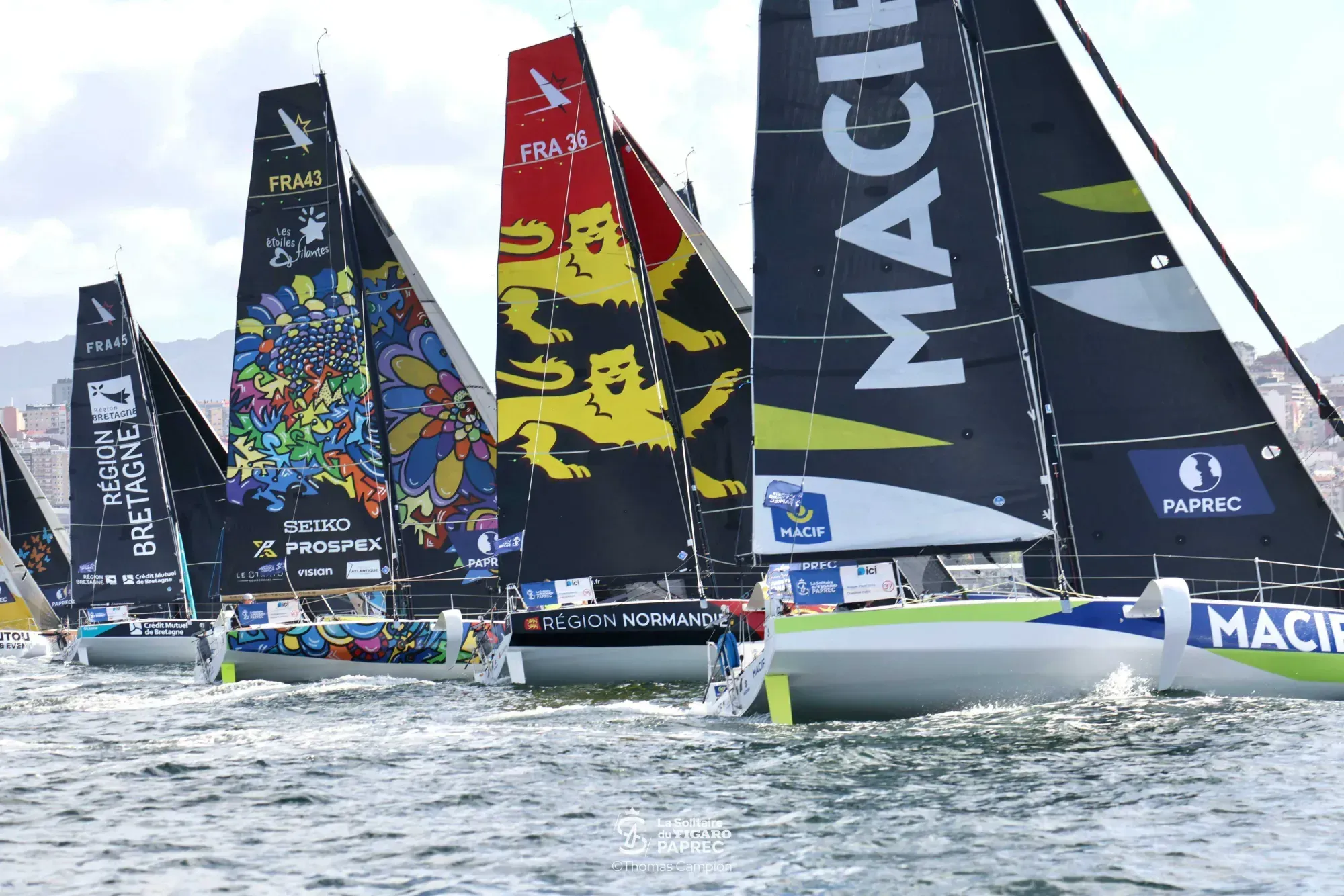
According to a press release issued by OC Sport Pen Duick, the change comes after a major review of the event conducted in conjunction with the race’s owners Groupe Figaro – the French media conglomerate which publishes the country’s largest newspaper Le Figaro.
Originally called the Course de l'Aurore, the race was founded in 1970. It was bought by Groupe Figaro in 1980 and has been organised by OC Sport Pen Duick since 2011.
Over the years, La Solitaire du Figaro has established itself as one of the flagship events in offshore sailing.
Its list of winners includes many of offshore sailing’s best-known protagonists – Lionel Péan, Laurent Bourgnon, Alan Gautier, Yves Parlier, Michel Desjoyeaux, Jean Le Cam, Pascal Bidégorry, Kito de Pavant, Charles Caudrelier, Armel Le Cléac’h, Jérémie Beyou, Nicolas Lunven, Nicolas Troussel, Yann Eliès, Yoann Richomme – many of whom have gone on to become stars on the IMOCA, The Ocean Race, and Ultim scene.
According to the French Sailorz website, one of the behind-the-scenes factors behind this major change was the fact that OC Sport Pen Duick makes a loss on organising the La Solitaire du Figaro. That’s reason enough for any business to look at ways of shaking things up, however, the negative press around the decision may be a storm that could prove difficult to navigate.
Although loss-making, La Solitaire du Figaro is, nevertheless, something of a household name in France. The start and stopover ports attract large crowds and the event also has a huge following in the mainstream media in France.
The strong winds and choppy waves off Lanzarote’s Playa Papagayo gave the 13 strong 52 Super Series fleet a solid insight into what lies ahead at the Marina Rubicón Lanzarote 52 Super Series Sailing Week as the official practice races proved and exciting, high speed test of boat handling and control.
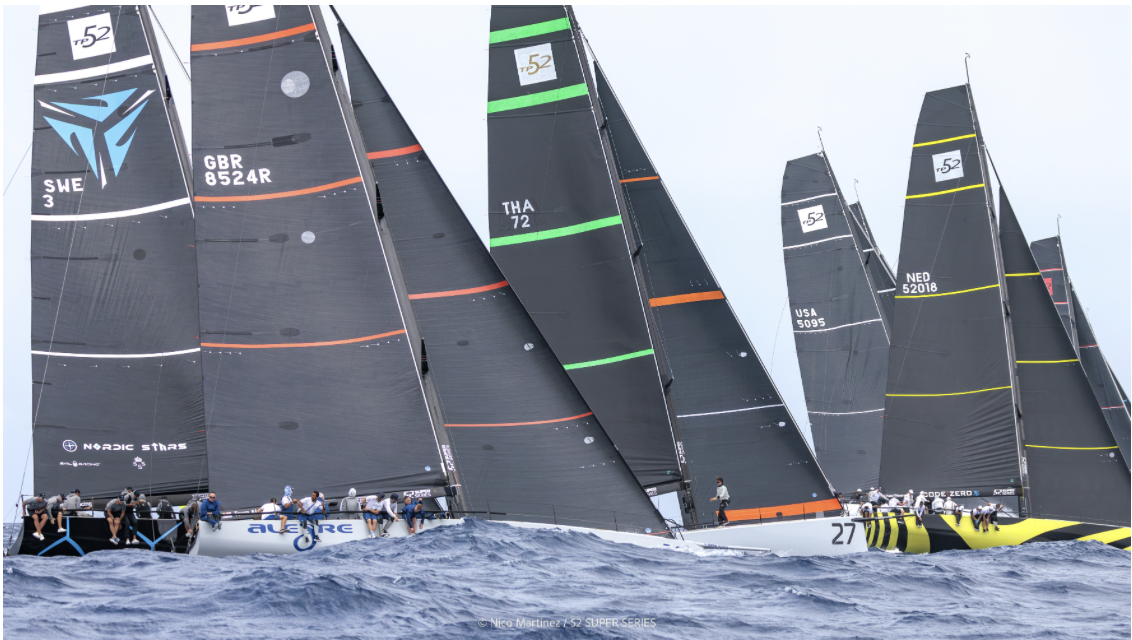
The fleet have put the light to moderate winds of the first two Mediterranean based behind them and the circuit’s first ever venture to Lanazarote looks set to deliver winds averaging as much as 20 knots and some tough, confused sea states.
Andy Soriano’s Alegre and Ergin Imre’s Provezza were among the day’s outstanding performers as most of the fleet completed a high-speed, high octane practice circuit. Season championship leaders Sled and Jochem Sundberg’s World Championship runners up Trinity also showed well in the muscular conditions.
“We learned today this is a ‘wavy’ place to sail!” smiled Alegre’s Italian navigator Francesco Mongelli “It is not an organised sea state. It was not easy for everybody. That part of the island in the north breeze we will see all week is a bit random where the wind shadow is and then there is one knot of current going against the wind. It was very demanding today. We had a fairly good start even if it would really have been a general recall and we went to the right corner and we were fast and mad the best decisions especially downwind.” Mongelli added.
This regatta is the second for Alegre’s new tactician John Kostecki and Mongelli explains how the American is changing the dynamic on board for the better.
“We just still need to just find our own self confidence again. Our crew work is good. John is one of the very top tacticians and he has a different way of operating. He is probably more of a pure tactician. He wants people to take responsibility. He is not getting into different areas,he wants people to fix their own issues. He is very specialist and it is not always like this. Quite often a tactician will get into the speed loop. John does not. It is easy to see why he is a winning tactician he is really good.” Mongelli concludes.
“It is really rough sailing here. It is a tough place for the race committee. We have lots of breeze on the west coast a transition in the middle and here at Pappagayo the winds are a bit milder but the waves are nasty especially as they don’t align with the wind.” Provezza’sArgentinian tactician Cole Parada reported. The 2023 season runners up were firing on all cylinders today and have Nick Heiner deputising as strategist. The Dutch 2020 Finn Olympian and 2014 Laser world champion has spent a lot of time training here and is fitting into the Provezza set up well.
Parada concluded “We have been tweaking our rig settings a bit and today was the first day of that and so we will see. We are expecting two long, hard events in these conditions so anything can happen. We can learn. Nick is doing a great job and knows the area.”
Local intel
Local ace is Gustavo Martinez Doreste, Spain’s 470 Olympian in 2000 and 2004, who is a coach with Alegre. Although he grew up in Grand Canaria he has been living on Lanzarote for nearly 20 years.
“The forecast is for moderate to strong winds all week. These are the typical trade winds of the Canary Islands, and once the anticyclone is over the Azores, the northerly winds become established. It’s guaranteed: it’s what we have 80% of the year.”
According to Martínez Doreste the Race Committee led by PRO María Torrijo, has a choiceof options to set the best racecourse each day: “It will depend on where you set it: downwindat Playa Blanca, the breeze tends to enter the channel through Papagayo or Pechiguera. There is a significant current parallel to the channel. Today for example, we had a strong southerly current. This is an important factor, and the waves are very varied, which is why it’s such an interesting place to train in all kinds of conditions. You can have anything from a large swell if you go east and southeast, closer to Lobos, where there’s a drop in depth and currents converge; choppy waves if you go closer to Papagayo and up to the east coast of the island, the same at Montaña Roja. And to the west there is a more oceanic wave. In front of the channel, you have flat seas, shifts, and pressure differences. It’s a great place to race.”
Racing starts today (Tuesday) and tuns through to Saturday. Today's warning signal is planned for midday local time (1100hrs UTC).
A claim you rarely hear from manufacturing companies is that of having reinvented the wheel. A world defined by evolution rather than revolution is more common. Spinlock are no different, they’re far too savvy to make such a bold statement.
And yet you could argue that looking in from the outside, their entire history and continued success has been built around rethinking items that had already reached peak evolution.
From rope clutches to tiller extensions, lifejackets and beyond, the Cowes-based firm have made it their mission to take a genuinely fresh look at items we take for granted by going back to first principles each time and working up their solutions from there. The results frequently leave the rest of us wondering why we hadn’t seen the potential for improvement all along.
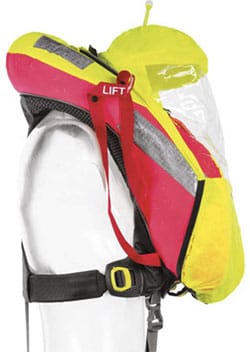
Their Deckvests are excellent examples. This range of lightweight, easy-to-use and highly practical lifejackets set new standards from the off, packed with innovations including Pylon Light, LumeOn Lights and Harness Release System. The strange thing is that when it came to upgrading their top of-the-range vest, the VITO, even they were a little hesitant about whether or not they could improve it.
With the VITO AFS now on sale, it is clear that they haven’t just refined a lifejacket that was already considered to be the best in class and the result of a seriously in-depth study for the Volvo Ocean Race back in 2017. Once again Spinlock has raised the bar significantly. Even more interesting is that the starting point for the new project wasn’t even the VITO.
‘A number of years ago we were awarded a grant to investigate the issue of flotation,’ explains product manager Myles Uren, who specialises in technical product development. ‘One of the issues when you’re assessing lifejackets is that it’s very hard to build meaningful data when you are using humans to test the flotation characteristics. Not only do you have to consider a wide range of weights and sizes, but even if you were using the same person throughout the tests, a human’s response in the water could be different every time making it hard to pin down the data.
‘So we started by setting up our own pool facility and creating a standard mannequin that we called “Randy”. This allowed us to vary all kinds of details relating to the buoyancy and conditions and then record the effect.’
Monitoring a wide range of factors from how quickly the lifejacket righted Randy to the angle of rotation, the freeboard achieved and more, the research team established a large amount of meaningful data that allowed them to focus on what would make the optimum lifejacket.
The results have led to the new AFS development. Keeping the bulk of the buoyancy low down and close to the body had a big effect on efficiency and made it clear what shape the inflated lifejacket should take.
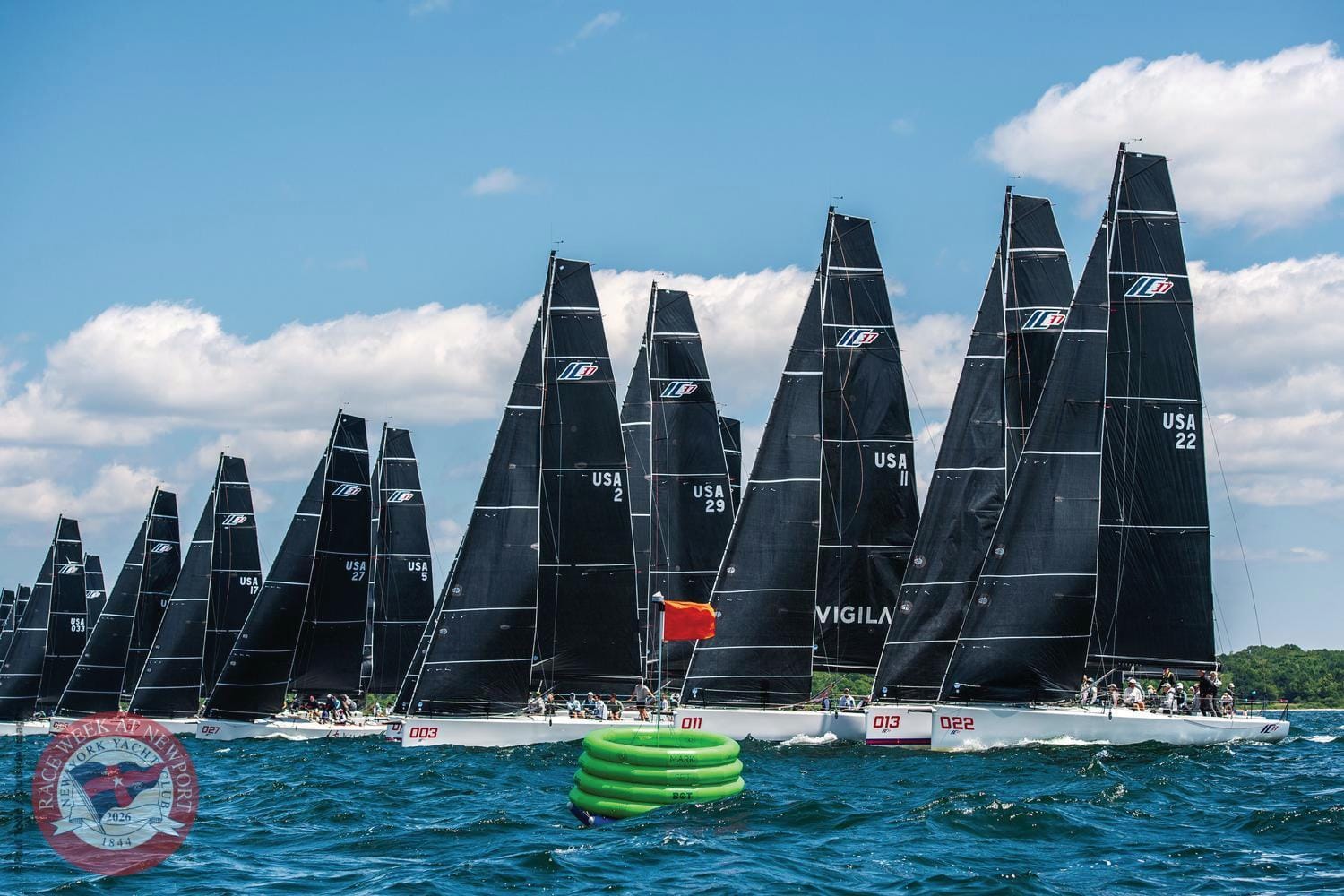
Race Week at Newport seems to bring out the best in Daniel Thielman and his crew on the IC37 KUAI. And even then, it almost wasn’t enough to claim a second IC37 National Championship in three years.
Thielman and his San Francisco-based crew started Race Week at Newport on the wrong foot as an OCS start saddled them with a 16th—out of 19 boats—in Race 1. But they quickly found their rhythm, reeling off five straight results of fifth or better. KUAI enjoyed an eight-point lead going into the final two races earlier today. A seventh in the first race enabled them to hold serve, but starting the final leg of the final race, with SHAMAN leading the pack and KUAI buried in 12th, the championship was very much up for grabs.
“I didn't even know how close it was, the team didn't tell me,” says Thielman, from Tiburon, Calif. “I thought we were pretty well off, and then at the end of the race, we thought we might have lost it. I was just trying to protect the lead that whole last race. I was thinking mid-fleet would do it, and, apparently, we needed a little more.”
That little bit more came on both ends, with KUAI picking up a place to 11th and Shaman dropping into second. The net result was a three-point win for Thielman, with Shaman, skippered by Carter Robinson, bumping up to second overall and Megan Grapengeter-Rudnick’s Vigilant team in third.
“After the way last season went, when we weren't the strongest competitor, to work our way back up, it feels really important,” said Thielman. “I would put this in the upper echelon of all the championships we've won. This is close to the top.”
The New York Yacht Club’s Race Week at Newport was first run in 1998, and took place this year from July 16 to 19 out of the New York Yacht Club Harbour Court, in Newport. R.I. The biennial regatta, run at the apex of the summer sailing season, has established itself as one of the premier summer race weeks in the Northeast thanks to the attractive combination of great racing conditions off Newport and the superlative shoreside hospitality at the Club’s waterfront Clubhouse overlooking Newport Harbor. The 2026 edition of Race Week at Newport is sponsored by Helly Hansen.
Recovering the form that carried Kuai to the 2024 IC37 National Championship was a process, says Thielman. He credits class coach Moose McClintock for steering the team in the right direction.
“He kept encouraging us and he gave us that last one or two percent,” Thielman said. “He corrected our moding, and once we corrected that, then we were strong in all conditions instead of strong in just the windiest conditions. [He got us to] sail and mode like everybody else when it was close quarters and then go back to what we know is the fastest mode when we have a clear lane.”
A similar process of refinement lifted Tom Rich and his crew on Settler to the win in ORC B. Now on their third season with the high-performance 42-footer, they are starting to get the hang of how to make her sing.
“The boat’s a great boat, and it certainly fits the current thinking for an ORC boat,” says Rich, of Portsmouth, R.I. “It’s taken a little while to get her going. We struggled to make the boat go in lump and light air. Downwind the boat is really good.
“We had a great fleet, a lot of boats were very similar. And [Doug Newhouse’s] Yonder sailed a phenomenal regatta; they were kind of the apple among the oranges. They’re a Spirit of Tradition 52. But they were right there with us the whole time. It was pretty cool because a lot of the races were decided by less than 20 seconds on corrected time.”
Rich started the regatta with two firsts and then two seconds, but a fourth in Friday’s final race, which Yonder won, put Newhouse and his team in the driver’s seat midway through the regatta.
The Settler crew responded with three straight wins, dominating the 19-mile race around Conanicut Island—hitting close to 20 knots on the downwind leg in the West Passage of Narragansett Bay—and then grinding out a pair of wins today, the first by just 11 seconds.
“We’ve won the regatta under PHRF, but I feel ORC is the cutting edge right now,” said Rich. “It’s really pretty cool to be there.”
A few months ago, Mitchell Callahan was one of the top skippers in collegiate sailing, regularly dominating in the small, slow two-person dinghies that are ubiquitous to scholastic and collegiate competition. Today he earned himself a national title in the high-energy M32 class, successfully filling in for a second straight event for Surge owner Ryan McKillen.
"It feels great," said Callahan. "I’m really grateful Ryan gave me the opportunity to drive his boat again. That’s super cool. The guys in front of me were totally flawless all weekend. I’m just a small part of this."
While this was Callahan's second regatta in the boat, it still felt like a new experience thanks to a diverse set of conditions and race locations.
"We really got a bit of everything," he said. "We raced outside the Bay and north of Gould Island. We sailed with the reef in and without it, in everything from around 20 knots down to about five.
"It was awesome to experience every type of condition in this boat. The crew work in front of me was incredible. With how versatile the conditions were, they made my job easy. All I had to do was sit there, listen and drive."
Joost-Olan Sheehan passed along a lot of credit for his win in PHRF B to the architect of the Warrier Won program, his father, Chris Sheehan, who built a successful offshore-focused team over the last decade but is taking this summer off from sailing.
“I learned a lot from him and from the Warrier Won program, sailing alongside my father, learning a lot from the guys that have sailed with my dad over the years,” says the junior Sheehan. “He probably wishes he was out there too. He follows all the races closely and he's really excited for me. I have to give a lot of credit to him for putting together the right people and the right boat to ensure success.”
Joost-Olan Sheehan took over the skipper’s role this winter and endured some humbling moments.
“My first time skippering a Cape 31 was this winter, and we had a lot of tough lessons when we were in Key West,” says Sheehan. “We didn't do well at all. A lot of work went into practicing my boathandling skills, watching footage, all that kind of stuff that I think has really paid off.”
PHRF B was the biggest rating-rule class in the regatta and one of the most diverse with boats ranging from small quick boats like the Cape 31 and GP26 to the classically styled Eggemoggin 47. But right from the outset, it was clear the two Cape 31s were going to be the boats to beat, taking first and second in the opening two races.
The Pacific Yankee team, led by Drew Freides, has enjoyed tremendous success in one-design competiton in the Cape 31 class and other similar one-designs. Since the boats shared virtually the same rating for the week, job one for Sheehan and his crew (Bow 74) was to beat the other Cape 31 (above, left) as many times as possible.
“Drew is an excellent sailor,” said Sheehan. “It's very evident that his boathandling skills are phenomenal. A lot of our success goes me staying consistent with my sailing, the rest of the team understanding what my skill level is and tuning the boat to that level.”


