



Advances in sailcloth design and fabrication would seem to be a mature technology, given the great leaps made in the past few decades from relying on assembled panels cut from rolled goods to being able to optimise the films and fibres in places where they are needed on a sail. Many variations on which materials to use and how best to do this assembly have been developed by various sailmakers, with varying degrees of success across a wide variety of applications.
Elvstrøm Sails’ prevailing philosophy is that even a mature technology is worthy of exploration and may have room for improvement. That is precisely what they have done with their new XYLO Core and XYLO Force spread filament sails.
Concepts in development
The quest to find a perfect sailcloth has always been daunting because several criteria must be met to achieve success. Not only does the material need to be stable and not distort under load, thereby affecting control on the sail’s shape, which is carefully designed to provide optimal aerodynamic lift in a specific range of conditions. It also needs to be as light in weight and as easy to handle as possible.
Also longevity: the ideal sailcloth material should continue to deliver these qualities for an extended period of time.
This would seem like an impossible task, yet Elvstrøm Sails has taken on this challenge with XYLO, which meets all of these criteria in bold and innovative ways.
A closer look at composites
First, the team at Elvstrøm Sails took a closer look at the current state of composite material technology in sectors other than just sailing.
It turns out that while we all assume carbon would be the fibre of choice as in aerospace applications, that is not the case. This is because while carbon has amazing strength properties, it is brittle and has low strain-to-failure which makes it less ideal for use in sails.
Elvstrøm Sails determined that Technora, a high-performance paraaramid fibre, was closer to being an ideal choice than other high-modulus fibres such as Kevlar, PBO, Dyneema or carbon. What Technora offers is a unique combination of many beneficial, inherent properties:
• Exceptionally high tensile strength combined with low creep and low stress relaxation
• Excellent fatigue and abrasion resistance, maintaining its strength even when subjected to repeated flexing and abrasion
• Resistant to acids, alkalis, organic solvents, and is unaffected by steam or seawater
• Unlike other aramids, it absorbs a minimal amount of moisture, less than two per cent, giving it enhanced stability in humid environments compared with them
• Technora does have some sensitivity to prolonged UV exposure, but Elvstrøm Sails has thought of a solution to this for its XYLO Force product line
• The fibre does not melt, with a decomposition threshold of 500°C providing excellent thermal stability.
This last trait is another key component in the success of the XYLO composite structure: Elvstrøm Sails was strongly focused on developing the right thermoset polyurethane resins to harness the full potential strength of Technora.
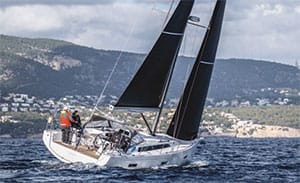
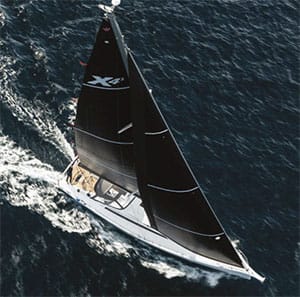
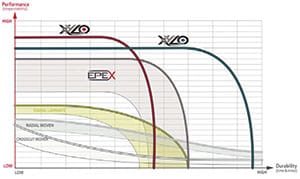
1/2. A lot of testing on the water, as well as in the lab, validates the high potential of XYLO. 3. XYLO sails have high shape stability and are very durable.
Thermo-set the right resin
In the decades-long quest for bonding film and fibre into membranes, the glue to stick them together was often more of a problem than the fibre. The development of membrane sails focused on finding practical materials and methods to bond a thin film, such as Mylar, to the fibres, but was limited by the need to constrain the heat and pressure used in the fabrication process to not exceed the thermal stability of any components.
Some later generations of sailcloth that use film-less, spread-filament tapes also require thermoplastic bonding agents that cannot withstand high temperatures.
Even Elvstrøm Sails’ own EPEX membrane sail technology relies on strong vacuum pressure to eliminate air pockets with the application of a modest amount of heat to activate the thermoplastic adhesion needed to bond the film and fibre.
To get truly optimal performance in a sailcloth, where all the qualities of the fibre can be put to work in the sail without compromise, a new adhesion technology was needed: thermoset polyurethane resins. This family of materials is fundamentally different from thermoplastics in chemical structure: strong covalent bonds link the polymer chains, increasing the cross-link density making the material resistant to melting and extremely strong. Examples of thermoset plastics include epoxy, silicone, polyurethane and phenolic.
This sounds like an ideal choice for a sailcloth because rather than relying on a thin film or repeated multiple overlapping meshes of spread filament tapes for strength and membrane opacity, this resin could both provide the necessary adhesion and add to the inherent qualities of the fibre filaments.
This solution does come at a price: the high temperature curing needed in the fabrication process would limit the use of some temperature-sensitive fibres such as Dyneema, but it is perfectly compatible with a para-aramid fibre like Technora.
‘We realised this was going to be a considerable investment and perhaps a long journey to get exactly what we envisioned we needed,’ says Morten Sørensen, CEO of Elvstrøm Sails. ‘So we reached out to some suppliers in the composites industry to help us find the right thermoset resin that met our requirements. That was not easy because none had experience with flexible composite structures like sails, but eventually we did find a solution in a polyurethane with help from a supplier willing to work with us.’
360° Stability
Technora’s unique molecular structure allows it to have some important properties. First, it can handle demanding load conditions due to its high tensile strength. Second, it can absorb tension without fibre failure. And third, it maintains flexibility without compromising on its structural integrity. Elvstrøm Sails refers to this as “360° pure Technora copolymer structure”. It is the first of three aspects in a principle of complete stability in the load distribution in the sail, which they’ve termed 360° Stability.
Join Elvstrøm Sails
Elvstrøm Sails is actively recruiting sail lofts in the USA to join the global Elvstrøm Sails family. Elvstrøm SailPoints enjoy the benefits of working with a wide product range across a number of segments: daysailing, long-distance cruising, high-performance cruising, club racing and grand prix racing.
The second aspect is the broad filament layout that enables Elvstrøm Sails to design and create a sail with full 360° coverage of fibres. Thanks to the wide filaments used, it also eliminates fibre-free gaps in the structure. This layout is optimised so that it distributes the loads through the sail, ensuring stability in all directions, and it stays intact no matter where the load moves. This results in greater shape retention and structural integrity. Elvstrøm calls this “360° load distribution layout”.
The third element to the 360° Stability principle is in the 360° crosslinking thermoset adhesives. These bond in a cross-linking molecular structure, creating a three-dimensional grid based on a rigid network at this microscopic level, and they stay inseparable after the curing process.
‘The claims made about XYLO’s superior performance are borne out in a series of tests made to compare this material with a classic grid fibre membrane,’ Morten Sørensen explains.
‘These test results conducted on XYLO fabrics clearly show that the spread filament layout delivers significantly higher stiffness and stability compared with a classic grid fibre membrane,’ he says. ‘With 20 per cent greater stiffness/ stability at 0°, 50 per cent at 12.5° and as much as 200–300 per cent at 45°, XYLO provides markedly improved load distribution and reduced elongation across multiple load directions,’.
‘This confirms superior structural stability and shape retention under tension, particularly when loads are applied off the primary fibre direction.’
Core and Force
XYLO technology made its debut in 2023 in the Force product line that is tailored for use in high-performance cruising where maximum durability and longevity are primary concerns. These aims are achieved by adding a taffeta fabric on both sides of the composite to provide the underlying XYLO filaments with further protection against abrasion and UV exposure.
Even with this additional material the Force sailcloth is still thinner than most equivalent cruising sailcloth materials. In applications such as in-mast and headsail roller furling, XYLO Force will make sail handling easier. It will also enhance performance by delivering the required stability at lighter weight, thereby lowering the centre of gravity, increasing stability and reducing pitch gyradius while sailing.
XYLO Core has been developed and introduced this year as a premier sailcloth targeted for the keen racer. Core is based on filaments only, creating the distinct racing profile whilst reducing the weight of the construction.
‘After a lot of investment in production methods and machinery, and a lot of testing, the effort to develop XYLO has been worth it,’ Sørensen says. ‘It is the next step in the evolution of our performance heritage, and we’re excited to bring this enhanced capability to performance sailors around the world. With this innovation we are now among a small group of sailmakers offering all four major sailcloth technologies.’


