



The elegance of sailing comes from the simple physics made available by nature to help propel the boat through water by optimising the balance of lift and drag forces exerted on the boat. Better performance occurs whenever clever design can reduce drag forces, which for non-foiling boats are always a factor for hull and appendage surfaces.
Hempel’s experts have addressed this by using the latest scientific methods and tools to make a new generation coating that achieves three important functions:
• reduce skin friction to minimise drag and improve performance
• provide effective antifouling functions to inhibit marine growth
• be more environmentally-friendly, lightweight and sustainable compared with traditional coatings.
Start with science
Prior generations of antifouling coatings relied on leaching biocides (such as tin and other heavy metals) that were effective, but dangerous to both applicators and the environment. Hempel has been at the forefront of developing new generations of coatings that rely on physical rather than chemical impediments to attaching marine growth. These so-called foul-release coatings (FRCs) are composed of cross-linked silicone elastomers and prevent the attachment of biofouling by means of their non-stick properties. Their low surface energies and elastic modulus act to reduce the adhesion strength of fouling organisms which can then be readily removed by the sheer force of water during cleaning or vessel movement, in a sense being self-cleaning.
By collecting extensive in-service data provided by many yachts and commercial vessels, Hempel has been able to use FRC research to help guide its product development solutions for a variety of project applications. The data collected has been on a variety of factors, such as hull roughness, friction reduction, drag coefficients, speed increase and fuel usage reduction.
Drag-testing has also been conducted independently at the Danish Technical University, providing external verification of FRC drag reduction statistics.
This data is then used to find correlations between hull roughness, resistance through the water and viscous drag to determine overall resistance at different speeds. A study of this type was recently completed on the 35.4m high-performance, eco-conscious superyacht Gelliceaux, designed by Farr Yacht Design and Nauta Design, launched at Southern Wind in 2023 and winner at the 2024 Bucket Regatta in St Barths.
CFD model research
Extensive analysis of this data has also provided guidance on how to predict the effect of FRC coatings in CFD simulations to model drag resistance more accurately. This is done by modifying the wall function of the CFD software using the roughness function values of coatings, and has been an important contribution to the research community. Most commercial CFD software relies on over-simplified roughness models that are not an accurate description of real engineering surfaces, which may not exhibit this behaviour.
Quantitative modeling based on this data has made it possible to predict savings in speed loss and fuel usage for powered vessels for each of the many foul release coatings in the Hempel portfolio. These have been calibrated with full-scale testing results from motor yachts where observed speed increases, compared with clean non-FRC hull surfaces, range from three to eight per cent.
The team at Hempel has also employed other scientifically proven methods, as recommended by ITTC 2017 and ISO 19030 standards, along with real data, to calculate the impact of products such as Hempaguard X7, Hempel’s benchmark silicone coating system. These methods are also used to make accurate and meaningful calculations on the frictional resistance, total resistance and power savings of all types of vessels.
These studies have also indicated some impressive results: a study made by the certification agency DNV in 2024 indicated Hempaguard X7 reduces fuel consumption by 20 per cent and achieves a surface drag reduction of up to five per cent at low speeds.
Product developments
Driven by this quest for predicting frictional drag reduction through these research techniques, Hempel is now developing a new generation of products that must meet the following four important criteria:
• maintain versatile and effective antifouling properties suitable for a wide variety of boat uses and settings
• have practical application methods accessible to any boatyard or shipyard
• deliver meaningful and measurable improvements in speed and operational cost savings
• meet environmental protection standards for sustainable use
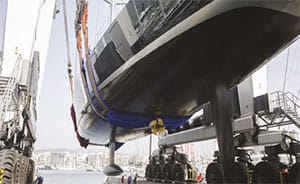
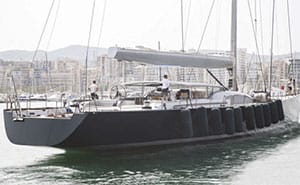
1. Hempaguard X7 was tested on Saudade’s keel and rudder. | 2. The result was ‘fantastic’ so they then applied it to the hull.
Hempel is pledged to create coatings that contribute to a more resilient and sustainable future, with the goal that by 2030 they will be able to reduce emissions among their customers and partners by 50 million tons of CO2.
For the performance sailor there are two especially interesting applications available from Hempel: Hempaguard X7 and Hempasil Pro.
Hempaguard X7’s antifouling performance is driven by the innovative combination of silicone-hydrogel with its patented ActiGuard technology. Refined over more than five years of research, ActiGuard enhances the siliconehydrogel's naturally slick characteristics by providing a low-friction interface between the silicone binder on the hull surface and seawater, where the hydrogel layer forms an impervious shield at the water-coating interface.
ActiGuard introduces a highly controlled release system of the biocide – the chemical agents designed to prevent the attachment and growth of harmful organisms on the hull. This very precise and controlled release ensures that biocides remain within the hydrogel layer, preventing them from diffusing into the ocean and thereby minimising environmental impact. Hempaguard X7 thus uses 95 per cent less biocide than conventional coatings while still providing strong protection.
Another advantage in use of Hempel FRCs are that these systems often require fewer coats than standard antifouling systems, and because the density of each coat is less than that of a typical copper-based coating this can also result in tangible weight savings.
Moreover, there are some serious race programmes that have adopted cycles of applying, then sanding, fairing and even removing their antifoul coatings prior to racing, then re-applying for intervals between race events. With the FRC systems this cycle is not required, and would in fact have a negative impact on speed and friction since even burnished surfaces can have a rougher microscopic surface than that provided by a properly applied FRC system.
Case studies
One of the world’s premier monohull superyachts is the 45m Saudade, built in 2008 by Wally Yachts to specifications provided by Tripp Design. The superyacht world is demanding in every sense: hi-tech engineering coupled with high aesthetic design standards, use that ranges from episodic to continuous and casual to competitive. In every way this sector demands the highest possible standards.
Saudade needed a new antifouling coating on her rudder and keel, and trusted Hempaguard X7 to provide not only an upgrade in sailing performance by reducing frictional drag, but also a reduction in maintenance costs (such as diving and cleaning prior to regattas), reducing fuel consumption and exhaust emissions during deliveries.
‘We tried X7 on the rudder and keel and had fantastic results and decided to do the whole boat,’ says Saudade captain Rob Cumming. ‘This was our first real experience with Hempel, they were fantastic, everyone was very involved in the process, we had a lot of support from the technicians coming down from Barcelona to make sure everything was applied perfectly. Communication was fantastic and we look forward to working with them again.’
Launched in 2009 as Cinderella IV at Vitters in the Netherlands, then refitted, rebuilt and launched again in 2018 at Pendennis Shipyard in the UK, the 39m Tripp-designed G2 has been providing outstanding luxury and performance for clients and guests on both sides of the Atlantic. She was painted at the end of 2019 in Palma de Mallorca and Hempel yacht coating advisors suggested the Hempaguard X7 underwater system. Although unnecessary, the existing coatings on the underwater hull were removed and a full new Hempaguard X7 system was applied.
Since back in the water, G2 has spent summer seasons in the Mediterranean and winter seasons in the Caribbean, both of which are quite challenging for the antifouling underwater protection. However, only some light cleaning at the waterline was needed after 16 months since the application and the yacht has carried on the same sailing activity, showing the remarkable performance of Hempaguard X7.
‘We are really happy with Hempaguard X7,’ says G2 captain Jason Geale. ‘We have almost no growth on the hull even while sitting in Antigua for three months.’
Despite these impressive success stories, you don’t need a superyacht to realise the performance advantages of Hempel FRCs. Paired with Nexus II, a dual-purpose conversion primer/tie coat, Valet Yacht Services in British Columbia applied Hempasil Pro (biocide-free X7 equivalent) on Gord Wylie’s XP 44 Phoenix, with outstanding results. The smooth, polished surface had exceptional self-cleaning and fouling release properties, with the final finish looking stunning to the local racing community.
Wylie and his team went on to win their class of 13 entries in last year’s edition of the biennial Van Isle 360 Race, a demanding two-week event held in nine legs around the perimeter Vancouver Island in all race conditions: near calms in flat water offshore in the Pacific swells.
While the drag reduction on a racing monohull sailboat with a bulb keel, like Phoenix, may be arguably a little uncertain, even a one per cent speed advantage from having an FRC bottom can translate to enormous advantages in long races. For example in the 2,225-mile Transpac Race from Los Angeles to Honolulu this would be 2½ hours in elapsed time – impressive.


