



The café next to the RORC office in Antigua buzzes all morning. Sailors stop by for coffee, conversations blend together and race talk moves easily from table to table. Over the course of an hour, Deborah Fish shares her thoughts on offshore racing, leadership, and the realities behind international events like the RORC Caribbean 600, speaking as both commodore of the Royal Ocean Racing Club (RORC) and as an active, successful offshore sailor.
Fish did not grow up sailing. She started the sport later than most, in her early 30s, when she finally had the chance to race offshore. ‘I started quite late,’ she says. ‘But once I did the Fastnet Race I was completely hooked.’ Since then, offshore racing has remained a major part of her life. She first raced with the RORC in 1999 and has completed the Rolex Fastnet Race 13 times, as well as many of the other major offshore events, including the Rolex Middle Sea Race, the Sydney Hobart, and the Caribbean 600.
That offshore background shapes how Fish approaches her role as commodore. Elected in January 2024, she became the first woman to hold the position. She describes it as a role that found her rather than the other way around, at a moment when the club was entering an important phase with the long-awaited return of the Admiral’s Cup and a strong international racing calendar.
Despite the title of commodore, Fish remains deeply connected to the sailor’s perspective. She continues to race actively, often double-handed, and believes that leadership credibility comes from understanding what competitors experience on the water.
‘You have to be a commodore for everyone,’ she explains. ‘From the maxi owners to the Contessa 32s. You need to understand the whole fleet.’ That understanding is not abstract. It comes from listening, conversations on the dock, racing the same courses and recognising that decisions made ashore directly affect those made at sea.
Balancing feedback is not always easy. ‘There will always be someone who wants one thing and someone who wants the opposite,’ she says. ‘The challenge for me is to work out what’s best for the fleet as a whole.’
‘As captain of the whole crew, I also have a team behind me within the RORC. It comes down to how you build a great working relationship between the committee and the staff. This allows us to balance the racer's perspective, the customer's point of view and to the staff's professional perspective. Bounce between those. Take your knowledge and experience, your views, and try to do what's best for everyone.’
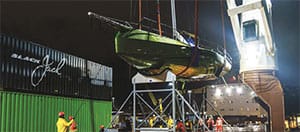
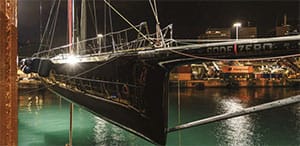
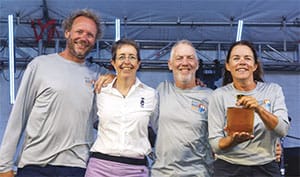
1. Modern offshore racing comes with spare parts containers 2. Tailormade yacht transport for modern racing programmes 3. Sedem crew at the Caribbean 600 prize giving
Nowhere is that more visible than in the Caribbean. ‘Here you really see it,’ Fish explains. ‘There’s a small army of staff and volunteers.’ The RORC team makes a point of meeting every boat, creating a welcoming atmosphere both on and off the water. ‘That’s why people love it,’ she says. ‘There’s so much going on and the volunteers are a huge part of that experience. They’re the people you interact with.’
Antigua itself plays a key role in fostering that feeling. Fish describes it as welcoming and safe, with a racecourse that is as beautiful as it is demanding. Fourteen islands, each with its own wind effects, create a race that is never straightforward.
‘It’s constantly interesting,’ she says. ‘And it’s exactly that combination, the challenge on the water and the people behind the scenes, that makes this race what it is.’
The Caribbean 600 is a race that Fish knows well and describes as ‘the most enjoyable 600-mile race’. Now sailing it for the fourth time, she knows its rhythm intimately. ‘You move from one navigation decision to the next, island after island. And with very little sleep.’
‘Offshore racing teaches you how to make decisions under pressure,’ she says. ‘Do you put more sail up to go faster, or do you hold back because the risk is too high? You’re always balancing performance, safety and consequences. It’s a very good life skill.’
This year, Fish is racing aboard Sedem, a Pegasus 50 owned by Dutch sailors Astrid de Vin and Roeland Franssens. The team’s journey to Antigua already reflects the broader logistics behind the race. Sedem arrived in the Caribbean via the Atlantic Rally for Cruisers (ARC ), sailing down through the Canaries before crossing the Atlantic. After the race, the yacht will return to Europe by ship.
‘They’ve been cruising the Caribbean,’ Fish explains, ‘and the boat will go back on transport with Sevenstar to Europe.’ Time, wear and tear, safety and predictability all play a role in the decision to ship a yacht rather than sail it back across an ocean. ‘Sailing a boat back can take weeks,’ Fish says. ‘It puts a lot of strain on the boat and there’s often pressure to be somewhere by a certain date.’
Offshore races like the Caribbean 600 depend on international participation, which in turn depends on reliable yacht transport. With only a handful of yachts based permanently in the Caribbean, shipping is essential to keeping the event truly international. ‘And that’s not just about moving a boat,’ she says. A modern offshore racing programme travels with containers full of sails, spare parts, tools and safety equipment. It often includes support boats such as RIBs and, in larger programmes, entire teams. At the top end of the fleet, the scale increases dramatically.
‘Some campaigns involve 45 people,’ Fish says. ‘That’s a whole organisation on the move.’ From feeding and housing the crew to managing equipment and maintaining schedules, the logistical challenge is significant. She smiles as she explains what that really means in practice. ‘Even something as simple as feeding the crew becomes a logistical exercise. There’s always someone who’s allergic to something, someone who doesn’t eat tomatoes, someone who needs to be somewhere else the next day.’
Transport offers certainty, not only that the yacht arrives safely, but that the entire campaign arrives together and on schedule. Without that certainty, Fish believes international offshore racing would look very different. For races like the Caribbean 600, where only a small number of yachts are based locally, transport is not an optional extra but a fundamental part of making the race possible. International participation is what gives races like the Caribbean 600 their character and that internationalism depends heavily on logistics. ‘Yacht transport is absolutely key,’ she says. Time constraints, wear and tear, safety and the sheer reality of modern life mean that very few owners can afford to sail their boats back and forth across oceans between seasons.
Long-term planning is also evident in the partnership between the RORC and Sevenstar Yacht Transport. From Fish’s perspective the interests align naturally. ‘We have a common goal,’ she says. ‘Making the events the best they can be for sailors.’
While a race might begin a week before the start for organisers and competitors, Sevenstar’s involvement and planning begin months earlier and continue beyond the finish line, when yachts, containers and teams move on to the next stage of their season.
Looking beyond individual races, Fish is deeply invested in the future of offshore sailing. One of the initiatives she is most proud of is the Griffin Project, a youth programme designed to bring young sailors into offshore racing. Open to sailors aged 18 to 30, the programme has already attracted hundreds of applicants from around the world. Selection is based on merit, attitude and willingness to learn, not gender. ‘When you select on that,’ Fish says, ‘you forget gender and you end up 50-50.’ The aim is simple: the long-term health of the sport. ‘Our average member is older,’ she explains. ‘If we want offshore racing to thrive, we need young people coming through.’
That same thinking extends to diversity more broadly. Visible role models matter. ‘If everyone you see in a sport is male, you think: this isn’t for me. A good mix changes that.’
For Deborah Fish, leadership remains inseparable from participation. ‘You only need two boats to make a race,’ she says with a smile. But to keep those races alive, international, competitive and meaningful requires far more than what happens between the start gun and the finish line. It requires planning, trust, logistics and people who understand the sport inside and out.
Deborah Fish is one of them.


