



These are interesting times at Nautor Swan. First the acquisition of the company, by Sanlorenzo in 2024, delivered a tenfold increase in financial clout and economy of scale. To follow that, a relaunch in North America. Then a major expansion of product lines, with Nautor Swan stepping boldly into segments of the sailing yacht market beyond its traditional niche.
Next, an investment in brand heritage alongside its future, as the ClubSwan division widens its scope from a focus on one-design fleet racing programmes to a broader church of events. In revenue terms Nautor Swan is now one tenth of a major league player in the yachting industry with a combined turnover above €1bn.
The driving force behind this accelerating pace of change is Massimo Perotti, the entrepreneurial leader and majority shareholder of Sanlorenzo. Few if any of his peers in the motor yacht business would seriously have considered buying a sailing yacht builder in 2024. But Perotti, who has steadily grown Sanlorenzo from a locally esteemed boutique shipyard into a highly profitable industry leader with international reach, has a track record of going his own way, sometimes against the tide of accepted wisdom – and reaping the rewards.
The other key player shaping the course of Nautor Swan is Giovanni Pomati, CEO since 2018 and for years before that a keen sailor in his spare time. His senior management background in hi-tech engineering and manufacturing brings a usefully sharp focus on product development, supply chain and production efficiencies to the role.
Joining Sanlorenzo has helped Pomati to improve the profitability of Nautor Swan through synergies in procurement and supply chain optimisation. Cost engineering also plays a key role. ‘We are designing the boats to be more efficient in production,’ he says. ‘This is not to reduce the value of the yachts, it’s completely the opposite.’ Efficiency gains in production are reinvested in the product, making it affordable to use higher quality materials and components. ’It is a topic we don’t speak about in this industry but it is so important.’
Two of Nautor Swan’s great assets are the high quality of its composite production and the fine craftsmanship of its interior joinery, both of which reflect the exceptional skill and knowledge of its workforce in Finland. Pomati says joinery production will remain there, though growth might require Nautor to use joiners in other locations in the future, which it has done successfully at times of peak demand in the past.

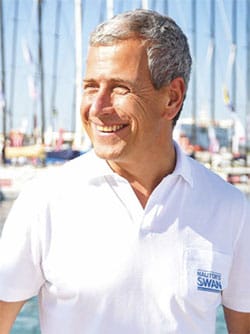
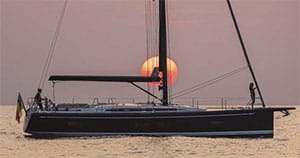
1. Giovanni Pomati – Nautor Swan 2. Massimo Perotti – Sanlorenzo 3. Germán Frers’ first Swan was a 51. 45 years on, the new 51 is one of his last.
As for composite production: ‘We have studied this a lot because the Swan Maxi line is pretty successful and takes most of the production space in the shipyard,’ Perotti says. ‘Swan Maxi production up to 40m will certainly remain in Finland because there is a lot of site advantage, the production is competitive and we are producing profit.’ Owners enjoy visiting the yard while their yacht is in build, he explains, and they like to take delivery in Finland. The 4,000-mile voyage through the Baltic and down to the Med, often with a side trip to the fjords of Norway, is a great cruising adventure.
‘For the smallest boats in our classic line, 51–55ft, we are still evaluating our options,’ he says. “Given the costs, size and the fact that they can be delivered by road, we may, in the future – not in the short term, as this is a decision for the years ahead – consider alternative production solutions, potentially including locations in Italy.
‘The objective is to ensure we remain competitive in the medium term. Our competitors look to Swan as a benchmark, and when you are the benchmark, the strategic choices become even more important. At this stage, we are simply reflecting on our options; no decisions have been made.’
Long term view
With the acquisition of Nautor Swan, Perotti is playing the long game. ‘Let’s talk about 10 years from now, not tomorrow,’ he says. ‘The climate is changing and consumers’ attitudes will change. My expectation for the sailing yacht segment above 70-80ft is reasonable growth but we must be careful to remember that this is in the medium to long term.’
The next generation of yacht buyers, who are now in their thirties, have a different mindset with more emphasis on sustainability and less on consumption. ‘It’s a new way of life,’ he says. ‘In 10 years they will be the market and in that market I expect an increase in sailing boats and a smaller increase in motor yachts.’
With revenue growth expected to come from customers who are new to sailing, Perotti says Nautor Swan must focus on elevating the levels of comfort on board. Larger yachts in particular will be reaffirmed as performance cruisers, because he expects yacht buyers in general will be less interested in racing, at least initially. ‘But we will not forget the tradition of Swan so performance will always be there.’
Across Sanlorenzo as a whole, about 90 per cent of new builds are already above 24m and most are above 30m. ‘So the market is ultra-high net worth individuals. There are more than 350,000 of them in the world today and the world can only build 1,200 yachts above 30m. That is just 2.5 per cent of the super-rich so we have huge potential to expand this business. However, we have to invest time and money now to gain future customers.’
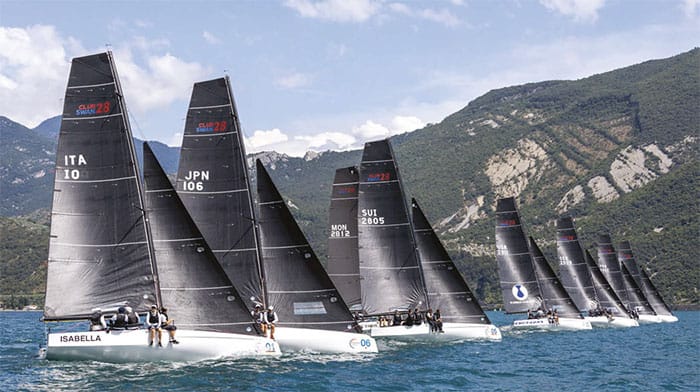
One focus of that investment in future customers is Nautor Swan’s collaboration with Terry Hutchinson and American Magic. In parallel with the ClubSwan 28 one-design racing circuit, which launches in the US this year, they are developing initiatives to revitalise sailing in America and engage the next generation of sailors.
New product lines
A key driver of Sanlorenzo’s steady growth over the last 20 years, Perotti explains, is a strategy of developing a wide variety of models tailored to suit different markets, aesthetic values and modes of use. ‘And this is exactly what we want to do with Nautor Swan,’ he says.
The three existing model ranges of sailing yachts –Swan, Swan Maxi and ClubSwan – will soon be joined by two new ones, Swan Alloy and Swanscape. The Swan Shadow line of motorboats will continue, with a hull length limit of around 60ft to avoid overlap with Sanlorenzo’s own motor yachts.
Growing the company’s revenues by adding these new product lines is the way to retain the quality and heritage of Nautor Swan, Perotti explains, and to keep the highly skilled people who are a valuable asset. ‘This is a key point because we have quite high costs,’ he says.
Swanscape
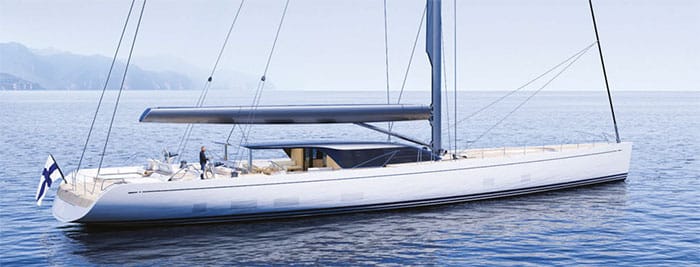
This is a new line of blue water cruising yachts. Initially a range of three models is envisaged, from about 20m LOA to more than 30m. The first of these, currently on the drawing board at Judel/Vrolijk and expected to launch in 2028, is a 24m sloop which, unlike any Swan for a very long time, will have superstructure to provide a spacious deck saloon with a comfortable inside helm position, and a sheltered cockpit.
‘It’s like an SUV product in the car industry,’ Perotti says. ‘Porsche builds around 300,000 cars per year and half of them are SUVs, not the famous 911s. Also Ferrari, Aston Martin, Maserati, they all make SUVs because the market has gone in that direction. In a similar way, Swanscape can increase the volume of our business.’
‘The key word is comfort,’ Pomati explains. ‘Not the comfort of a sun bed. It’s the comfort of living on board for long periods of time, the comfort of sailing the boat on long ocean passages. We are making a lot of studies of that.’ He points out that while some ocean racing yachts, notably Imoca 60s, have moved from exposed, open cockpits to enclosed ones, high-performance ocean cruisers in the 20m to 30m range have yet to follow suit. ‘And you’re supposed to sail to the Arctic while staying outside all the time, it’s crazy.’
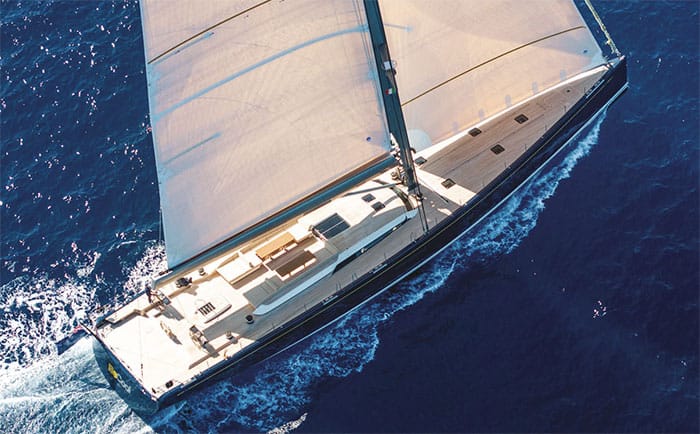
Elegance and styling are just as important for Swanscape boats as they are for the Swan and the Swan Maxi models, Pomati says. A lot of work has focused on combining the very high levels of comfort, living space and sailing performance which the design brief requires. ‘That is one of the big investments Sanlorenzo has made. Our new product development team has worked a lot with Judel/Vrolijk to find the right compromise.’
Like Swans and Swan Maxis, Swanscape hulls and decks will be composite sandwich construction. Up to 80-90ft, glassfibre will be used with carbon fibre reinforcement where it’s needed. Larger models will be full carbon composite. Pomati is keen to stress that the choice of fibre materials has nothing at all to do with quality. In a cruising yacht, unnecessary use of carbon can have an impact on the comfort of life on board, he says, as well as increasing the vessel’s environmental footprint.
Swan Alloy
The other new line of Swans is a major move upmarket. An initial range of three semi-custom models, from 44m to 58m, is planned. These will be the first Swans built in aluminium, the first Swans above the 40m threshold and the first Swans ever to be built outside Finland.
Malcolm McKeon has designed the first of these models, the Swan Alloy 44, which has a main deck aft configuration quite similar to a motor yacht in terms of access to the water, living space and layout. Hull #1 is already in build at Gouwerok in The Netherlands, one of the world’s leading aluminium yacht fabricators. The bare hull will be finished and fitted out in Italy at a new Nautor Swan shipyard in Sanlorenzo’s home port of Viareggio. Christian Liaigre is designing the interior. Delivery is scheduled for June 2028.
The owner of this pioneering project, which sets the template for Swan Alloy, is Perotti himself. This is entirely in character for a man who built the first ever fuel cellpowered large motor yacht, a Sanlorenzo 50Steel, in 2024 for his own private use. The logical next step in this trajectory towards more sustainable yachting is a move from power to sail. His Swan Alloy 44 will have a dual energy technology, with 44kW of batteries and a hydrogeneration capacity of 50kW per hour – enough to power all hotel and sailing systems while keeping the batteries charged – at 12 knots boatspeed, which the yacht should easily achieve in moderate winds.
The design phase of the second Swan Alloy model, a 50m project, was due to kick off as this issue of Seahorse goes to press and plans for an even larger one were teased at the recent Monaco Yacht Show.
A longer term goal for Swan Alloy, which Perotti says could technically be feasible as soon as 2030, is to build a sailing yacht with a methanol fuel cell-electric hybrid setup and no combustion engine or generator. This will use next-generation fuel cells that Siemens is bringing to market in 2027, and will leverage the knowledge Sanlorenzo gained from its 50Steel fuel cell project. ‘We are talking about the future but we speak about it with experience,’ he says. ‘The technology is already here but there needs to be a will to push and invest in the production and distribution of methanol.’
New era
The current generation of classic Swans under 80ft is nearly complete. One more model is in the pipeline: a new Swan 73 that will be launched in 2027. This marks the end of an era, as it will be one of the last Swans designed by Germán Frers, whose decades-long mastery has shaped the world of yacht design. Frers has drawn the lines of almost every Swan and Swan Maxi for nearly half a century, which is a remarkably long and successful tenure. So what happens next?
‘Then we have to start again,’ Pomati says. ‘This will be an incredibly important restart for us. It’s on the drawing board of our new product development team but it’s super top secret as you can imagine. We have to stay ahead of the industry.’
‘A lot of people are watching what we are doing,’ Perotti says. ‘We have a change of control after 25 years from Leonardo Ferragamo, who has been a fantastic owner of the company. He really did a lot for Nautor Swan. Soon there will be the change of designer, of course we have to think to the future. So the programme is full. A lot of work, a lot of risk, a lot of investment.’
One thing is definitely not in that programme. ‘I made an agreement with Giovanni [Pomati] when I bought the company,’ Perotti says. ‘We are not going to build another maxi raceboat. That in my opinion should be left to a different kind of company. ClubSwan will continue to grow, but not above 50ft. For us, the magic words are performance cruising.’
Club for all Swans
Pomati and Perotti are both clear about the value of Nautor Swan’s legacy as they evolve and develop the brand. ‘The heritage is so important that recently we decided to expand ClubSwan where we used to have mainly racing,’ Perotti explains. The owners of all Swans, from 60-year-old classics all the way through to current models, will be encouraged to join ClubSwan and get involved in not just racing but a variety of events.
ClubSwan Racing will continue to run its one-design, owner-driver regatta circuits, which have proved successful in Europe and are now launching in North America, alongside several new divisions. ClubSwan Legacy is for boats built before 1990: designs by Sparkman & Stephens, Ron Holland and many by Germán Frers. ClubSwan Spirit is for the remainder of the fleet, which in total adds up to more than 2,000 yachts.
ClubSwan Legacy events will be organised in partnership with the Swan S&S Association and the Swan Classic by Frers Association, initially in the Mediterranean where many of these yachts are based. In collaboration with the New York Yacht Club, ClubSwan is also planning to revive the Swan American Regatta which was a major event for many years. They will start this summer with a rendezvous in Newport, Rhode Island open to all owners of yachts in the ClubSwan Spirit fleet.
Germán Frers’ first Swan was a 51. 45 years on, the new 51 is one of his last
Meanwhile, the new ClubSwan 28 North America circuit has just launched, running almost in parallel with the ClubSwan 28 Europe circuit. Sailors of a very high calibre are involved: for example Terry Hutchinson of American Magic, Scott Nixon from Quantum Racing and past-New York Yacht Club commodore Jay Cross.
The American ClubSwan 28 season kicked off with warm-up races at the end of February. The racing then starts in earnest with two spring events in Pensacola, Florida, before the circuit moves north to Newport, Rhode Island for a midsummer regatta. The season concludes in November with the ClubSwan 28 Gold Cup – the international championship for this new and growing one-design class – at Fort Lauderdale, where 10 boats from Europe are expected to join the eight North American boats.
The other big happening in the Swan calendar this year is a special edition of the biennial Rolex Swan Cup, hosted by Yacht Club Costa Smeralda at Porto Cervo in Sardinia from 14 to 19 September. This brings the entire Swan fleet together, with several hundred yachts of all ages and sizes expected to attend, some travelling from halfway around the world to celebrate the 60th anniversary of Nautor Swan.
Notable boats among the confirmed attendees include two new Swan 128s, the largest boat that Nautor ever built, the Swan 131, the new Swan 80 and the original S&S-designed Swan 36 Tarantella, the first boat built by Nautor Swan back in 1966. Tarantella is having a major refit in Pietarsaari this winter, so will be looking and performing at her best in Porto Cervo.
ClubSwan has a well-earned reputation not just for excellent race management, but also for equally excellent après sail parties. Nautor Swan’s official 60th birthday party is sure to be an epic celebration.


