



J/Composites has been exploring some thought-provoking ideas in the rating space with the aim of helping to ensure maximum equity and fun
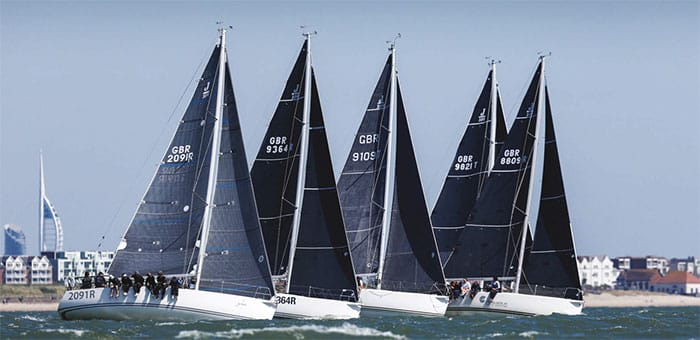
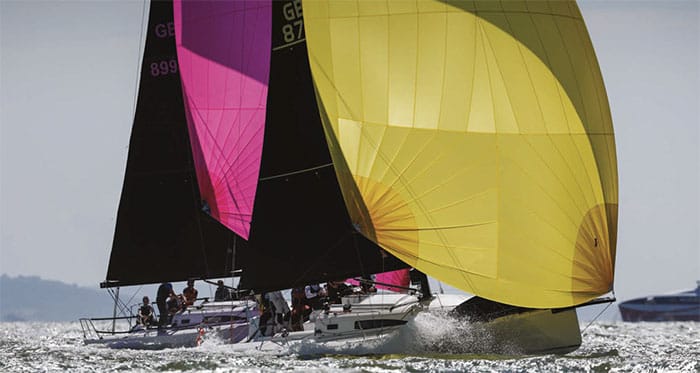
'Racing yacht design is advancing rapidly but the growing gap between mainstream production boats and more extreme specialist designs is putting pressure on handicap systems, event formats and participation,’ says Frédéric Bouvier of J/Composites. From low freeboard and shallow, beamy cockpits to sailplans with square-topped mainsails and giant asymmetric kites, each capable of creating a partial eclipse, through to specialist double-handed racing yachts that are designed to promote shorthanded crews, these are exciting times for the racing scene. The recent success of some scow hull configurations have been among the latest developments to challenge what we consider as normal, yet despite their unconventional looks their growing popularity in some areas suggests that the sport is on the verge of yet another new trend.
But at what price?
Bouvier, a lifelong racing sailor who has clocked up many sea miles both inshore and offshore, says he is the first to acknowledge and celebrate the rapid and exciting growth in design.
As J/Composites’ commercial director his day job takes him to the heart of the sport where their own models frequently go head-to-head with some of the most extreme designs on the racing circuit. And while he freely admits that his prime commercial focus is on J/Boats, the combination of this and his long and sustained involvement as a hands-on participant in the sport provides both perspective and a useful datum to understand and comment on where things are heading.
‘It is definitely an exciting world right now with one of the widest ranges of options for owners and crew that we’ve seen, but this rapid, and at times extreme development, also comes at a cost,’ he says. ‘The technical improvements within racing design have been fascinating but they have also been responsible for a polarisation of sailing. Supporters of more radical designs would argue that innovation has always driven the sport forward and that rating systems must evolve accordingly. However, the result is that it has become difficult if not impossible at times to provide equitable racing across a range of similarly sized boats that were designed to excel in different ways. The problem now is that often we’re asking our rating systems to compare bananas with carrots.
‘Take the current and growing trend in scow designs as an example. There is no question that they are capable of raising the performance bar, they’ve already proved it. The way in which the limitations of these designs, particularly upwind, have been overcome is fascinating. But this is also a configuration that is very hard to build competitively as a production boat for mainstream racing as the performance benefits depend on creating large, voluminous structures down to a weight.
‘This in turn leads to an expensive path with boats built from advanced lightweight materials which in turn pushes the price up, ‘he continues. ‘And in simple terms, extreme designs, exciting as they are, have never been a good way of attracting people in big numbers.’
It is easy to see his point, but surely the argument is that rating systems are there to even out those differences?
Bouvier believes that handicap systems are now being pushed harder than ever to provide equitable racing between boats with very different performance profiles across a wide range of conditions and disciplines. And while the argument isn’t a new one, he and many others are concerned at what effect this will have on the sport and where the solutions lie.
According to the J/Composites team there are ways of tackling the issues. They see advantages and opportunities in their long term and wide-ranging experience where they have been immersed in the thick of strong domestic racing in France and in the varied fleets on the international scene. The ability to make their own assessments in how different configurations could be catered for to provide close equitable racing, by studying their own fleet of almost 200 J/99s, is a good starting point.
‘One of our goals here is to see whether it would be possible to bring a standard J/99 with, say, an alloy mast, back into contention with the more advanced specifications by adapting a handicap. If we can, then our longer-term goal is to apply this to other areas of our range.
‘To achieve this, we will be focussing on the J/99 to start with as it is a very versatile design which has proved to be successful in both fully crewed and shorthanded events across both inshore and offshore racing.
‘The design has also been pushed hard by some stiff competition too, so we know the data is good and that the results prove consistently that the J/99 is a highly adaptable and competitive design. Perhaps we shouldn’t be surprised, after all it has smooth polar curves rather than those of more extreme designs that have performance spikes. Naturally, this is one of the clearest indicators to a good all-round performer.’
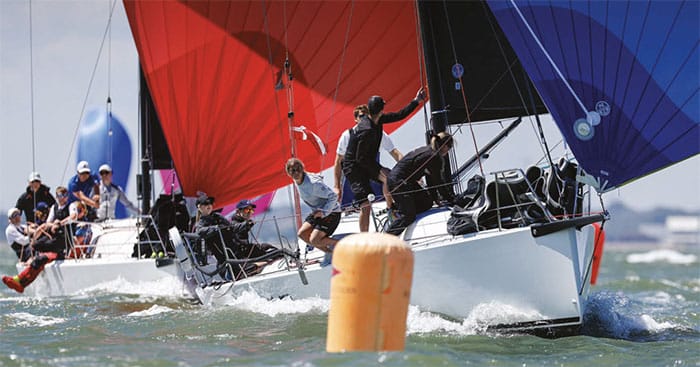
Making close comparisons across a varied fleet and establishing what works and why started at the Spi Ouest regatta in La Trinité this spring.
‘We had 10 closely matched J/99s in the middle of the IRC2 fleet which gave us a good datum,’ he continues. ‘All the boats in this class were of a similar overall concept and were separated by just a few points on rating which meant that the racing was about getting a good start, taking the right shifts, making good manoeuvres at the leeward mark and so on. Success was not defined by your handicap figure.
‘But what was particularly interesting was comparing our performance in the water and on handicap to boats of a similar size but with very different design concepts such as the new scows and others that were in IRC1. Because we had rolling starts on the same course we were able to look at the numbers and make good comparisons. And what was clear was that while they were quicker on the water we would have beaten them on corrected time by a big margin. And the reason is that these boats were having to race on a windward leeward course with a full crew which is at odds with what these offshore boats are designed for.
‘One of our main concerns is that in trying to account for this disparity with the more extreme, grand prix designs, that handicap systems forget about the bigger number of competitors in the mainstream classes. And when I say this, I mean we are afraid for the sport as a whole, not for our business because if that does happen it actually opens a door for companies like ours that have a strong following to do our own thing – but that’s not what we want.
‘The Admiral’s Cup is a good example. There is no doubt that it was a huge success, great to watch and I’m sure great to be a part of. But the risk is that it is driving IRC into a very professional, expensive area and away from the mainstream. The same can be highlighted under ORC with latest new design campaigns. The investment into development, especially AI assisted, has set another standard to challenge the loopholes of the handicap system’
J/Boats has another way of collecting data, making comparisons across an impressively wide range of models and making their point thanks to their own well-attended regattas such as the J/Cup Europe.
But Bouvier and J/Composites believe that the future of keelboat racing is not simply about the numbers. Events need to be fun too. And while you might think this is a case of stating the obvious and unrelated to the technical arguments, Bouvier and the team argue that they are linked. They argue that time, money and commitment that has been invested to refine grand prix designs and the way that they are sailed has increased pressure to succeed which in turn has raised expectations at the cost of general enjoyment.
‘The simple fact is that if a crew’s goal is solely to win, then only one crew will be happy,’ he says. ‘Aside from the social events which are important of course, the changes that have taken place in the way that events are structured plays into whether people enjoy their racing. Spi Ouest is a good example again as it is typical of other events. The total number of competitors has reduced but the number of classes has increased which dilutes the racing while making it more complex to run for the organisers. It doesn’t make sense on any front. We believe that the answer is to bring more competitors together in fewer classes, but this means addressing the format of the racing itself along with tackling handicap issues for boats that are of different concepts.
For Bouvier, the problem is not only technical. Once boats become harder to compare fairly, events become more fragmented, more expensive and, ultimately, less enjoyable for the majority of competitors.
‘No one here is pretending it is easy, but we do believe that it is necessary for the health of the sport.’


